151. The Gregory River and Lawn Hill.

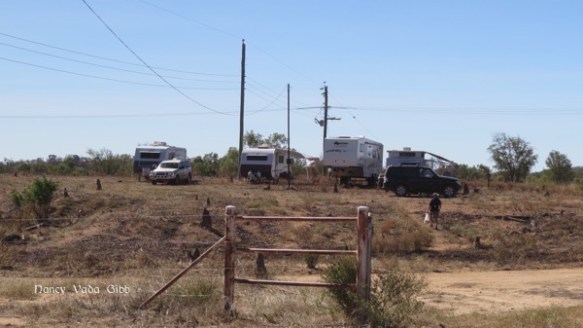
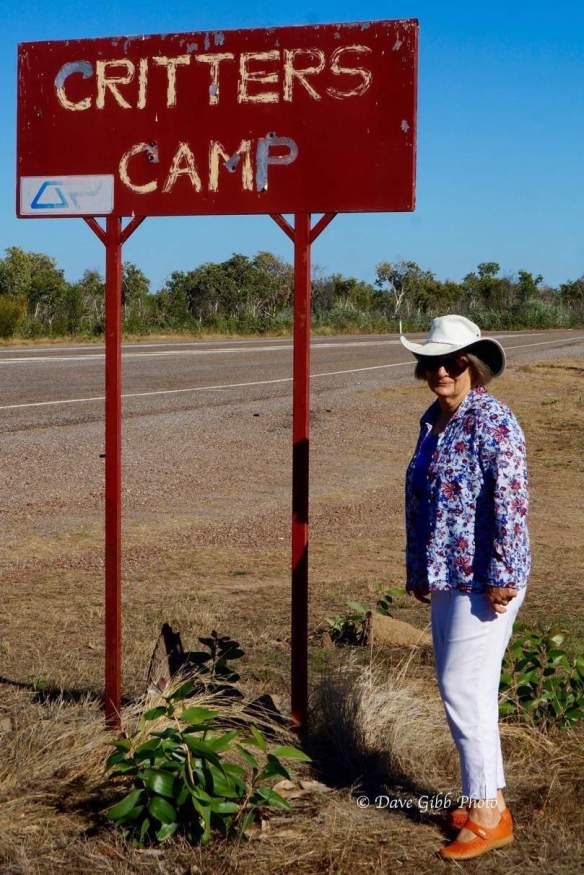
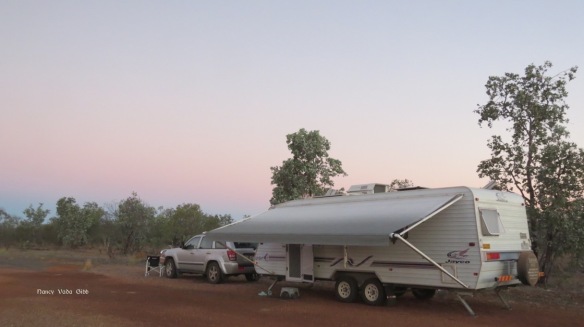
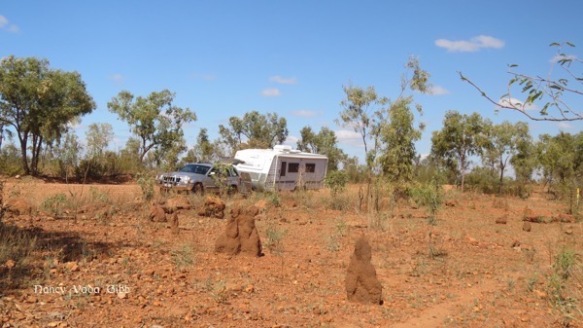
Leaving Cloncurry (again!) we knew we couldn’t make it to Gregory Downs via the Burke & Wills Roadhouse before nightfall so spent the night at a free camp by the roadside, in company with about 5 other caravans. We nearly missed it, we couldn’t find the free camp we were looking for but eventually came upon another just as dusk was falling. Another van arrived just after us – they couldn’t find the earlier camp either. Dave has already told (previous blog) of changing a flat tyre here.

IMG_0877

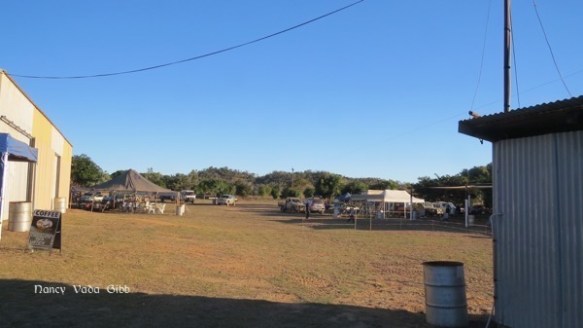
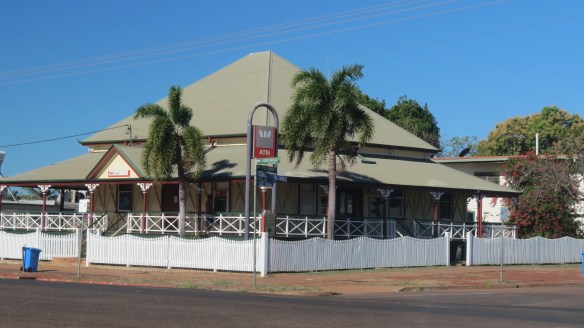
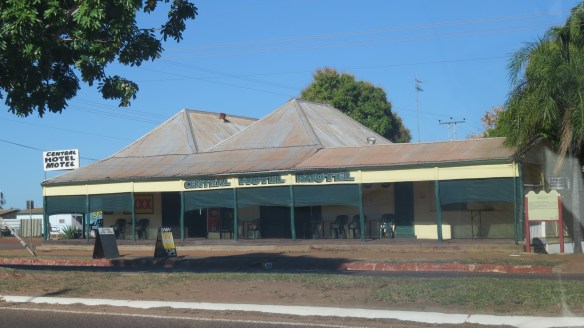
Next morning after avoiding some jaywalkers on the highway we arrived at Gregory Downs at the end of the bitumen; from then on it was unsealed to both the Boodjamulla National Park (Lawn Hill) which includes Adels Grove and to Burketown. One dusty motel, one dusty little shop with a fuel pump, a few houses along a dusty side street, and some quite good public toilets …. was that really all?

IMG_0879

IMG_0883

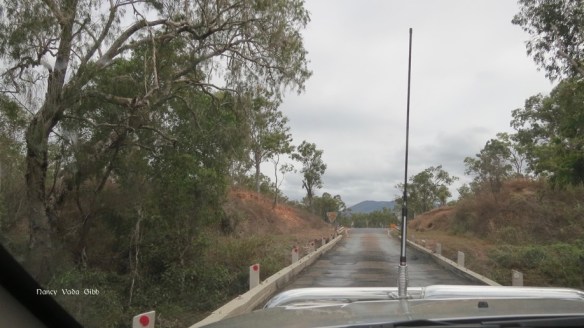
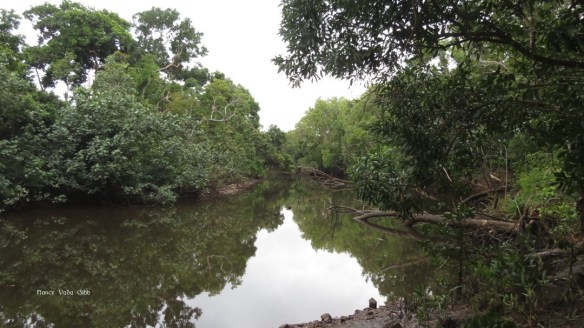
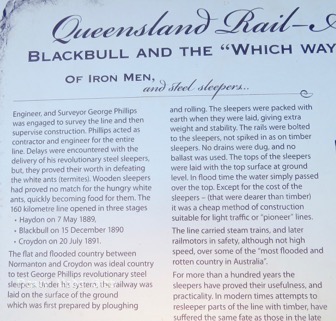
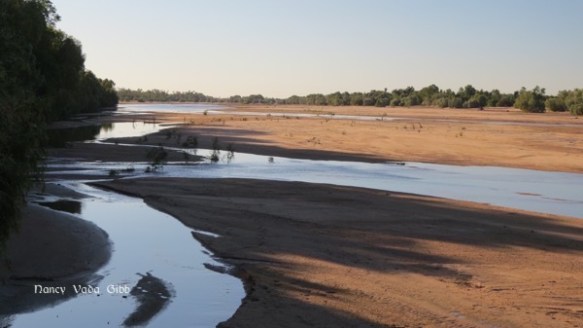
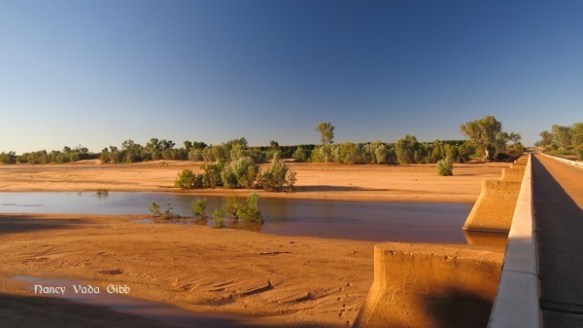
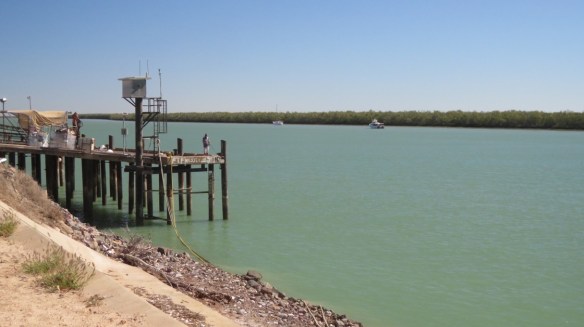
But just a few hundred metres away was another world, the banks of the Gregory River. As we approached the bridge all we could see was a huge dusty space marked ‘preferred camping ground’ and no caravans at all. Yet we knew this was a favoured stopping spot. All became clear as we went over the bridge – it looked like 50 or more caravans were parked on one side of the river bank below. How to get down? A likely looking track was labelled Stop – No Caravan Access but a passerby assured us it was the way down to the river, everyone went that way. So we went.

IMG_0921

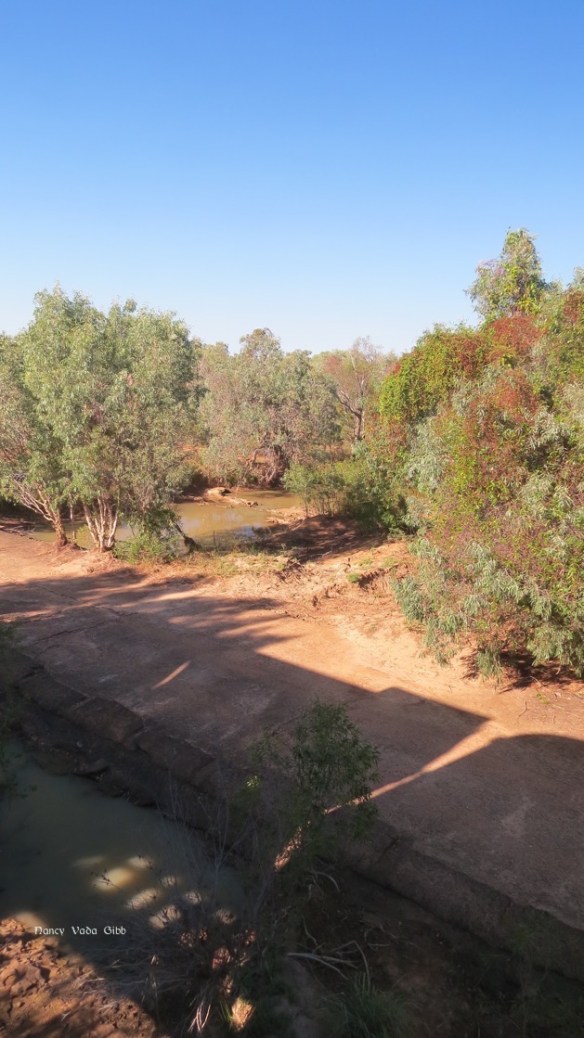
This is the way caravans used to get to the riverside. No wonder a newer ‘driveway’ had become necessary. The day after we arrived a bulldozer blocked off this old bridge with some large rocks.

IMG_0889

IMG_0899

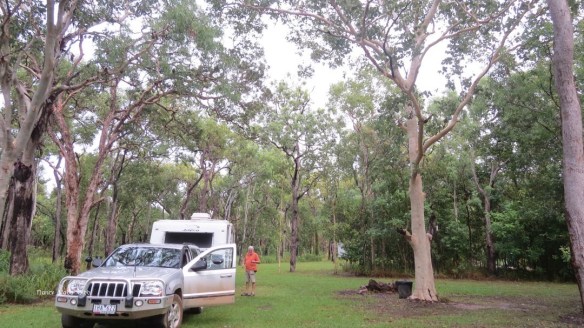
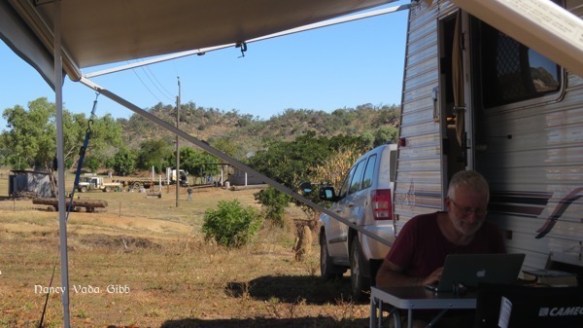
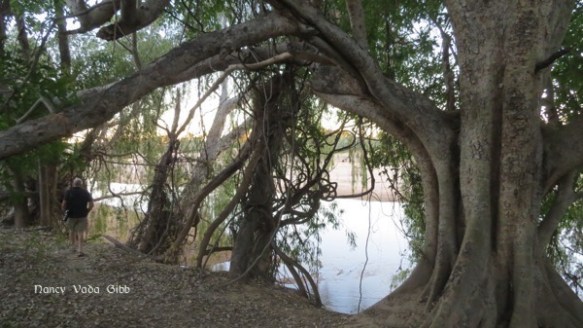
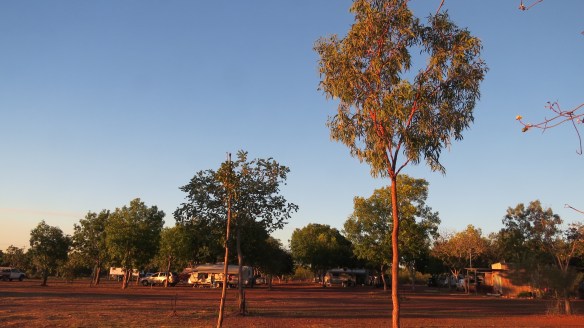
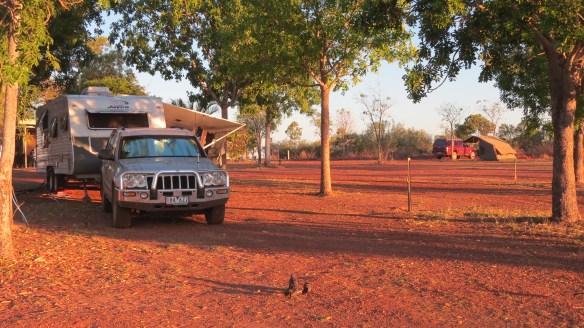
We were soon set up on slightly higher ground than the immediate bank, all places there being taken, under the shade of a large tree. There we stayed for four nights, and even then were reluctant to leave.

IMG_0888

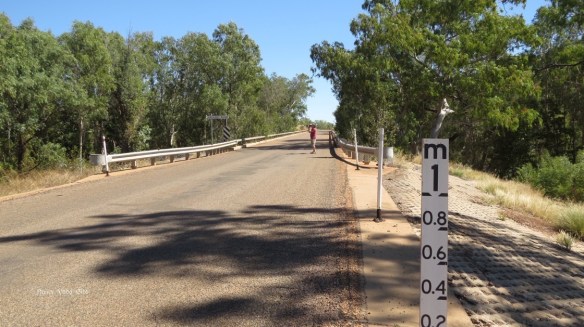
We went for several walks including one over the bridge. The very next day a sign appeared – No Pedestrians Permitted on the bridge(!) First the bulldozer then the sign – surely we were not responsible?!

IMG_0910

IMG_0915

IMG_0916

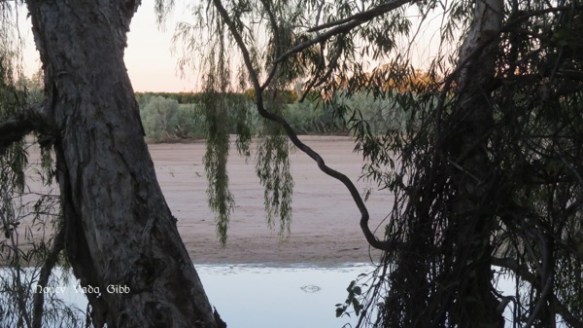
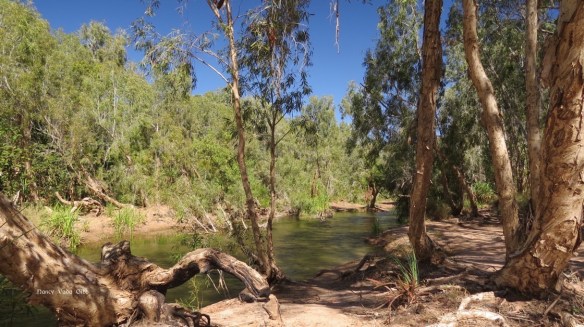
The river at this point was very cool and clear, not very wide and infinitely inviting. We joined a couple of children and adults drifting down the river feet first until fetching up near a small sandbank were it was possible to stand upright again. The pebbles were very sharp underfoot so our elderly feet were pleased we carried our crocs with us while drifting … but thankfully didn’t see any real crocs. No photos of us swimming, alas.

IMG_0902IMG_0901IMG_0892IMG_0891


Someone was feeding the kites which swooped and soared above the camp. At one point there must have been 20 or so, the word soon spread. They were being fed with pieces of meat or chicken including fat and bones, thrown as far up as possible. A few adventurous kites would swoop right down to retrieve the pieces that had been missed or dropped. Here are Dave’s photos – the one with a rounded tail is a whistling kite, the others are black kites:

Here’s an outback setup which seems to be very popular … just a smallish trailer which folds up and out and includes a large BBQ, etc. We’ve seen many of these since reaching the outback proper.IMG_0890

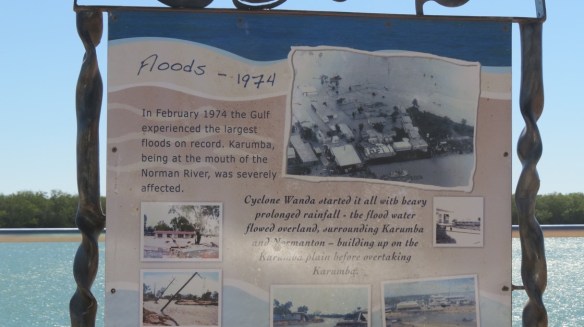
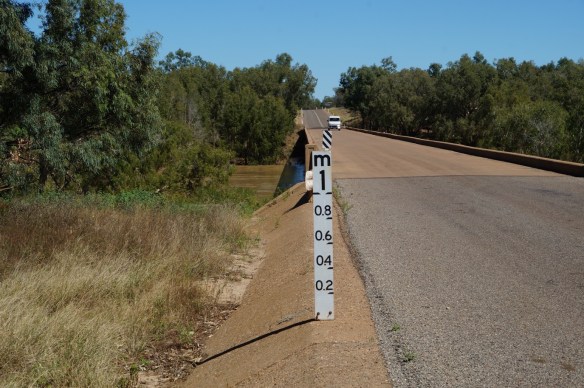
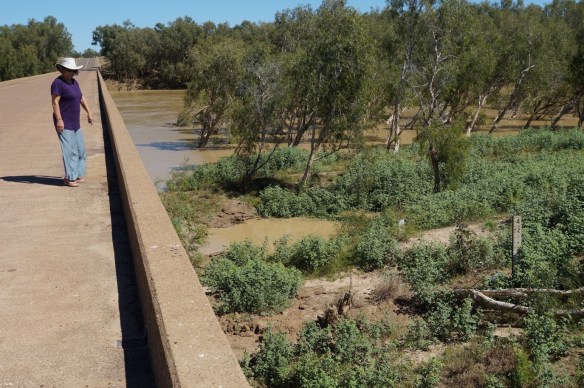
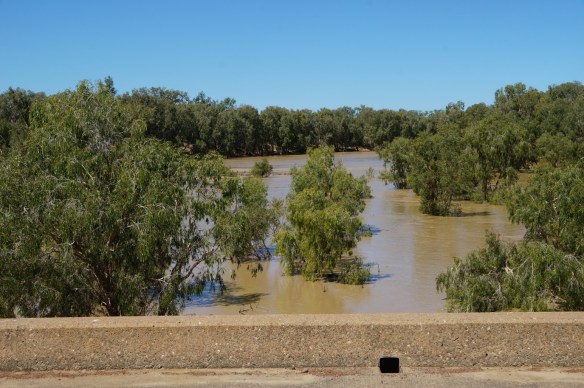
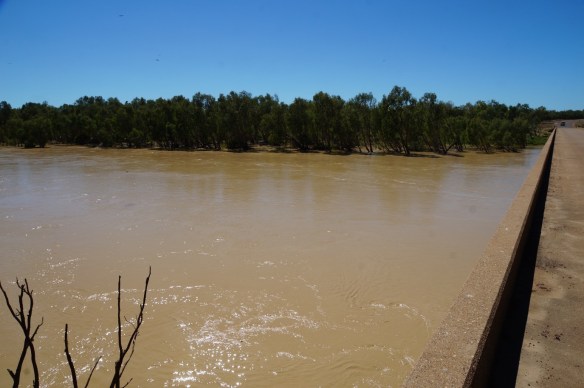
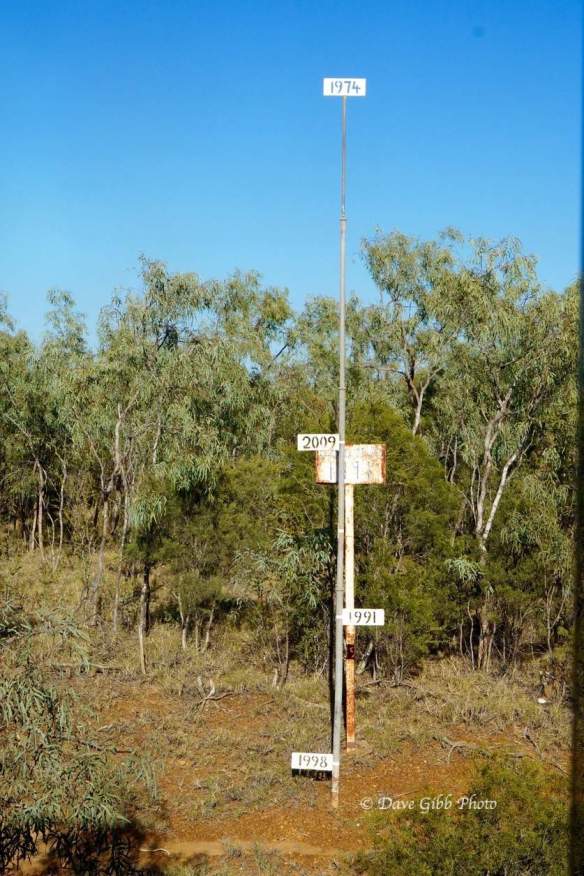
We became friends with two of the nearest neighbours, enjoying pre-prandial drinks and even a small fire on the last night. We marvelled at the fact that the river never runs dry even during summer. And that during the Wet, it can rise over 2 metres in less than an hour! (The photo of the old bridge taken from the new one plus the 1M flood sign  will give some idea of just how high the Gregory can rise).

The “small dusty shop” proved surprisingly well stocked. They offered cafe style coffee on a little verandah outside next to a book exchange and clothing rack. Notices everywhere asked for glass jars (I was able to offload several), help with Excel, and apologies because they had run out of coffee beans, so no coffee (!). On our last day there the weekly (?) food truck arrived from Burketown and I was able to get some fresh vegetables and a pot of sour cream (essential for potato salad). A peek inside the covered truck showed a number of large and beautiful potted ferns as well as boxes of food for outlying stations. The spunky young guy driving the truck (why didn’t I have my camera with me) had to write everything down in painstakingly neat figures, so many lemons etc weighting x at y per kilo, total z dollars. I think he stocked up in Burketown but everything came from Cairns probably by huge road train.

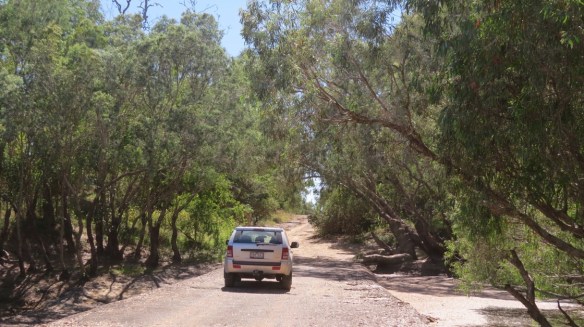
We still had a flat tyre to contend with, and the Gregory Downs roadstop couldn’t help, so we left Westy by the river and drove to Adels Grove in the Lawn Hills National Park for the day. Luckily they thought they could fix the puncture there, as indeed proved the case.

A bit of bitumen before the dust started. The distant hills beckoned.

IMG_0924

IMG_0932

So we were at fabled Adels Grove at last! Named after a French naturalist who established a sort of oasis there, it’s now a business running a holiday park, canoe/kayak hire and solar-powered boat trips up the gorge. Usually you have to book for the latter and initially we were told we’d have to wait two days, but luckily there was a cancellation. Here’s what the gorge looks like from the air.

IMG_0936

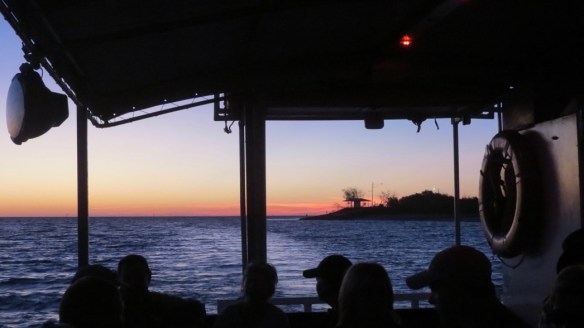
It was surreal gliding along the Lawn Hill River, no motor discernible, with a knowledgeable guide explaining various features. (This is the boat with the previous load of passengers).

IMG_0939

Gregory Adels 07

IMG_0944

Through the gorge we went, admiring the huge cliffs with ferns and trees clinging precariously……. (the sun was very bright, difficult to take good photos with the deep shade)

Gregory Adels 08

IMG_0947

IMG_0960

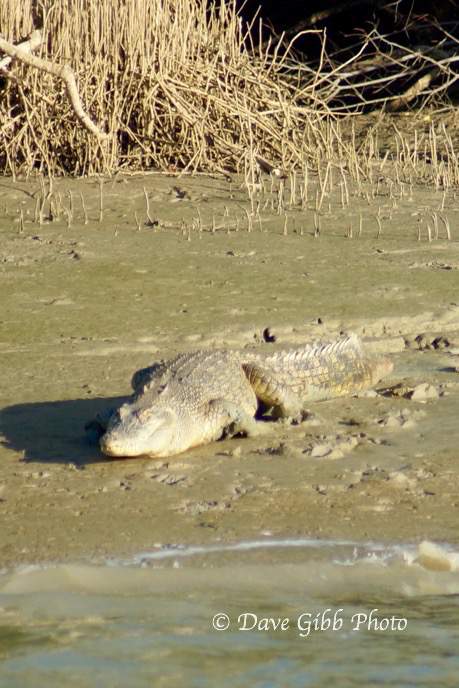
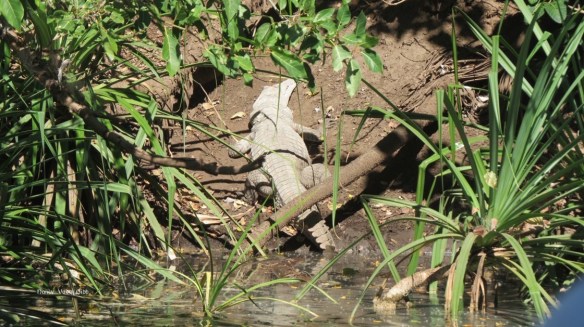
….. spotting a lone croc sunbaking and a couple of Leichhardt trees…..

IMG_0950

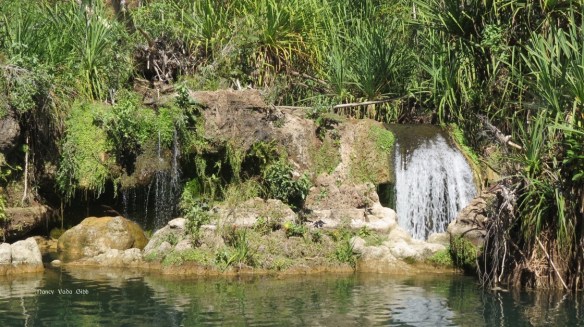
….. and finally coming to a barrier, the Indarri Falls, formed by calcite concretions called Tufa which had slowly built up over the years. The river is very high in mineral content, much higher than most other rivers. Some people were swimming near this barrier, apparently a fairly safe place compared the rest of the river! It was a very hot day and I quite envied them, but we were relatively cool on the boat under a canopy.

IMG_0953

IMG_0955

IMG_0956

IMG_0954

An explanation of tufa, for those scientifically inclined, as gleaned from a series of noticeboards:

Rainwater falling on the Barkly Tableland, a large area of limestone to the SW, soaks into the porous rock. Rainwater combines with carbon dioxide in the soil to form a weak acid which dissolves the limestone. the water now rich in calcite and dolomite flows through aquifers (underground springs) of the Georgina Basin which underlies the tableland. Where the honeycomb-like limestone meets the less-porous sandstone, underground water is forced upwards as springs which fed into the creeks and rivers.

In the creek, as water flows over obstructions such as rocks or debris, a reaction similar to unscrewing the top of a soft drink bottle takes place and carbon dioxid e gas is given off and a skin of solid calcium carbonate (calcite) is deposited on the obstructing surface. With time the calcite forms a porous brittle rock known as Tufa.

As calcite is deposited in the creek, plant and animal matter can be trapped and  fossilised within the tufa….. Scientists believe that in ancient times calcite rafts played role in fossil formation.

Indarri FallsWater at work:M.yrs

Back down the gorge to our starting point. Nobody wanted to leave the boat, but another  group of passengers was waiting.

IMG_0959

Time to move on. We packed up and left the river with regret, heading back the 148 km to the Burke & Wills Roadhouse, then north towards Normanton.

150. Mary Kathleen.

A previous blog (No. 144, Another Postcard – a Wee Mishap) has covered the events in between leaving Camooweal and returning to Mt. Isa. Briefly, we set off via dirt road for Adels Grove in the Lawn Hill National Park, but some way along a caravan spring broke, Dave did a marvellous jury rig job and we limped back to Mt. Isa. Next day Dave managed to obtain the necessary materials to do a proper job. Mt. Isa was hot, the camp was hot and uninteresting (although it did have $3 washing machines), the caravan was fixed … time to move on.

IMG_0737IMG_0743

IMG_0783

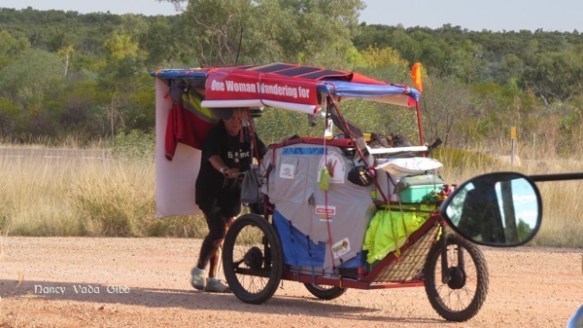
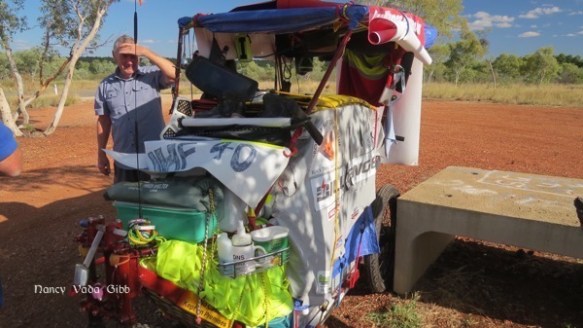
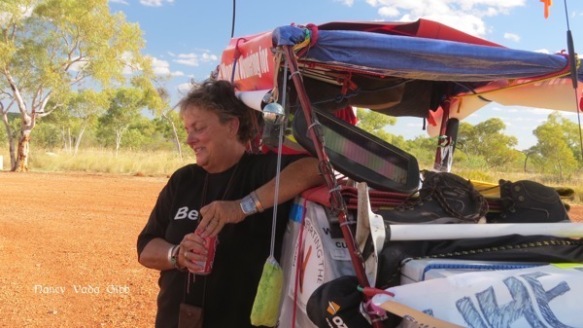
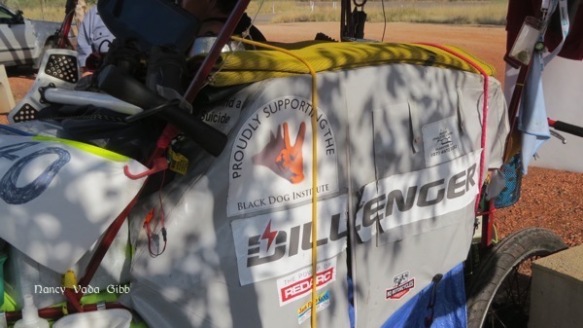
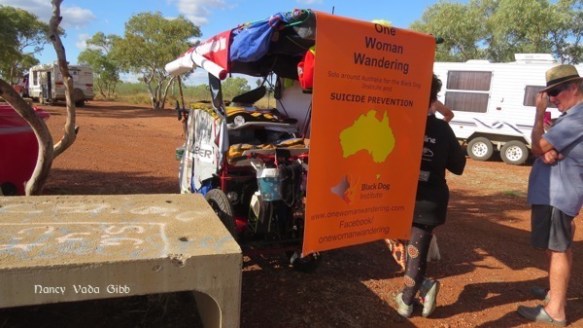
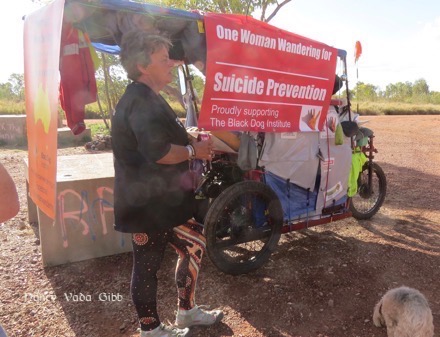
One thing not mentioned in the Postcard was the remarkable lady who we met at the Barkly Highway-dirt road turnoff where we’d stopped for a cuppa before the long slog back to Mt. Isa. We had spotted her some days earlier, walking along by the highway pushing a well-laden … something-on-wheels. Unfortunately with the caravan in tow we couldn’t stop then, so it was a delight to meet her in person with time to chat. A lovely friendly and very fit looking person with a friendly little once-white-and-fluffy dog called Dexter as her only companion. Dexter rides in state on top of everything else but under a canopy, so remains relatively cool. They sleep under the stars most nights.

IMG_0769IMG_0772

The tricycle has a small solar-powered motor to help her get up hills, plus she has a mobile phone, a good camera, a CB radio, and an EPB (emergency personal beacon) so is well equipped. The whole weighs about 350 kg, still not enough to prevent being blown over by a road train thundering past. Tracy righted it on her own.

IMG_0774

She has been on the road for over one year and intends to continue for another two or so! She is basically trying to raise money for mental health awareness. Her website can explain it better than me: www.onewomanwandering.com.au.

IMG_0773IMG_0775IMG_0777

To resume the blog:

We thought it would be a good idea not to go too far from Mt. Isa until we were confident all was well with Westy the caravan. We still had hopes to get to Adels Grove but by a different route, Cloncurry to Gregory Downs (all surfaced) and then, perhaps, the last 90 km or so unsurfaced to the Grove.

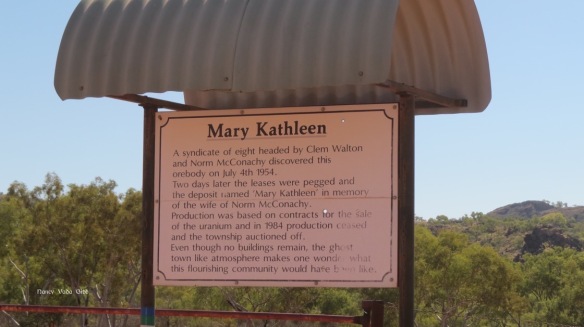
The 180 or so km between Mt. Isa and Cloncurry seemed a good testing ground, with a planned stop at the old Mary Kathleen uranium mine, where there is now free parking in the abandoned township. After stocking up on groceries etc in Mt. Isa (and taking some more photos for Ross F. who once lived there) we set off. All went well and soon we were at the entrance with its very rough looking track. Oh well – spring testing time!

IMG_0806

IMG_0807

IMG_0816IMG_0813

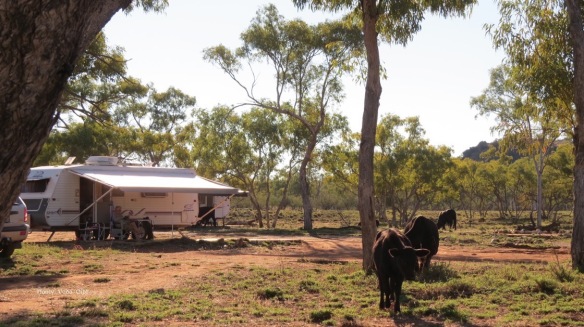
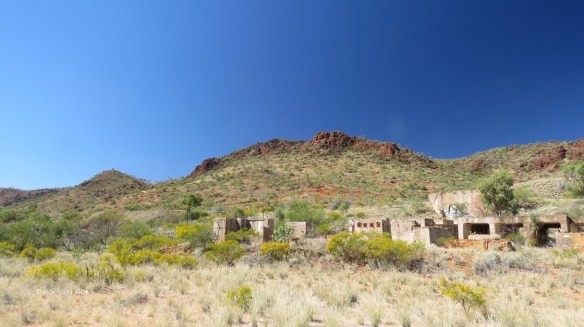
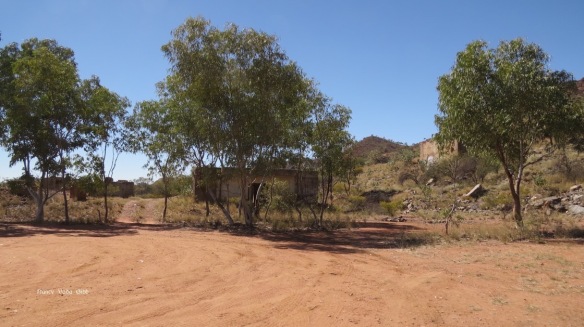
The area is not well signposted and we missed the turnoff to the camp and lurched along a winding bush track for some time until finding the back entrance. Once in the ‘township’ – all that remains are concrete slabs, a few rock walls and some plantings of hardy oleander –  we found a suitable slab to serve as our front patio and were soon set up with our lovely big awning providing welcome shade on what was one of the hottest days we’ve encountered so far, barring the one when the spring broke (!).

IMG_0857

IMG_0855

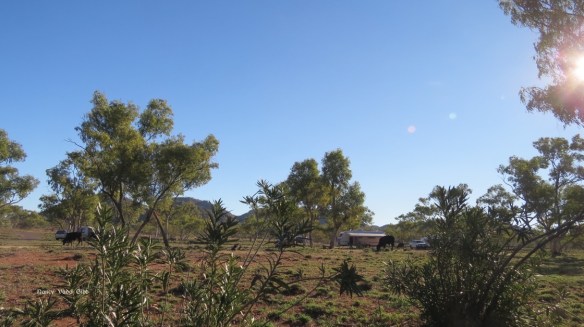
That evening we were entertained by a mob of cattle wandering past; it seems the township is part of a private property. A few years ago the owners were greatly agitated at the news that the mine might be revived, but it seems their fears were unfounded. They were fearful that stirring up the old tailing dumps would mean radioactive and/or poisonous chemicals would be blown all over the property and would contaminate water and vegetation. This did not seem to worry all the campers we saw, some had obviously been there for some time.

IMG_0854

We decided to try and find the mine itself, leaving Westy behind. More lurching along innumerable bush tracks, finding a couple of old ruins and then by good luck we spotted a tiny little sign saying Mine and an arrow. (Later we were to direct several other lost explorers to that little sign!).

IMG_0814

IMG_0815We parked where the top of the open cut mine was just visible, then walked. What a surprise was in store.

IMG_0833IMG_0820

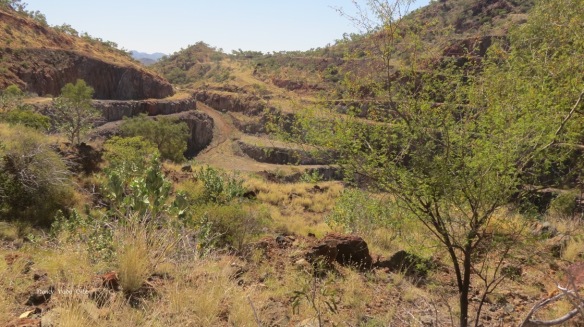
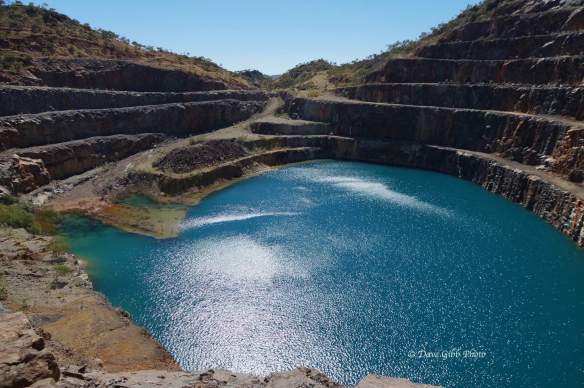
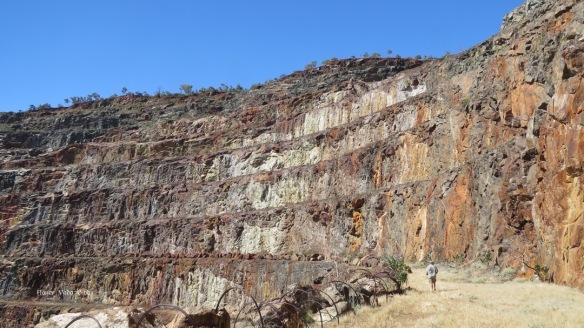
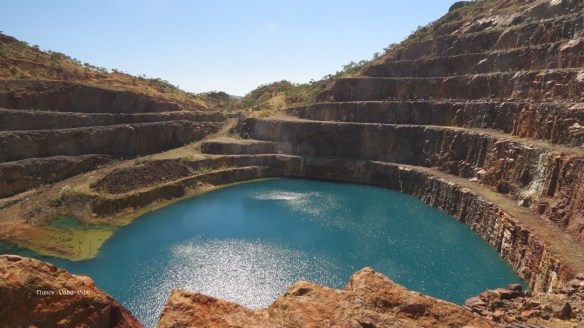
A lake! Our photos do not do justice to the colour. Not for swimming though – the water conceals and/or contains a multitude of sins such as poisonous chemicals and mine tailings.

cloncurry Camooweal 37

IMG_0829

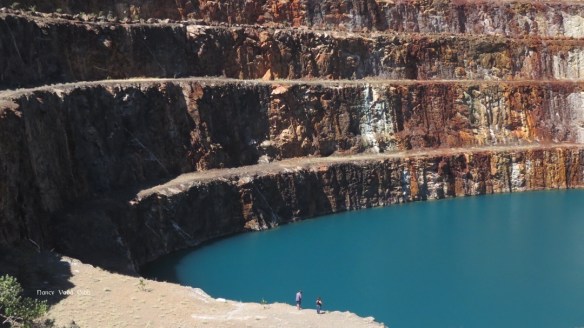
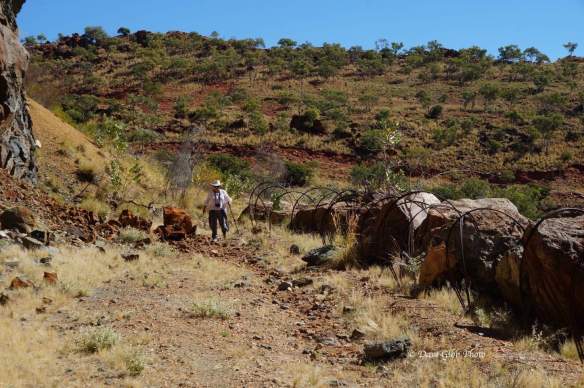
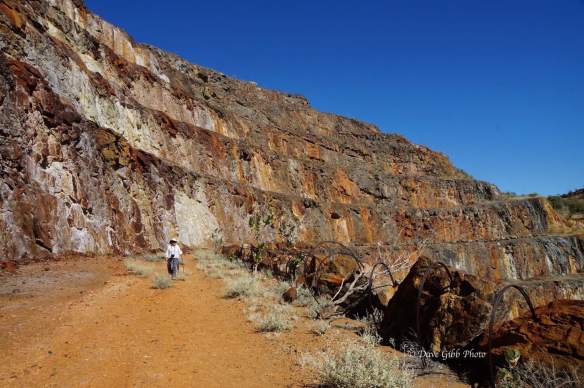
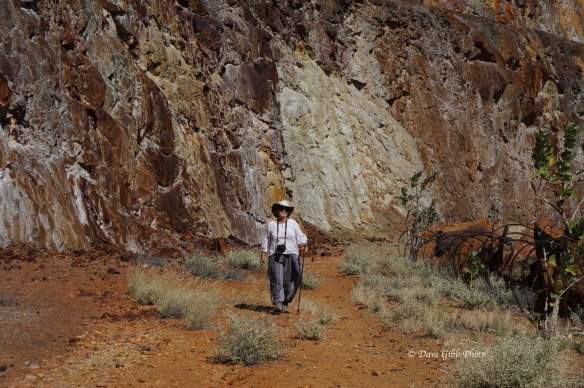
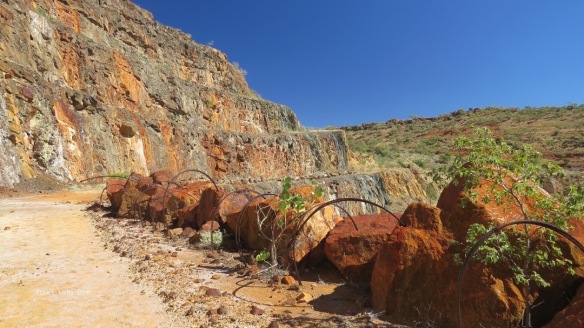
The temptation to try to walk all around the ‘lake’ on one of the terraces was overwhelming. Dave finally found a reasonable approach and we were off along the third terrace from the bottom, which for some reason has a low outer wall of large boulders and thick wire and also appeared considerably wider than some of the other terraces. I’m proud that I did that walk.

IMG_0838

cloncurry Camooweal 36

cloncurry Camooweal 42cloncurry Camooweal 41

IMG_0843

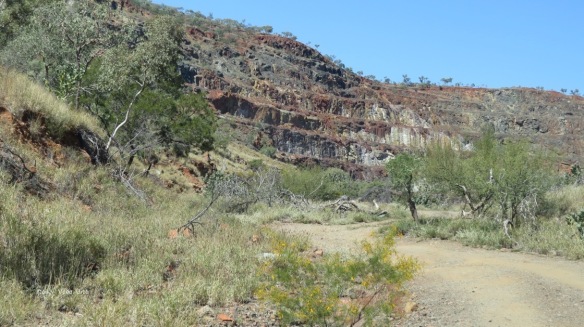
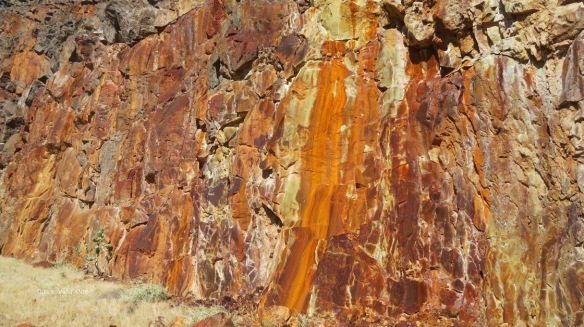
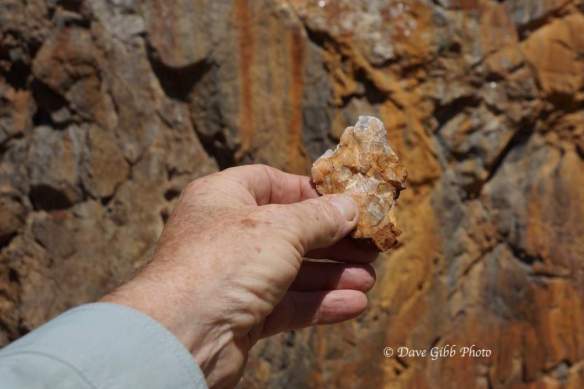
The colours were amazing … and so many minerals visible in the rocks. IMG_0839cloncurry Camooweal 38IMG_0845

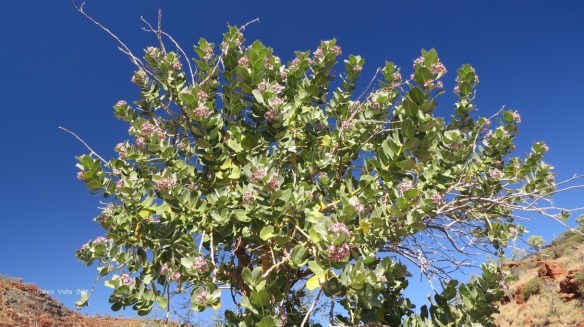
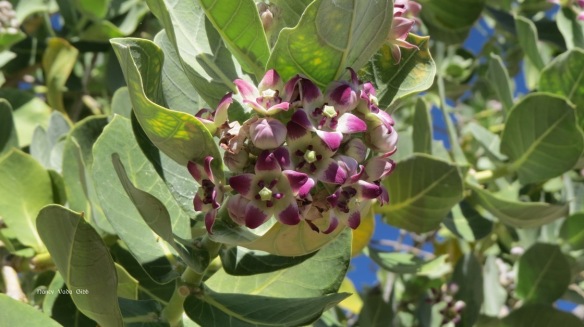
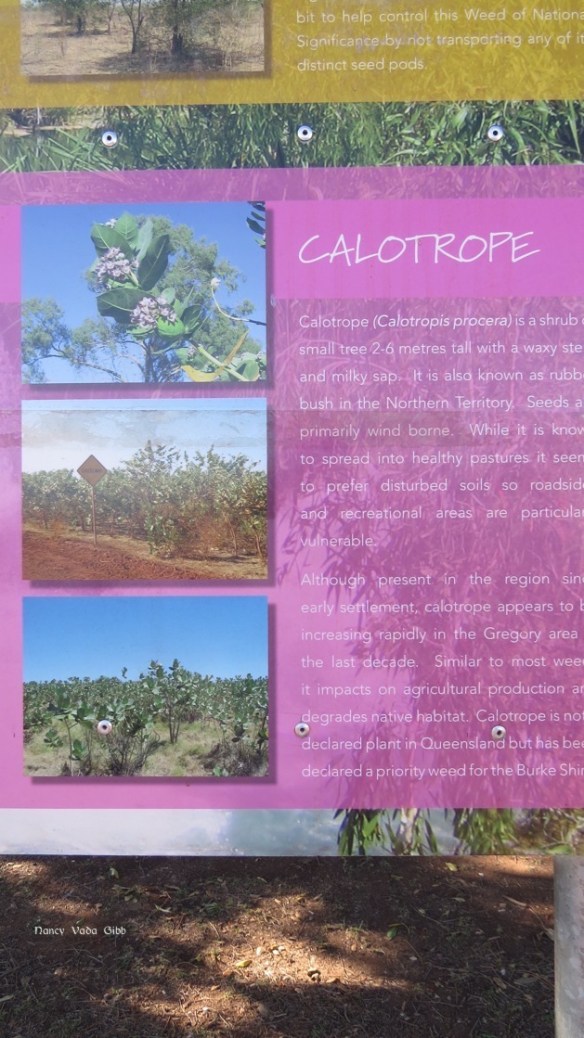
One shrub seemed predominant everywhere, and I finally found out what it was – Calotrope – a “priority weed” for the Burke Shire in fact. (We’ve been seeing more and more of it as we move east). 

IMG_0822IMG_0821IMG_0884

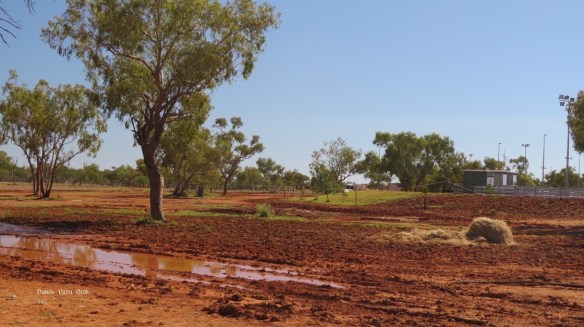
We decided not to stay more than one night but to head for Cloncurry and then north. We called in at the scene of the Stockman’s Challenge on the way – what a difference a week makes. The grounds people had obviously taken full advantage of the well-tilled earth and planted lots of new shade trees. Grass was springing up everywhere in the well-fertilised red soil.

IMG_0860IMG_0867IMG_0866

Dave’s version: Mount Isa to Cloncurry to Gregory Downs

After putting everything back together at Mount Isa and hopefully locking everything in place with  large quantities of Loctite we left early-ish and drove quietly down to the Mary Kathleen Mine village. After setting up there and having lunch we went for a walk through the mine, or rather we walked around a large hole in the ground that had been the Mary Kathleen uranium mine. Uranium was discovered here in 1954, the mine started production 1958 and closed in 1982.

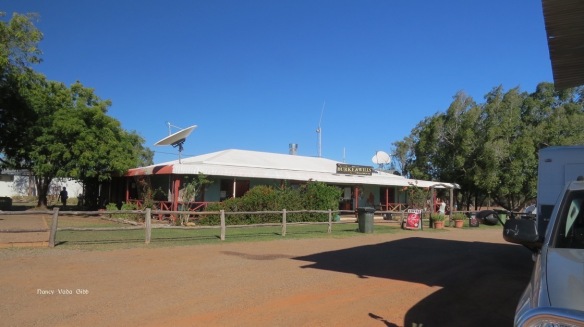
The Spring rebuild seemed to be holding up so we carried on through Cloncurry and up the highway to Gregory Downs. We topped up tanks at the Burke and Wills Roadhouse…..

IMG_0873

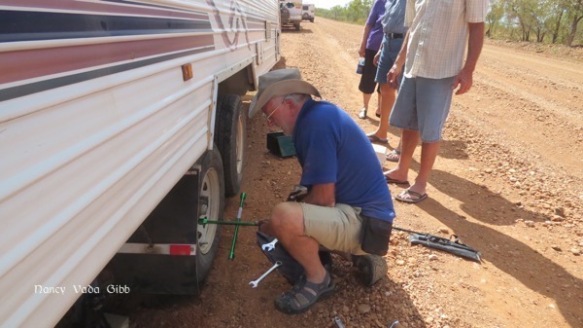
….. and while doing so I noticed something shiny in one of the tires, drove forward to clear the pumps and stopped to inspect the wheel, unfortunately the bull dust was coating everything and I couldn’t find the shiny bit. Keeping my fingers crossed we drove off towards Gregory Downs and stopped at a free camp beside the highway.

IMG_0877

Checking the tire again I found there was a nail in it although the tire was not flat. This brought on the old dilemma, had the nail gone through the carcass of the tire or had it gone sideways in the tire and should I pull the nail out or should I leave it in. Guessing from the angle of the visible part of the nail that it had gone in sideways I decided to pull the nail out and found I had guessed wrong. So I changed the tire to the spare and the next morning we carried on to Gregory Downs where we are now camped in the bed of the Gregory River in company with about 20 or 30 other vans.

Tomorrow we will head up to the Adel Grove where I have to get the tire repaired.

149. Camooweal

Another place I couldn’t wait to visit. Nowadays it is considered a sort of outer suburb of Mt. Isa (!) But it has a total different character; it’s the OUTBACK.

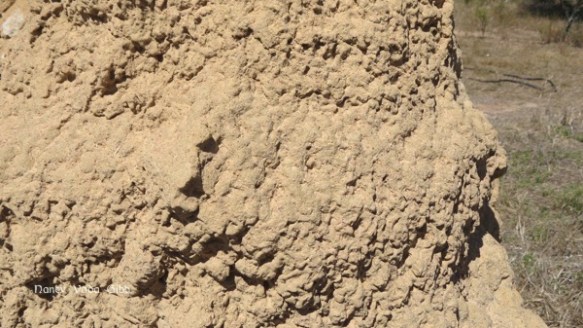
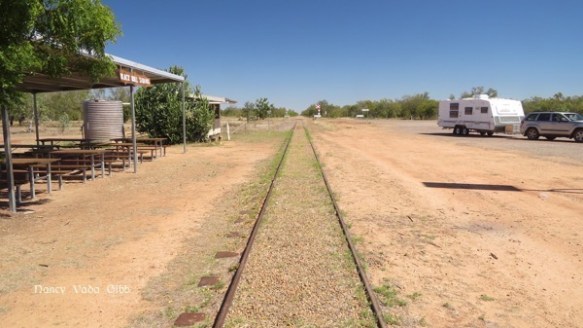
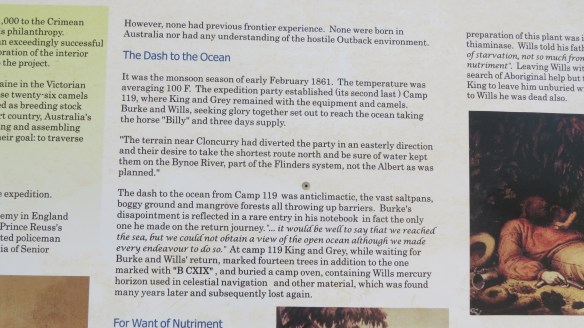
The 189 km of Barkly Highway between Mt. Isa and Camooweal (“Tojo’s Highway”) with its varied scenery and thousands of red anthills, was broken at one point by an unusual feature – a section of the old highway which was built during World War II with American funds. It was originally designed as a link between the southern states and the theoretical ‘front line’ in the NT. Before 1940 it was just a track which ran close to the telegraph line erected in 1897 and meandered from waterhole to waterhole. The new road, commenced in 1941, was ten miles shorter. By the end of 1941. Australian and American traffic on the road was up to 1,000 vehicles pre day! (That’s a section of the old road in the foreground of the second photo.)

IMG_0483

IMG_0484

IMG_0476 (1)

Nowadays it is a useful resting/camping place for many caravans, and sadly the place where one dog had to be left behind. No not this one …

IMG_0486

IMG_0485

This rest place was not far from the turnoff to the station “Calton Downs” where my grandfather d’Archy worked as a stockman aged 22 according to the Queensland electoral roll of 1905.  Ten years later he was managing  “Headingly” station and three years later, now a married man, he was managing “Chatsworth”. Perhaps not the easiest country for mustering.

IMG_0480

IMG_0477

Our first stop on the outskirts of Camooweal was the Drover’s Camp. My great grandfather having been a drover in this area in the late 1890s and 1900s I was especially keen to visit. However, the focus is on the 1920s-1940s and the volunteers who care for the place were once real drovers themselves.

IMG_0489

IMG_0499

It was a fascinating display and Dave found the long talk very worthwhile.Tales of the Canning Stock route and of setting up camp with everything done in orderly fashion including lining up all the pack bags in precise order so the could be grabbed by the correct person and loaded on the correct packhorse next morning.IMG_0491

IMG_0502

IMG_0505IMG_0501

A fascinating demonstration of how to make and light a carbide lamp (oh the horrid smell!).

IMG_0493

IMG_0498

And an extraordinary portrait gallery of drovers, including several women.

IMG_0507

IMG_0510

Then on through the town – very small with one general store cum post office and a couple of roadhouses and two fuel stations.

IMG_0632IMG_0634IMG_0595

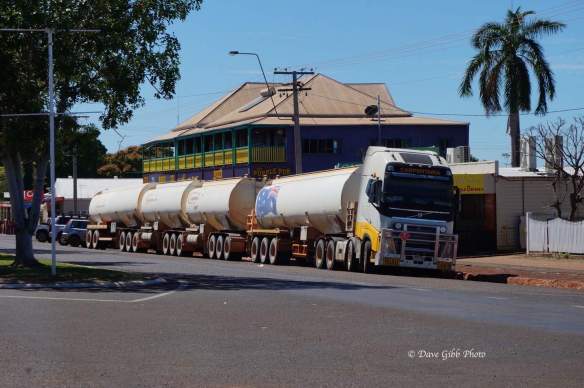
Road trains thundered along the main street…

IMG_0620IMG_0629

The township of Camooweal does not have a great many attractions but one which does get attention is this statue of a stockman. I like the way he looks backwards.

IMG_0594IMG_0587

IMG_0586

He is beside a lovely old building, once the shire hall, said to be a fine example of colonial architecture and currently being restored. It was a beautiful pink colour which Dave said was merely undercoat but which I hope will also be the final colour.

IMG_0604

IMG_0619

IMG_0614

We were heading for a free camp on the banks of a large billabong just outside town. It had been raining in the area recently and the ground was quite soft so we were a little nervous about venturing too far from the main camping area.

IMG_0572

IMG_0703

IMG_0560

Later on we wished we had – there are several kilometres of dirt track bordering the waterhole, with caravans and other camping vehicles spread far and wide. It looked like some had bedded down for a long stay. And why not? Absolutely glorious scenery, peace and quiet, water and necessities available not too far away …. we could definitely have stayed there for much longer. And all free. The birdlife along the river was amazing. Brolgas, egrets, pelicans …. and beautiful white and purple waterlilies. I make no apology for the number of photographs.

This is what I saw the first morning.The waterhole at this point is narrow with a small number of waterlilies.

IMG_0563

IMG_0577

IMG_0544Early next morning I went for a short walk:IMG_0546

IMG_0545

IMG_0525Some of Dave’s bird photos:

cloncurry Camooweal 20

cloncurry Camooweal 30

cloncurry Camooweal 32

Further down the track, so to speak the waterhole widened and the waterlilies exponentially multiplied – as did the birdlife.

IMG_0554IMG_0555IMG_0542IMG_0540IMG_0539IMG_0536

IMG_0659

IMG_0660More of Dave’s birds:

cloncurry Camooweal 29cloncurry Camooweal 28cloncurry Camooweal 24cloncurry Camooweal 22

More camping as the far end of the waterhole, where it starts to narrow:IMG_0696IMG_0674IMG_0670IMG_0669

IMG_0658

Apart from an occasional sortie into town to get bread and milk, we made one short trip, as one does – to the Northern Territory. Only 12 kilometres down the road. The effects of unseasonal rain were still in evidence.IMG_0646

cloncurry Camooweal 17

Here’s map showing Camooweal and its relation to some other places we’ve passed through. We will be heading for Normanton soon.

IMG_0625

We didn’t visit the Camooweal Caves National Park, as the caves are closed to visitors and camping is not permitted within the park.

Next blog: an Adventure! Actually it’s already been covered  by Blog No. 144.

148. Mt. Isa

(Posted from Normanton in the Gulf … only a few more blogs to catch up on).

Sometimes the places we are ambivalent about visiting turn out to be some of the best, or at least they have a few special places-within-the-main-place. And so it was with Mt. Isa.

Like Broken Hill, Mt. Isa is a mining town started in the 1920s and dominated by one or more representatives of the mining industry, in this case a couple of huge smoke stacks and mining structures. Unlike Broken Hill however it has a plentiful supply of water unlikely to become depleted in the near future. The main streets are lined with trees and private homes have flower gardens. There is a modern shopping centre. Huge road trains thunder along the highway.
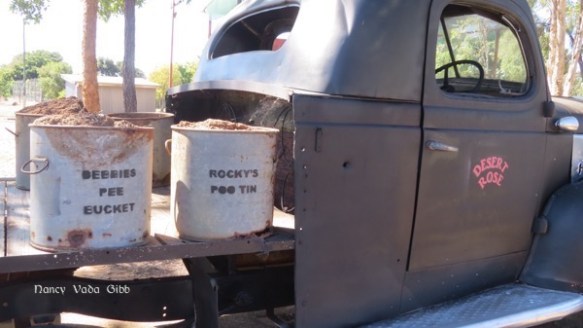
IMG_0356IMG_0353

IMG_0629

We set up in a camp just outside the town, on the road to Lake Moondarra. Unlike most other camps this one had rows and rows of single-room cabins each with an air conditioning unit and also many static caravans with annexes, obviously semi-permanent homes. I guess this reflects on the transient population.

The weather was not too good but little further rain was expected so we felt safe in the camp, accessed via a floodway.

IMG_0460

We paid a visit to the Lake, not knowing what to expect. Certainly not such a huge expanse of water!

IMG_0361IMG_0370IMG_0368

It started with a dam over the Leichhardt River constructed by Mt. Isa Mines – at the time it was Australia’s largest privately funded water scheme. Before then Mt. Isa’s water needs were met by a series of bores, which ironically is the situation now facing Broken Hill as the Menindee Lakes are practically dry due to the Murray no longer flowing. (The dam is just visible on the far right in the photo below).

IMG_0391

IMG_0393

IMG_0380IMG_0384

“In late 1956 a rocky gorge on the Leichhardt River 16 km downstream from the township was selected due to its natural bedrock attributes …. work began without delay …. seasonal rains in December 1956 sent flood waters rushing through the gorge causing extensive damage to the partially completed wall … it was finally finished in 1957.”

IMG_0373IMG_0360IMG_0358

For those who want to know, the catchment area is 111,369 hectares, dam surface area about 2.6 hectares, storage capacity/volume 107 gigalitres and max depth 11 metres.

IMG_0390

The names Lake Moondarra and Warrina Park (below the dam) were selected from over 400 entries by local school children.

We had a quick look around Warrina Park, it would be lovely on a fine day but not in the rain. Along the perimeter we came to a sudden halt at a peacock crossing … so many birds! They must be a great attraction.

IMG_0397

IMG_0396

IMG_0400

We did not ‘do’ the celebrated Mt. Isa Hard Times Mine, “an unique underground experience”, but we did visit the Underground Hospital. Another item on my Must-See list. Run by a couple of hard-working local volunteers, who offered us a cup of tea with them on closing as we were the last two visitors and had asked lots of questions. I was delighted to find some information about old families pertinent to my  family history in some old books on display.  (They’ll be included in a future blog in the Darchy Chronicles). 

Besides the underground section there was a treasure-trove of medical and surgical items in the old house which served as an entrance. (It was part of the old hospital itself). Even on the verandahs……

IMG_0403IMG_0404IMG_0449

The Underground Hospital was constructed by volunteer Mt. Isa Mine workers in the hill beside the existing hospital in 1942, when Northern Australia was on a war footing. Darwin had been bombed earlier that year and it was feared Mt. Isa would be next.

IMG_0435

IMG_0406

The Underground Hospital was completed quickly, an E-shaped structure carved out of the hill with surgical, medical and maternity facilities, and even and outpatients department and operating  theatres. Fortunately it never had to be used for the purpose for which it had been built. In later years some nurses on night shift used it as a cool and quiet place to sleep!

IMG_0416IMG_0415IMG_0414IMG_0408

It fell into disuse and was forgotten then rediscovered in 1977 …. the roof was partially collapsed, debris everywhere, and wooden fittings white-ant eaten. In 1997 restoration started using old photographs as there were no plans or details on record.

IMG_0433IMG_0432

Bunk beds constructed according to the old photos

IMG_0420

IMG_0431

A storage cupboard constructed from old packing cases, just as in the old photos.

IMG_0429

Some of the artefacts recovered from the rubble.

IMG_0427

cloncurry Camooweal 15

There were various interesting signs and some objects along the short walk to the underground hospital. Such as a number of these kerosene lights used to mark out the Camooweal airstrip for the Flying Doctor plane.

IMG_0439

One more thing – right next to the hospital is an example of a ‘Tent House’, the last one remaining. With canvas walls, roof and sunshades, protected by a completely separate corrugated-iron second roof.

IMG_0454IMG_0452

IMG_0451

No, two more things. Lining the parking ground to the Underground Hospital and Tent House are fantastic examples of mineral-bearing rocks. I could not believe they were just casually sitting there. Usually such things are only seen in museums. But it was Mt. Isa!

IMG_0456

IMG_0457

147. Cloncurry – 2. The RFDS.

The  Cloncurry Visitors’ Centre has a magnificent display of minerals and some interesting local history, where I managed to find out a little more about Kuridala.

IMG_0165

IMG_0161IMG_0170

There is also a section devoted to the explorers Burke and Wills. I like this painting by Patricia d’Arcy (no relation) entitled the Final Journey.

IMG_0158

Of even more interest though was the Royal Flying Doctor Service Museum, which is carpeted with a specially woven carpet depicting the Cloncurry district from the air. An absolute must-see for anyone passing through Cloncurry (the museum not the carpet!).

IMG_0207IMG_0222

In 1937 my grandfather d’Archy was flown by Flying Doctor from Macarthur River Station in the NT to Katherine, where he died. He was the Station Manager and together with the cook was struck down by a ‘mystery illness’, at first thought to be cholera, or possibly some form of food poisoning and later accepted as typhoid. It made news all over Australia! He would have been flown out in a plane like this, if not this particular plane.

IMG_0214

IMG_0220IMG_0215IMG_0217

Also he was most likely attended by Dr. Alberry or possible the RFD’s first female doctor Jean White. (I hope to obtain more specific records later; we did enquire but they are not held there).

IMG_0209

IMG_0211

Did you know who actually invented the pedal wireless?

IMG_0210

I was surprised to learn that Queensland’s first School of the Air opened in Cloncurry on 25 January 1960. I thought it was much earlier. there were 14 pupils on remote properties as far distant as Normanton, Richmond, Camooweal and Birdsville. By the end of 1960 there were 74 children on the roll. The school relocated to Mt. Isa in 1964, with the move of the flying doctor base.

When it wasn’t raining we visited the Chinaman’s Lake just outside town. The extensive lake is formed by a dam but there were few signs to give its history.

IMG_0181IMG_0183

It had two interesting signs, one about lice and one on a small monument to Wesley Nicholls with a poem part of which I remember from years ago, although I only knew the last four lines.

IMG_0182IMG_0179

Here is a glimpse of the lake through a thicket of wattle and other bushes.

IMG_0184IMG_0185

It is not the Stinking Wattle which makes the camp smell gaseous at times.IMG_0155IMG_0156

When I passed through Cloncurry in 1971 I had no idea of its importance in my family history, and the big modern bridge over the Cloncurry River had not yet been built. Geoff and I must have driven over this causeway in the MGTF. Parts of the old highway can still be seen.

IMG_0194

IMG_0200

IMG_0202IMG_0201IMG_0196

After almost a week in Cloncurry it was time to move on. Next stop: Mt. Isa.  Only 119 km.

146. Cloncurry – 1. The Stockman’s Challenge.

I couldn’t wait to reach Cloncurry, the area of my mother’s birth. Her  father was managing Chatsworth Station at the time. The birth was registered at Friesland, a mining town which later changed its name to Kuridala due to sensibilities about Germans during the war. It is still on most maps although the mining town is long abandoned. We decided not to try to visit.

IMG_0787

After a long drive through red anthill country,  livened with occasional swathes of wattle and/or Brahman-type cattle, the approach to Cloncurry is marked by an unusual rock formation. The town is not as large as could be expected, being overshadowed by Mt. Isa. It has very wide streets, two supermarkets and a reasonable selection of other stores, although very outback orientated. There is a saddlers which has a huge collection of western-style clothing and leatherwork decorated with the bling so beloved of rodeo contestants.

IMG_0136IMG_0139

IMG_0141IMG_0144IMG_0146IMG_0148

Somehow we’d managed to time our visit not only for a period of rainfall but also the time of the annual Stockman’s Challenge. We were snug on a hard gravel surface in a camp, well sheltered and with some interesting new neighbours who invited us to share a pizza cooked in one of the camp’s BBQ ‘ovens’ in the rain.

IMG_0172IMG_0173IMG_0174

IMG_0240.jpg

We made full use of the camp’s showers and also washing machine, and were vastly entertained by a mob of apostle birds and other birds plus a couple of magpies who took a liking to our bumper bar and bull bar, kept nice and shiny by the rain. The gidyea (stinking wattle) did perfume the air a bit but we soon got used to it.

cloncurry Camooweal 12cloncurry Camooweal 04cloncurry Camooweal 02

cloncurry Camooweal 07

IMG_0176

IMG_0177

The stockmen were not so fortunate. The Equestriation Centre where the Challenge was held was simply a sea of red mud. The huge horse transporters and their recent occupants soon had everything churned up to a high degree, helped by pools of water everywhere. Poor horses! Most had to stand in mud up to their hocks. Lots of hay was put down and I saw several  horses trying to have a roll in the hay, still wearing their blankets. Red mud, red mud ….. everyone had red mud half way up their legs. it was also amazingly cold, with a bitter wind sweeping the yard (we did not feel it nearly as badly at our camp). Yet the show went on.

IMG_0245

IMG_0233

IMG_0252

IMG_0238IMG_0258IMG_0273

IMG_0256IMG_0269IMG_0272

I had not attended a stockman’s challenge before and had surmised it to be similar to a rodeo. There was a rodeo one evening but it was just ‘entertainment”. The serious business was almost an equestrian competition. First crack a whip, then walk, trot, canter …. and come to a screeching halt in front of the judges, several times. Then there was the Drafting (capital D) – each stockman in turn had to separate a chosen steer from a bunch of six in a small yard, then steer (sic) it in a figure of eight and then through a set of posts. Not everyone accomplished that. One particularly obstinate steer need three horsemen to separate it from the small mob.

Winton&cloncurry16

Winton&cloncurry08Winton&cloncurry13Winton&cloncurry20Winton&cloncurry21

We did not see nearly as much as I would have liked, mainly because it was just too cold standing in the wind and, sometimes, rain. Although together with our camping neighbours we did find bit of shelter behind the bar building, where the heater outlets were good for warming cold hands! But it was a wonderful event to witness and something to always remember about Cloncurry.

IMG_0270

Winton&cloncurry17

145. Winton & the Walkabout Hotel

We camped for the night at a free camp just off the road to the Dinosaur Museum (this photo was mistakenly included in the Longreach blog) ….

IMG_0082

Winton&cloncurry18

…. then next morning paid a visit to what remains of the Banjo Patterson Museum in Winton. Part of it was destroyed by fire in early 2016, but sufficient was saved and much more material has since been donated, so it is once again an interesting if somewhat smaller museum. The staff were wonderful and cheerfully recharged my camera battery while I wandered around, camera-less (all photos are by Dave, some at my instigation).

Winton&cloncurry04

Winton Museum01

Winton Museum05

The 4X4 Jeffery Quad:

Winton Museum02Winton Museum03Winton&cloncurry06Winton&cloncurry07

We were still travelling with John and Leanne.  Soon after leaving Winton we noticed an unusual shifting dark shape in the sky – then two dark shapes – then the penny dropped, it was a huge flock or flocks of birds. They were much too far away to get any good photos but I tried anyway!

IMG_0089


The country was changing again, after all the flat and father bare landscape there were some butte formations but we were past the best before I realised.
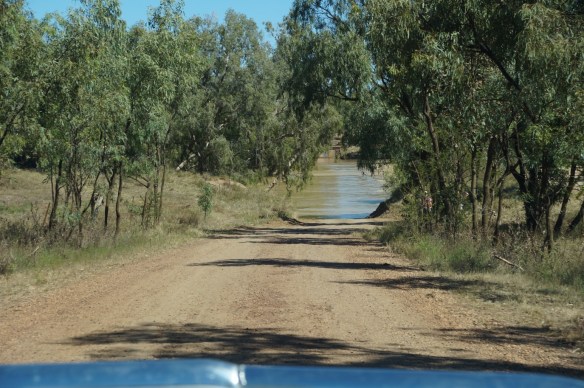
IMG_0093

We didn’t stop at the rather famous Blue Heeler pub…..

IMG_0097

….. but continued on through featureless country until we came to our planned night stop – the Walkabout Creek Hotel at McKinlay, made famous by the Crocodile Dundee movie.

IMG_0105

IMG_0130

IMG_0111It was sold a few years back and almost all the memorabilia were auctioned off, so now it is just a slightly seedy country pub which however served very good pizza (that night only, we were lucky) with very cold and welcome drinks, and also provided a good camping area with excellent showers for a very low camping fee.

IMG_0114

IMG_0106

Road trains thundered past until well into dusk. Rosellas were everywhere. An attempt was being made to prettify a small residential area. McKinlay had ATMOSPHERE.


IMG_0117IMG_0107

IMG_0109IMG_0127IMG_0125IMG_0123


144. Another Postcard – A Wee Mishap

I’ve just posted a blog about Longreach, but since we were there we’ve travelled much further, to Cloncurry and Mt. Isa and Camooweal.  More posts are coming, but in the meantime ….

Two days ago we left Camooweal intending to go the 200 or so km to Adels Grove via Gregory Downs (map at bottom of blog). Here’s Dave’s account of the trip.

IMG_0737

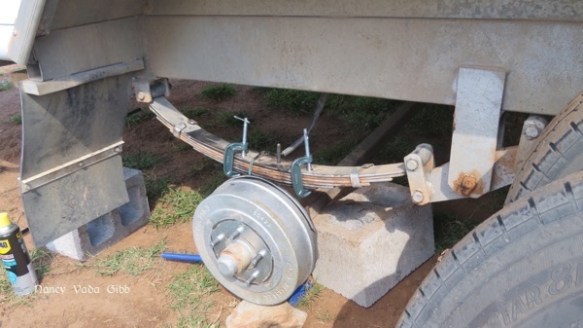
(Dave:) This involved about a hundred and twenty-five kms of gravel road to Gregory Downs and then a further 90 kilometres on a four wheel drive road to Adel’s Grove. We were at 42 kilometres into the gravel when we saw a couple with a caravan and truck changing a wheel. We stop to check if they needed help but they said okay so we carried on … about 200 metres on over a slight crest …  when the caravan started exhibiting all the throes of a flat tyre. Hastily pulling over to the side of the road I leapt out to inspect the damage, to be greeted by a far worse scenario, the rear right wheel of the caravan was jammed back against the chassis. Checking the damage it appeared the locating pin for the leaf springs had sheared, allowing the springs and the axle to slide backwards.

I was checking the caravan when another couple of caravans stopped to help; one of them luckily had a 21 mm spammer required to undo the  U-bolt nuts. Also luckily I had a 6 mm bolt that I’d saved when changing the feet on the stabilisers. I was able to line everything up, insert the 6 mm bolt and bring everything back together again.

IMG_0738

IMG_0739

IMG_0741We decided to turn around and return to Mt. Isa where I hoped to be able to find a proper high tensile pin for the spring. When we arrived back in Mount Isa we rang the local spring maker who informed us he was on holiday until next Wednesday, and “…. the nearest places where it could be done are Alice Springs, Darwin or Townsville!!!”

I decided to bodge up a fix, kiwi bush mechanics style, found the local bolt supplier, bought a couple of high tensile steel bolts and then found that the holes in the leaf springs were a strange size. Soooooo…   I asked around and the guys at Excellent Engineering of Mt. Isa were recommended to turn the bolt down to size, which they did and only charged me $10. With the bolt becoming a pin of the correct size I was able to put everything together quite quickly.

IMG_0783

Nancy: another couple of purchases beside THE BOLT were a larger stronger jack, a spanner, and an umbrella to shield the workman.IMG_0781

So tomorrow we will do a short trip and I will check the U-bolts again to see if they are okay. If so we will carry on, if not we will return to Mount Isa and wait for the spring-maker to arrive back from his holiday. I would still like to go to Adels Grove but now we will probably go via Cloncurry as it will be mostly sealed road.
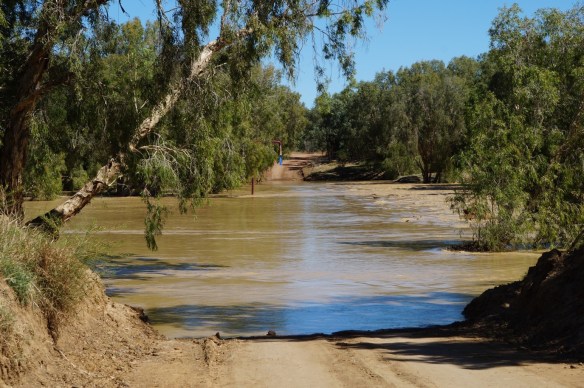
IMG_0784

IMG_0744

143. Longreach
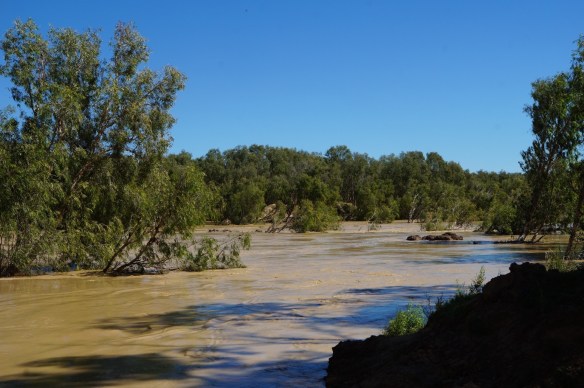
By Dave: This sure is a big country and there are an awful lot of caravans travelling around it. We arrived at Longreach planning to stay in a free camp several km north of the town, however when we arrived the camp was chocker.

IMG_9941

IMG_9948

Nancy decided that we couldn’t fit in there and so with our friends John and Leanne we decided on a commercial camp. John rang around and found one that didn’t sound too expensive so we went there instead.

IMG_0082

Being fully self-contained we elected to the cheapest sites, moved in and set up. Our ancient grey water hose broke while setting up so I spent most of the next day buying a new hose and trying to find suitable adapters to fit it. Longreach being a small town this proved impossible however, so in typical Aussie fashion we just dumped a great deal of water on the ground.

Nancy: camping here in Aust. is very different to NZ, where most caravans have large fresh and grey water tanks. Here it seems to be normal to have small fresh water tanks and to hook up to a tap at every camp site (ie with mains pressure) and simply discharge grey water via a hose to the  nearest tree or garden plot if there is one; very occasionally there are proper discharge points. We do have a portable grey water container which we use in “fully self-contained” camps but often see Aussie caravaners ignoring this basic rule.

Longreach is full of interesting old buildings. I was disappointed they have repainted the railway station white; in 1971 it was a beautiful blue (and there was no tarmac in front, just red earth).

IMG_0072

IMG_9924

IMG_9926IMG_9925IMG_9952

Dave: We had planned to visit the Quaintarse museum and the Stockmans Hall of Fame but after wasting so much time chasing round we decided to concentrate on the Hall of Fame. Several people recommended spending a little extra and seeing the show associated with it. Unfortunately we believed them and wasted an hour listening to some Country music and a bunch of lame jokes. There was a small part of the show that dealt with the skills Stockmen needed which was mildly interesting.

IMG_0040

Nancy: On arrival at the Hall of Fame there was a stockman type holding a very placid Brahman-type steer, most likely a hand-reared orphan, which of course most people stopped to admire and pat. Apparently the large hanging loose skin is actually a cooling mechanism, it increases the surface area which helps heat dissipation.

IMG_0030

IMG_0061

Dave: Nancy had an appointment with a local historian after lunch so we left the Hall of Fame to talk to her and then returned afterwards.

Nancy: she gave me some wonderful maps of local stations, and in particular helped me find some of the stations mentioned in the many newspaper reports of ‘Drover Tim Darchy’, my Great great uncle. We visited his grave in the Cemetery.  Some graves had curious coverings rather like seed raising beds. Rosellas were everywhere.

IMG_9937

IMG_9940IMG_9931

Nancy: I was also interested in the Stockman’s Hall of Fame exhibit of a drover’s camp.

IMG_0048

IMG_0049

Also this wonderful painting called “the Drover’s Wagon” by Philip Silcox. We visited the street where Tim lived with his wife and daughter when not droving; part of it is now in  the town but I would imagine it was once out of town a little as he would have needed to keep quite a number of horses. IMG_0218

Dave: One of the staff was making stock-whips and I was surprised at the amount of work that went into each one.

The museum was quite interesting and some of the stories on the unsung heroes boards were amazing.

IMG_0054

IMG_0055

Back at the camp we were entertained by two resident brolgas who paraded around, much to the delight of the photographers.

Nancy: When we first saw them the male was doing most of the dancing, offering nesting materials.  We were told that earlier they were stalking along peering in all the windows at the nearby motel, possibly looking for a nesting site. next day however they were much calmer – maybe he had had his wicked way.

Winton16

IMG_0018

Dave: Next morning we made an early start or at least early for us, and headed to Winton where we parked for the night at the Long Waterhole Camp. Winton&cloncurry01Winton&cloncurry02Winton&cloncurry03

Dave: Along the way we stopped at the Age of Dinosaurs Museum for an interesting couple of hours.

Winton03Winton12

These fossilised mussels were only babies, the adults were over a metre long. Fantastic chowder they would have made!

Winton11Winton10

‘Mick’ was a dinosaur … that’s a cow vertebra on the right  for comparison

Winton08Winton09

Nancy: the  Museum included two escorted tours, the second being around the laboratory. A charming young man talked for ages and made it all look very interesting but it was a dead loss for me, so when we were leaving we suggested to the Museum that they investigate providing a captioned, signed interpretation of the talks on an iPad, and/or a downloadable version on the phone app ‘STQRY’. They were interested. We earned our Brownie points for the day!

The Museum is high on a ridge with wonderful views all around.

IMG_0079

IMG_0077

Winton17

IMG_0057Two other things noted were the colourful native flowers, and themed coffee.Winton01

Winton07

Dave: We had hoped to get to Winton in time to check out the Banjo Patterson Museum, but on arrival found that most of the Museum had burnt down earlier this year and the remainder had to shut for the day. Maybe tomorrow.

Winton&cloncurry04

142. Charleville.

I have long wanted to revisit Charleville, 750 km SW of Brisbane. In 1971 my first husband Geoff and I just drove through, and I did not know at the time that it was where where my Great Great Uncle Louis Darchy met an untimely end. He is buried in the churchyard. I thought I might be able to locate some photos and extra information about him.

But first – we thought we would try the Bush Caravan Park (“non-smokers, must have toilet, $5/night” (!!) on the other side of town. We found it just before dusk and set up in the sunset glow. Invited to join a group around a large campfire (“there will be damper!”) the first person we saw was a woman with a cochlear implant.  Gosh they are becoming common (!). Another woman in the group round the fire was hearing impaired and told us she is on the waiting list for an implant. I usually dread these campfire gatherings with a group of strangers, but this time ….. we were still chatting away when it became too dark to see anything. And yes the damper was delicious!

IMG_9833

IMG_9879IMG_9838

There was a small street parade for a Junior Rugby Tournament going on, but we wanted to visit the Information Centre  first … and they didn’t know anything about the parade! By the time we got back into town the parade was over anyway. Like most others we have visited, the iCentre was modern, cheerful and very helpful, with a wide range of brochures.

We visited the cemetery, but it was impossible to find Great Great Uncle Louis. I have a photo taken some years earlier by one of his descendants, which showed no headstone, just a grave marker. But since then the cemetery has been badly flooded, and many grave markers displaced. It was obvious that despite careful efforts of the cemetery trustees and their helpers, many grave locations can probably never be determined with certainty. Great Great Uncle Louis’ remains may or may not still be there … they could be many miles away down the nearby river. Probably where he would prefer to be.

IMG_9855IMG_9862

IMG_9870

IMG_9868

IMG_9865

Next stop the Historic House Museum, built in 1889, “today the museum brims with the precious memories and items from the district’s pioneering families…” (Trying to get a photo of the heritage building free from modern signs etc was impossible).

IMG_9849IMG_9850

Old photographs …. no wonder the streets were and still are so wide, designed so that bullock teams could turn around.

IMG_9844

IMG_9840

IMG_9843

A very charming man went through all the computerised photos which the museum possessed and located a photo of Hackett’s Hotel, where Louis died in 1910. It burnt down a few years later. He also found two photos of a station homestead where Louis and his wife Anna Maria worked before they moved to Charleville.

IMG_9846

IMG_9847IMG_9848

World War Two may be a distant memory but the people of Charleville certainly celebrated the end of it. In 1945 every business in Charleville painted the V-for Victory symbol on their facades, including this old building, the Warrego Chambers, which still displays it to this day.

IMG_9851

There are lots of old buildings …. the Courthouse in particular.

IMG_9841IMG_9842

Back to the Bush Camp and another lovely evening with our new friends John and Leanne, with whom we were to travel during the next week. A mob of Apostle birds kept us company for a while. In the distance two kangaroos bounded away, chased by a farm dog.

IMG_9874IMG_9875