52 Ancestors …. Week 16.

Theme: A Quiet Life.

My GGGF Dr. Thomas Lyle 1791-1859 may have sought a quiet life, but did not entirely succeed in this ambition.

Although described in the 1851 Census as “a Surgeon in general practice”, it appears certain from the numerous books and collections he left behind that he was far more interested in early Scottish music and songs, and in bryology (the study of mosses). Born in Paisley to a weaver family who may earlier have been farmers, his parents both died in their early 30s, leaving him with a elder brother John and younger sister Anne aged about five, three and one respectively. It is thought the children were brought up by relatives. John, initially a weaver, enlisted in the 91st Regiment of Foot and rose to the rank of Colour Sergeant, surviving Waterloo but defeated by yellow fever after a few months in Jamaica. Anne became a housekeeper to a wealthy Glasgow man. Thomas, who must have been the gifted one, was educated at Paisley Grammar School. He attended medical classes at Glasgow University. About 1815 he set up as a druggist in the High Street of Glasgow, and in 1817 he was licensed as a surgeon by the Faculty of Physicians and Surgeons of Glasgow.

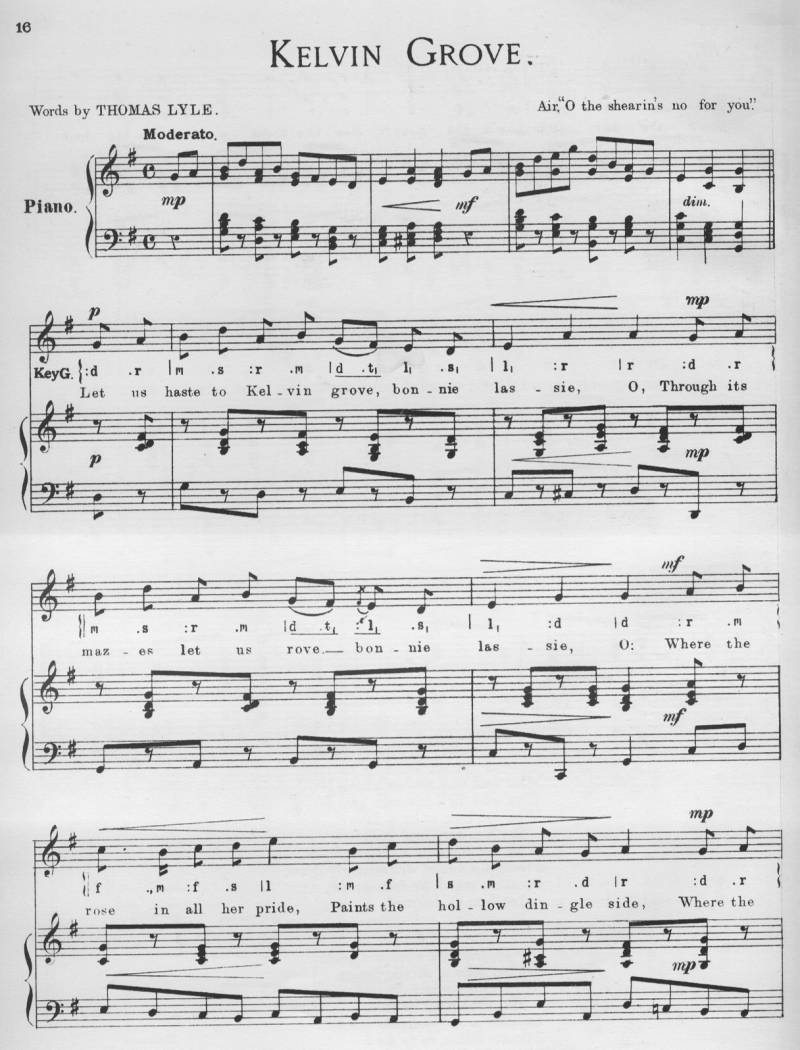
According to the Oxford Dictionary of National Biography, Lyle “… seems not to have enjoyed much success as a doctor. He was of a retiring disposition, happiest on botanical excursions, collecting old ballads, or writing verse for his own amusement… (He) was the author of several lyrics, but is remembered solely for the beautiful song ‘Let us haste to Kelvin Grove, bonnie lassie, O’ first published anonymously in the ‘Harp of Renfrewshire’ in 1820. Lyle contributed to RA Smith’s ‘Irish Minstrel’, and edited ‘Ancient Ballads and Songs’, London 1827. The latter work contained several of his own songs, including a version of Kelvin Grove somewhat different from the original..”

Dr. Thomas Lyle married Margaret Cochrane in Glasgow on 30 May 1821. They had four children in Glasgow then about 1830 the family moved to Airth in Stirlingshire – a Royal burgh and village on the River Forth, near Falkirk. (Incidentally, the Airth graveyard includes a number of cast iron ‘mortsafes’ – large coffin-shaped containers used to thwart the body snatchers of the early 19th century. Dr. Lyle would almost certainly have honed his surgical skills on such bodies in Glasgow some twenty years earlier). The origins of Airth go back to the 12th century and Airth Castle has been the site of many battles and skirmishes over the centuries.
At least three more children were born in Airth. A slightly earlier one died as a baby – he may have been the reason the family moved from Glasgow. The family stayed in Airth for many years. The Censuses show them still there in 1851 but by then all children had left home apart from the eldest boy who seems to have been his father’s assistant. Surprisingly, all the children had to earn a living – the two youngest girls were both cap makers in Glasgow before emigrating – separately – to Australia.

Why did they move to Airth? According to the current Airth Parish Community Council, the parish of Airth “… covers approximately 5500 acres of predominately good agricultural land with some woodland at Dunmore Park and around the famous Airth Castle. There is a working peat moss of around 500 acres to the west of Letham village. Part of this moss lies within the Parish boundary.” (Robert Smith). Thomas did practice in Airth, and seems to have taken part in village life as he signed the Census forms for a number of Villagers.The population in 1841 was 850. (In 2026 there is a single Medical Centre). But mosses seemed to have been his first love. He does not seem to have provided particularly well for his children.
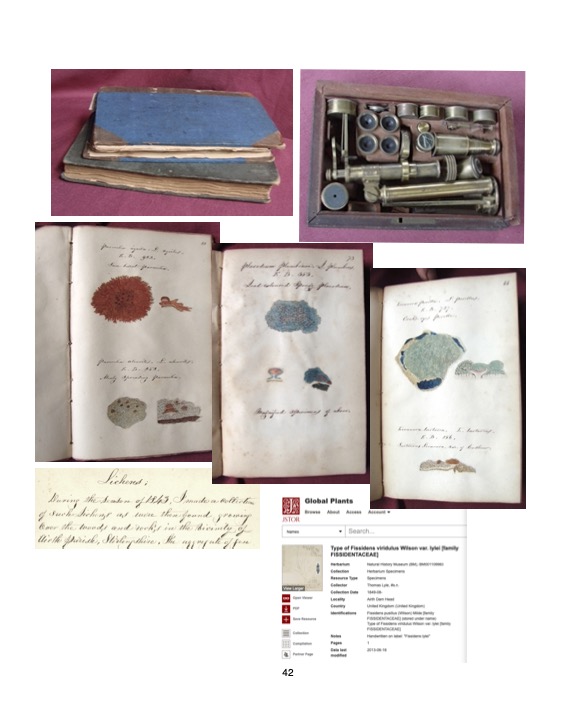
Lyle maintained a voluminous correspondence with Mr. William Wilson of Manchester (1799-1871), a world authority on mosses. A hand-bound volume of the collected letters from Mr. Wilson covering the period 1849 and at least 1854 (the date on the last collected letter) are in my possession. Also a treasured book of watercolours of mosses, meticulously catalogued.

Dr. Thomas Lyle is listed in Desmond’s Dictionary of British and Irish Botanists and Horticulturalists (2nd Ed., 1994); and a collection of Lyle’s correspondence and some mosses are in the collection of Wilson correspondence at the Natural History Museum in London, and some plants at the Paisley Museum.

It would seem, if Lyle did indeed move to Airth for “a quiet life” involving roaming the countryside collecting mosses and perhaps doing a little doctoring, to some extent he succeeded. But – as poignantly indicated in a letter from Wilson dated 18 October 1853:

(after some bryological correspondence – a new paragraph, fresh pen)
If you must needs go to Glasgow, I sincerely hope that you will succeed in the attainment of your moderate wishes, and escape from the pestilence that you go to withstand – I shall rejoice if this revolutionary event of your life shall be productive of good to you and your wife – Whether we shall ever meet face to face, now that you are coming more within reach, is uncertain – I have still a load of toil before me and my health is quite precarious, not to mention my eyesight …

Then on 9 March 1854:
My dear Sir,
You have often been in my thoughts and I had fully intended to write to you on the day that I received yours informing me of your loss – it is a relief, I trust, both to yourself and to your departed wife (who must have suffered much under the protracted and hopeless illness) that she is gone to her rest. I trust also that you will have all the consolation which you need, in this your bereavement. The parting is a solemn event, and must have caused deep exercise of thought and feeling….

There was an epidemic of typhoid in Glasgow in the 1850s – possibly the pestilence referred to. It was indeed the cause of Lyle’s death in 1859.

52 Ancestors …. Week 15.

Topic: Unexpected.

I wrote some years ago: “I have learned …. Following new leads in the quest for further facts may sometimes lead down new and intriguing pathways, not always to the expected destinations. And on the way, it’s not wise to push seemingly irrelevant information to the wayside. One day, suddenly, it may all fit in.” This is a condensed version of an earlier research article.


My great great uncle Robert Wentworth Wade was the Mayor of Hokitika on the West Coast of New Zealand in 1892 to 1894, and a Councillor for several years on either side of those dates. I knew he had married an Irishwoman, Kate Behan, although it was some years before I found the actual record of their marriage. Having a reasonable amount of information about Robert, I decided to investigate Kate a little further.

Eventually I found their marriage certificate which showed that Miss Behan was the niece of one of the town’s leading doctors, Dr. Rossetti. It also told me that Catherine (Kate) Behan was born in Ireland to Peter Behan, a farmer, and Bridget O’Grady. Knowing the difficulty of searching Irish records, I wondered if Dr. Rossetti could lead me to discover more about Kate’s origins.
A database of early NZ doctors showed me that Dr. Francesco Rossetti was born in Switzerland and graduated MD from Pisa, Italy, in 1850. He emigrated to Australia and was practising as a doctor in Hepburn, Victoria, in 1865. He was deleted from the Victorian register in 1866 and registered as a doctor in Hokitika, NZ, in the same year on 22 June, then registered again under a later Act in 1868. He was naturalised in NZ on 21 January 1870, appointed the Italian consular agent in Hokitika 31 March 1870, and the public vaccinator for Ross (close to Hokitika) in 1897. He died in Hokitika on 11 July 1904 ‘aged 73’ (actually 79, from his gravestone, therefore born about 1835). His will was accessible and a cemetery list showed both him and his wife Catherine who died in 1889 aged 66. All easily verifiable facts.

I had high hopes of obtaining more information from Dr Rossetti’s will but it was a disappointment. He left his entire estate to four nieces, three in Ticini, Switzerland and one in Paraguay.

Mention of Dr Rossetti practising briefly in Hepburn, Victoria sent me off on another path in the quest for information about Kate. I searched the Australian records for a Rossetti-Behan marriage without luck, and then started to look further afield. It did not take long to find Rossetti-Maher and Maher-Behan marriages, although not in the same generation, and the exact link remained obscure. Guiseppe Rossetti, born in Switzerland, married Ellen Maher and they lived in Hepburn. Was he Dr. Francesco’s brother or cousin?

Australian records also showed that Kate had an elder sister … I felt I had sorted out the Behan sisters satisfactorily, if not their relationship to Dr. Rossetti and his NZ wife, another Catherine.

Complications arose when I was sent an entry from a book by Joseph Gentilli about the early Ticinese immigrants to Australia – a story in itself. It listed seven Rossettis all from Biasca, Ticini including Guiseppe who married Ellen Maher; and – to my surprise – a Dr. Francesco Celeste Rossetti who had married Honora Quinn and had 5 children in the Hepburn-Queenscliff area between 1868 and 1878. It further said that Dr. Rossetti was born in Biasca in 1835, emigrated to Australia on the ‘Chusan’ in 1853, was a hotel and storekeeper in 1855; naturalised in Australia in 1861; Hon. Surgeon at Daylesford hospital; at Hokitika NZ in 1885 (?); and owned a restaurant in Geelong, Victoria in 1891. It did not list his death. Was this actually the same man?

That Dr. Rossetti was in the Hepburn-Daylesford area at one time is undisputed. He is mentioned in Cheda’s book L’emigrazione Ticinese in Australia, published in Switzerland over 20 years ago:
“Among the Swiss-Italians involved in supporting the Daylesford hospital in its earliest days was Dr Rossetti, one of the area’s first physicians.”
Gold mining provides the link between Hepburn and Hokitika. Most of the Ticinese immigrants were miners and when the gold became scarcer some were doubtless attracted to the rich new field across the Tasman. A wealthy Dr. Rossetti could conceivably have popped over from time to time to ‘visit’ his countrymen.

At this point there seemed to be two possible explanations:
Dr. F Rossetti and FC Rossetti were one and the same person. If all records were correct then he would have had to move back and forth between Victoria and NZ for many years, practise medicine only in NZ, be appointed Italian consular agent in NZ the same year his wife had a baby in Victoria, and finally settle in NZ with a second wife. But what happened to the first wife and all the children, not mentioned in his will in NZ? Why was his middle name not given in any NZ official records? It did not seem possible.

Or were they two different people, born about the same year in the same village of Biasca. One a Doctor and one a storekeeper-restaurateur. From various websites I discovered that the Ticini area of Switzerland was a wild mountainous place and whole villages could consist of only one or two surnames. Six Rossetti males had all emigrated from Biasca alone in one year – and not all of them were listed in Gentilli. That was not a concern – it was known that many did not stay more than a short time before returning home, or moving elsewhere. The same pattern occurred in America. But then where was FC Rossetti’s death and what happened to his wife Honora?

The arrival of Catherine Rossetti’s death certificate put an end to these speculations. What a wealth of information is contained in a NZ certificate! She was born Catherine O’Grady, in Newbridge, County Kildare, sister to Bridget O’Grady the mother of Kate and Bridget Behan.

Catherine married an F. Rossetti in Geelong, Victoria when she was 31, that is in about 1853 – the same year in which Dr. Francesco Rossetti is believed to have arrived in Australia. By the year of her death, Catherine had been in New Zealand 23 years, which agrees with the year Dr. Rossetti is known to have arrived in Hokitika – 1866. There was no living issue.

So – there were definitely TWO Francesco Rossettis. One a Doctor and the other most likely without medical qualifications. It is confidently expected that any further information such as that contained in NZ and Victorian electoral rolls will support this conclusion.
Robert Wentworth Wade the Mayor of Hokitika in New Zealand married an Irishwoman – but the pathway to discovering who she was and where she came from was not as straightforward as expected. It led me through a remote alpine village in Switzerland and the goldfields of Victoria, with many interesting discoveries along the way.

52 Ancestors …. Week 14.

Topic: A Brick Wall Revisited

Isabella Johnston, my 1C2R, a descendant of my GGF’s elder brother, was born about 1847 in Glasgow. Her father Charles Johnston (1817- d.before 1857) married Isabella McFarlane (b. abt 1819 – d. bef 1857) on 20 Nov 1837 in Glasgow. They had six children including Isabella. I could not find any precise dates for either her mother or Isabella herself, nor in fact the dates for any of the other five siblings. But I did find some Census entries. They show that all children were born in Glasgow.

By 1861 the family dynamics had changed. The parents had both died, probably due to typhoid, cholera or dysentery. Isabella and two of her siblings were living with their unmarried Aunt Mary and Uncle Robert in Glasgow. Isabella was still with her Aunt (by then married) in 1871, and she continued to live with them until at least 1891. By then she was aged 42, an unmarried waitress. I had not been able to trace her any further.

So now, under the impetus of this 52 Weeks quest and the knowledge that there were many more entries in ScotlandsPeople, I returned to the search – and soon discovered Isabella’s death record – she died aged 76 and she had a husband named Balfour McGregor. Scottish death certificates are very informative and confirmed that her parents were Charles Johnston and Isabella McFarlane.

Back to the 1911 Scottish Census and there she was aged 60, with husband Balfour McGregor, a brass finisher/Labourer aged 58, duration of marriage 22 years??? (most likely a typo – actually 12 years as discovered later.) Living with them in Glasgow was an English-born schoolgirl named Kate McIntosh aged 4 and a lodger also born in England.

On to the 1921 Scottish Census which gave them at the same address as on her death certificate, but with a new surprise – a daughter Catherine aged 20½, born in London. Isabella would have been aged 52 then so perhaps Catherine was Balfour’s daughter but not hers – and most likely the Kate McIntosh of the 1911 Census.

Balfour’s identity is not in question. He was born in Anderston, Glasgow in 1858. Was Balfour married before? Could Catherine have indeed been Isabella’s daughter …? I cannot find any marriages for her, to either Balfour McGregor or an earlier McIntosh. And what happened to the daughter? Questions for more research! But I am happy that I have progressed well beyond that earlier brick wall.

52 Ancestors …. Week 13.

Topic: A Family Pattern

My Scottish Johnstons were not a very imaginative lot. Within five generations there are eight Charles, eight Georges, 12 Marys (five with the same middle name, originally a Generation 3 surname) five Alexanders and four Margarets, Peters and Roberts. Almost all born in Lanarkshire, particularly Glasgow.

The earliest known who can be identified with certainty is Charles Johnston, born in Graetney, Dumfriesshire (on the Scottish-English border) about 1725. He married Helen Glendinning on 8 July 1753 in Graetney. They had six known children, one of them the second Charles. There appears to have been a wider Johnston clan at Graetney as there were other baptisms of Johnstons about the same time as “my” Charles’ children. A subject for future research!

Charles 2 had six children including Charles 3 and Alexander 1. Also a John. Incidentally I only recently discovered that the Graitney Johnston/es were almost certainly descended from the original Lord Johnstone of Lochwood and Earl of Hartfell, a title created by King Charles I in 1633.

The children did not seem to follow the same occupations as their namesakes; nor did the families follow strict naming patterns, which might have made identifying them a little easier!

Of course I couldn’t resist going a little further …. Here is a page from the PR Births in Graetney in 1771. A little difficult to read! But after enlarging and careful scanning I’ve found a total of five Johnstons who may or may not have been related.

March 19, 1771. Baptised John son to John Johnston and Agnes Well in Green – the West Green.

April 8, 1771. Baptised Christian, daughter of Christopher Johnston elder and Mary Blackstock at Miln town on Sark. They m. 12 June 1747 and had 10 children.

April 30, 1771. Baptised David son to Thomas Johnston and Jean Richardson in B….oights. (some more lettering, indecipherable) they m. 1748 Graetna. According to FamilySearch. They had about 11 children.

April 30, 1771. Baptised Charles son to Charles Johnston and Helen Glendinning in N. Graetna. – 7 children

May 17, 1771. Baptised Robert son to Willam Broach and Jean Johnston in Logan M… Half Morton. (There were about 10 Jeans born within a reasonable time frame in the general area so she cannot be identified with certainty).

52 Ancestors ….. Week 12. (I have missed the previous 2 weeks)

Theme: an Address with a story.

A formal address can include the name of a house or building as well as the street and town/city, etc. I have chosen to focus on a house name.

The first time I encountered the name “Redmarley” was on a huge ornate nameplate near the front door of my maternal aunt’s home in Sydney, Australia, which 10-year-old-or-so me used to admire on our frequent visits.

Many years later I discovered it was the name of a village in Worcestershire (now Gloucestershire) where my maternal GGGGMother Elizabeth Cook (1775-1859) was born and married William Hunt. They had 12 children, all born there – the full name being Redmarley d’Abitot.

British Military History records that the “Battle of Redmarley” was fought on July 27, 1644 between Cromwell’s General Massey and the Royalist General Mynne – at which 170 Royalists were killed. Seventeen of the casualties have been identified as buried in the Redmarley churchyard. There are gouge marks on the south side of the church tower, made by Cromwwell’s soldiers sharpening their weapons before the battle.

After that brush with fame, Redmarley d’Abitot sank back into obscurity and was rarely if ever mentioned in the histories of the region, with one exception. It was where the last English ‘Trial by Water’ of a reputed witch was held. The story goes that William Lygon, the first Earl Beauchamp, was riding through his constituency in 1820s when he came upon a throng of excited rustics, and learnt they were about to put an alleged witch through the ordeal. He managed to assert his authority as a County Justice and saved her.

My GGGF Thomas Hunt was the eldest of the 12 children of William and Elizabeth. He married in 1819 and at some time in the next eight years, moved his growing family to Reading, Berkshire. From there several of his children emigrated to Australia, taking the Redmarley name with them – there are or were at least 6 houses in the Sydney area called Redmarley. A name that endures. Yet it was at least 40 years between the Thomas Hunts moving to Berkshire and then some of the children emigrating to Australia, and none of the children would have ever lived in (and most likely never visited) the original Redmarley.

As a postscript – guess what my own home is named! It seems particularly apt as it is built of red brick.

According to Wikipedia, the name Redmarley comes from ‘woodland clearing with a reedy pond’, from the Old English words hrëod and lëah. An alternative derivation has been suggested as from the local red heavy clay or marl. The difficulty with this explanation is that the word marl entered the language many centuries later. D’Abitot is thought to come from Urse d’Abetot, who was Sheriff of Worcestershire and who held the manor in 1086.

52 Ancestors …. Week 9.

Theme: Conflicting Clues.

After over 20 years of occasional searching, my GGGUncle Reuben Hunt remains undiscovered. Born on February 6, 1824 to Thomas Hunt and Ann (Nancy) Welding, he was baptised on October 25 in St. Lawrence, Reading.

He is in the 1841 Census (name misspelled) with his parents and siblings. His father is described as a Shoemaker (which confirms earlier evidence) and he is 17, a shoemaker’s apprentice. It is probable he was born in Pendock, Worcestershire where his parents were married and lived for some years and his eldest sister was born in 1820.

What happened to him after that? As a young man of 17 it is unlikely he would settle down immediately. His eldest sister had already left home. Quite possibly he decided not to be a shoemaker all his life.

The only likely entry in the 1851 Census is for a Reuben aged 27, born in Eydon, Northamptonshire, a hand loom weaver with a wife Elizabeth (“British subject, born in North America”) and one year old son Thomas, born in Shutford, Oxfordshire where the Census was recorded.

This family emigrated to the US, as so many others did at that time – and turned up in Fayetteville, Iowa in the 1860 Census – Reuben Hunt, 35, master mason, b. England with wife Elizabeth b. New York and 3 children born in England (the eldest a Thomas aged 11) plus one in New York. This family were also in the 1880 US Census where father Reuben is now a stone mason-beer retailer. He was aged 82 in 1905, in the US 48 years and in Iowa 44 years. Widowed.

Searching for the parents of an Eydon-born Reuben baptised on 13 July1856 turned up William and Hannah Hunt. So, definitely not my Reuben. (There was also an earlier Eydon-born Reuben baptised on 3 Aug 1820, parents John and Sarah! )

Yet another Reuben Hunt of the correct age was born in Abingdon, Berks according to the 1861 Census, a fishmonger with a wife Elizabeth and 2 children born in Henley on Thames, Oxfordshire where they were then living. This Reuben was actually born 1823 died October 1865 in Henley on Thames, Oxfordshire. Not my Reuben. And incidentally, another Reuben was born May 1824 in Abingdon, Plymouth, Massachusetts where he and his family always lived!

And another Reuben Hunt born Blackwater, Hampshire; and one in Roxwell, Sussex … and so on. All born in the same year. Sigh.

And also ….. A Reuben Hunt was born to parents Thomas and Ann Hunt in Tarrant-Crawford, Dorset – but baptised in 1821. Not my Reuben.

A Reuben Hunt born in Sedgebarrow, Worcs (close to Pendock) unfortunately died in 1837 in Evesham, Worcs. His family continued to live there for more than one generation; a much younger Reuben Hunt is in the ERs for 1884-1908. Not my Reuben. (He’s claimed by another family on Ancestry).

A child Esther was born in Lighthorne, Warwick in June 1870 to Reuben, a labourer, and Mary Anne Hunt. Unlikely – he would have been 46 then.

A Reuben born about 1826 died in Wiltshire in 1884.

And finally, there is a private photo on Ancestry of a Reuben Hunt born May 1824 died 1854. I have messaged the owner but do not have much hope that it is my Reuben.

It would be lovely to finally find him and put him to rest in the family tree!!

52 Ancestors …Week 8, 2026.

Theme: A Big Decision.

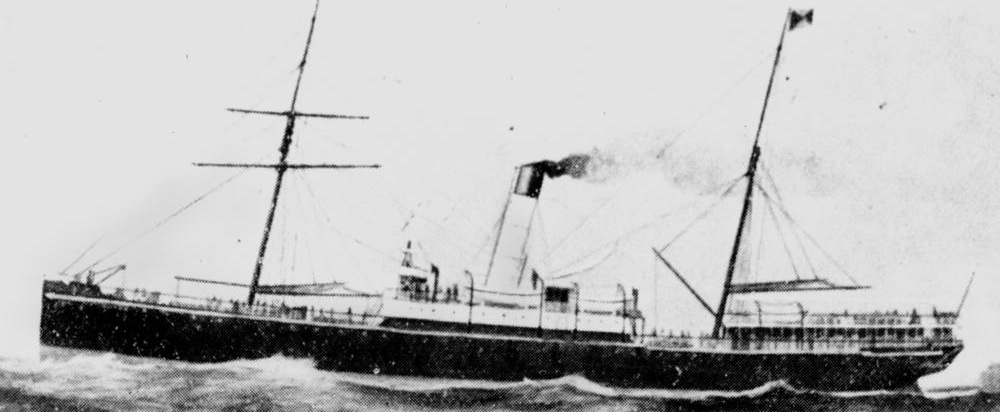
Of all my immigrant ancestors who came to Australia from Ireland, Scotland and England in the nineteenth century, surely the biggest decision was made by the biggest family – school Headmaster Edwin Hunt (Brother of Emma in the previous 52 Ancestors theme) and his wife Margaret Morgan, and eight of their ten children (two died earlier) in 1879. By then immigrant ships were vastly improved; Edwin and family traveled saloon class on the Aconcagua, a fast (and very big!) steamship. Even so it must have been a trying voyage which took 49 days (the earlier sailing ships usually took over 100 days).

A description of the ship says …”The first saloon is supplied with steam heating apparatus, and the arrangements generally (including smoking room, ice-house, &c) are such as to ensure the greatest comfort for an Australian voyage. Both first and second saloon cabins are furnished with every requisite, including bedding, linen, &c. A free table supplied daily with fresh meat, poultry &c, will be provided for each of these classes. An experienced surgeon and a stewardess will be carried. Fares from 15 to 70 guineas.” The ship was powered by two combination engines although she also used sails where there were advantageous winds.

The voyage was London to Plymouth then the Cape Verde islands, Cape Town (South Africa) nd via the Roaring Forties to Adelaide, Melbourne and Sydney. Some passengers continued on to New Zealand.

By an amazing coincidence I discovered a shipboard diary written by one of the New Zealand passengers, in a NZ Library. Although it did not specifically mention the Hunt family, there were references to children, and the many trials and tribulations of the long ocean voyage.


52 Ancestors …Week 7, 2026

Theme: What the Census Suggests.

My Great Great Aunt Emma Hunt, born 1829 in Reading, Berkshire, was the fourth child and only daughter who stayed in England – three of her siblings emigrated to Australia and one brother is thought to have gone to America.

The 1851 England & Wales Census shows Emma, aged just 21 and head of the household, a milliner and dressmaker, living at Ing Court, Reading, with her younger brother Edwin aged 14, a ‘teacher at a charity school’ and a very young Helena E Hunt aged 1, her ‘daughter’. (A surprise!). Her father had died in 1848 and her mother Ann (Nancy) was living with a family with 4 young children on Census night in 1851. She is listed as a Nurse; there was also a Governess and a servant. An older sister was also working as a Nurse with another family.

The child Helena enabled me to identify Emma’s family – she married Joseph Waugh on November 18 1855 in Reading. Joseph, a gas fitter, was still living with his parents and younger siblings in 1851, at an address in St Marys, Reading – very close to Emma. By 1861 they were living together; by now Joseph was a shoeing smith, and besides their listed daughter Ellen aged 11 (thus born in 1851) there were two younger children. They were to go on to have nine children, including another daughter before their marriage. Subsequent Censuses gave Helena’s middle name as Ellen, which fits with the one-year-old Helena E. Hunt.

52 Ancestors … Week 6.

Topic: Favourite Photo.

This is the only photo I have of my Grandfather Alex Johnston (1868-1952), indeed the only known photo of him at all. A very private man, he reluctantly succumbed to the pleas of his granddaughter when I was about 10 and armed with my first camera, a Baby Brownie box camera with a very simple shutter mechanism. Also in the photo are my father and brother – and again, this is the only photo of all three of them together, so doubly precious.

Granddad was an extraordinary man. Born in Tasmania, Australia to immigrant Scots, he travelled extensively when young, making several trips to to the Far East and Japan in between working as a newspaper reporter on the Western Australian goldfields and in Melbourne, painting exquisite watercolours and playing the violin “like a young Joachim” according to a tiny newspaper cutting which I miraculously discovered concealed between the pages of one of his books. (No, NOT Joaquin Phoenix! The name, a Spanish evolution of a Hebrew name, means ‘lifted by God/Yaweh’ with connotations of divine favour, strength and stability; in 1899 the reference was probably to Joaquin Rodrigo, a Spanish composer and pianist.)

My father in contrast was a quiet man who had no desire to travel and was content to spend long summers on the beach with his children. Like his father he did however have an enquiring mind and was a wonderful life teacher.

My brother was different again – a gregarious man who enjoyed talking about himself! Not interested in journalism or anything resembling it, not an artist, not very musical ….

%2 Ancestors – Week 5, 2026.

Topic: A Breakthrough Moment.

I wasn’t getting very far with my wider Glasgow-based Johnston famiiy. Census entries were useful but not always to be trusted, with multiple common names like Charles, George, Peter and Mary.

I had established that my GGGF Charles Johnston was born in 1797 and died in 1848, and that he married Mary Learmonth in Glasgow. They had seven children including Charles b. 1817, plus George, Peter, Robert, Alexander, John and Mary. The elder Charles died in 1848 aged 56; he did not leave a will but I discovered a huge legal document signed by two of his sons and his wife, who ”… entered upon the management of the deceased’s personal Estate”. So I can be certain of his date of death.

I knew Charles was buried in the Southern Necropolis, Glasgow. So I contacted the Necropolis office in the hope that some more information would be forthcoming. It was!

they told me that either Charles or his son a younger Charles (born 1817) was the registered owner of a lair (grave), and there was a huge tombstone … (Incidentally I am very lucky to have this photo as I’ve been told it has since fallen over).

Curiously the top portion is engraved IS … 42 (Isaiah 42?). The property of Charles Johnston”. But which one? Charles Senior, born 1797, died in 1848; his son Charles (born 1817) and also his wife Isabella are known to have died before 1857. Their son, yet another Charles, was born about 1838 and died in 1857 – his death certificate says both his parents were deceased.

The monument has Charles’ name and two others. One is George Johnston (d. 1906), son of Charles and Isabella; the other is Jessie Johnston, who was George’s wife. The surprise was that another five people aged between 2 months and 82 years, who died between 1848 and 1935, were also interred in this lair according to the Necropolis office – who helpfully gave me full details of their names, death dates and ages.

With all these names and the certain knowledge that they were part of my wider family, I was able to expand my family tree. Modern-day DNA matching has turned up several distant cousins all easily traceable to Charles Johnston and Mary Learmonth.

As to why the second Charles and his wife Isabella were not buried there, I surmise that either there is another undiscovered lair nearby, which seems unlikely, or that they succumbed to typhoid or cholera and had to be buried quickly in a mass grave – there were known outbreaks in 1848 and 1853. Glasgow was desperately overcrowded at the time with fresh water and sewerage problems.

So although learning the names of the family members buried the lair undoubtedly gave me a breakthrough, it also raised some more questions.

(Amendment – after some discussion it is agreed the top of the tombstone is a biblical reference – Isaiah 52. )