52 Ancestors …. Week 16.

Theme: A Quiet Life.

My GGGF Dr. Thomas Lyle 1791-1859 may have sought a quiet life, but did not entirely succeed in this ambition.

Although described in the 1851 Census as “a Surgeon in general practice”, it appears certain from the numerous books and collections he left behind that he was far more interested in early Scottish music and songs, and in bryology (the study of mosses). Born in Paisley to a weaver family who may earlier have been farmers, his parents both died in their early 30s, leaving him with a elder brother John and younger sister Anne aged about five, three and one respectively. It is thought the children were brought up by relatives. John, initially a weaver, enlisted in the 91st Regiment of Foot and rose to the rank of Colour Sergeant, surviving Waterloo but defeated by yellow fever after a few months in Jamaica. Anne became a housekeeper to a wealthy Glasgow man. Thomas, who must have been the gifted one, was educated at Paisley Grammar School. He attended medical classes at Glasgow University. About 1815 he set up as a druggist in the High Street of Glasgow, and in 1817 he was licensed as a surgeon by the Faculty of Physicians and Surgeons of Glasgow.

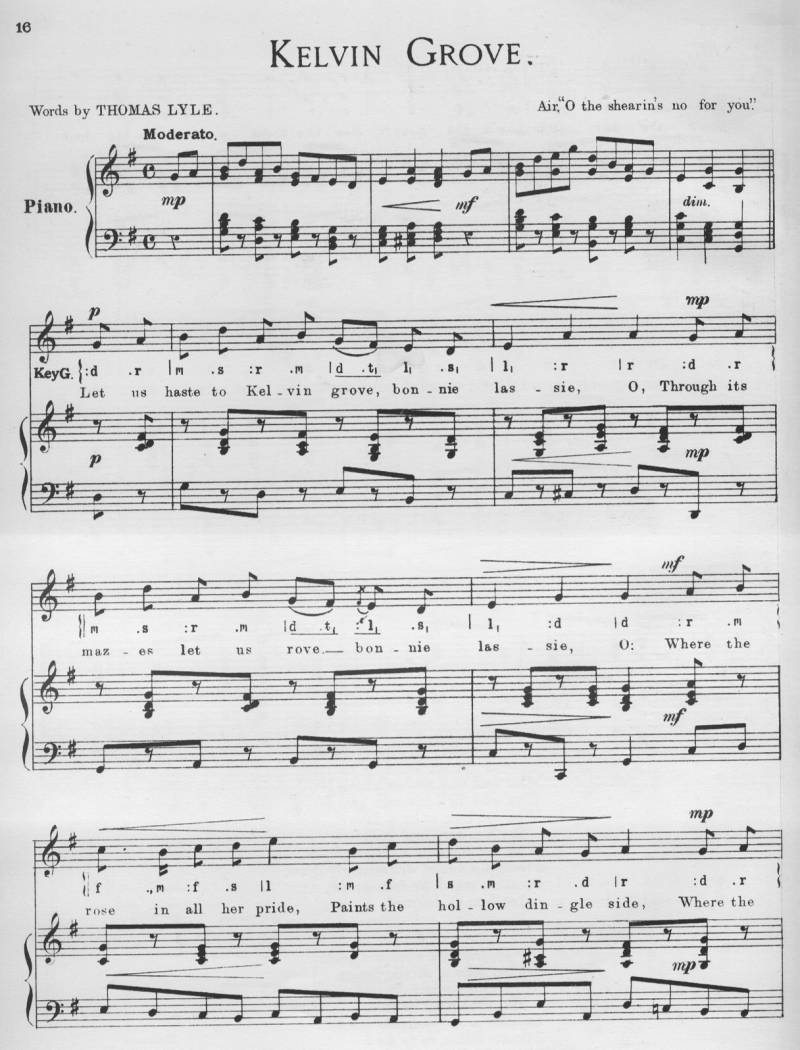
According to the Oxford Dictionary of National Biography, Lyle “… seems not to have enjoyed much success as a doctor. He was of a retiring disposition, happiest on botanical excursions, collecting old ballads, or writing verse for his own amusement… (He) was the author of several lyrics, but is remembered solely for the beautiful song ‘Let us haste to Kelvin Grove, bonnie lassie, O’ first published anonymously in the ‘Harp of Renfrewshire’ in 1820. Lyle contributed to RA Smith’s ‘Irish Minstrel’, and edited ‘Ancient Ballads and Songs’, London 1827. The latter work contained several of his own songs, including a version of Kelvin Grove somewhat different from the original..”
Dr. Thomas Lyle married Margaret Cochrane in Glasgow on 30 May 1821. They had four children in Glasgow then about 1830 the family moved to Airth in Stirlingshire – a Royal burgh and village on the River Forth, near Falkirk. (Incidentally, the Airth graveyard includes a number of cast iron ‘mortsafes’ – large coffin-shaped containers used to thwart the body snatchers of the early 19th century. Dr. Lyle would almost certainly have honed his surgical skills on such bodies in Glasgow some twenty years earlier). The origins of Airth go back to the 12th century and Airth Castle has been the site of many battles and skirmishes over the centuries.
At least three more children were born in Airth. A slightly earlier one died as a baby – he may have been the reason the family moved from Glasgow. The family stayed in Airth for many years. The Censuses show them still there in 1851 but by then all children had left home apart from the eldest boy who seems to have been his father’s assistant. Surprisingly, all the children had to earn a living – the two youngest girls were both cap makers in Glasgow before emigrating – separately – to Australia.

Why did they move to Airth? According to the current Airth Parish Community Council, the parish of Airth “… covers approximately 5500 acres of predominately good agricultural land with some woodland at Dunmore Park and around the famous Airth Castle. There is a working peat moss of around 500 acres to the west of Letham village. Part of this moss lies within the Parish boundary.” (Robert Smith). Thomas did practice in Airth, and seems to have taken part in village life as he signed the Census forms for a number of Villagers.The population in 1841 was 850. (In 2026 there is a single Medical Centre). But mosses seemed to have been his first love. He does not seem to have provided particularly well for his children.
Lyle maintained a voluminous correspondence with Mr. William Wilson of Manchester (1799-1871), a world authority on mosses. A hand-bound volume of the collected letters from Mr. Wilson covering the period 1849 and at least 1854 (the date on the last collected letter) are in my possession. Also a treasured book of watercolours of mosses, meticulously catalogued.
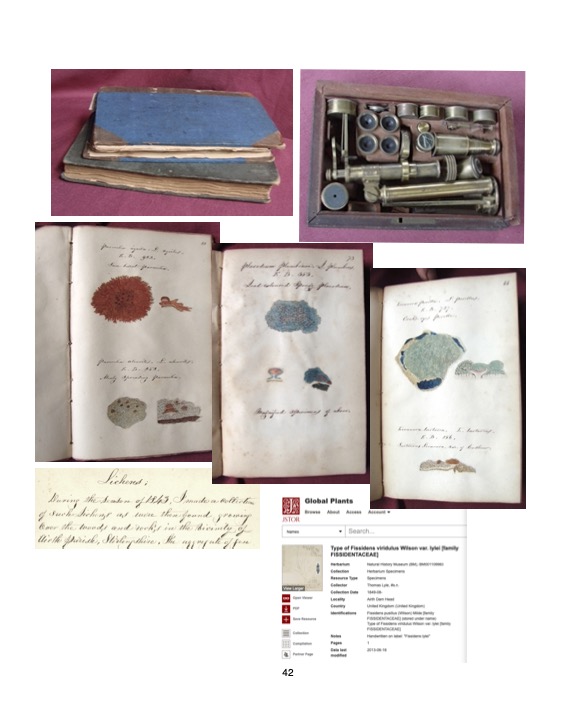
Dr. Thomas Lyle is listed in Desmond’s Dictionary of British and Irish Botanists and Horticulturalists (2nd Ed., 1994); and a collection of Lyle’s correspondence and some mosses are in the collection of Wilson correspondence at the Natural History Museum in London, and some plants at the Paisley Museum.

It would seem, if Lyle did indeed move to Airth for “a quiet life” involving roaming the countryside collecting mosses and perhaps doing a little doctoring, to some extent he succeeded. But – as poignantly indicated in a letter from Wilson dated 18 October 1853:

(after some bryological correspondence – a new paragraph, fresh pen)
If you must needs go to Glasgow, I sincerely hope that you will succeed in the attainment of your moderate wishes, and escape from the pestilence that you go to withstand – I shall rejoice if this revolutionary event of your life shall be productive of good to you and your wife – Whether we shall ever meet face to face, now that you are coming more within reach, is uncertain – I have still a load of toil before me and my health is quite precarious, not to mention my eyesight …

Then on 9 March 1854:
My dear Sir,
You have often been in my thoughts and I had fully intended to write to you on the day that I received yours informing me of your loss – it is a relief, I trust, both to yourself and to your departed wife (who must have suffered much under the protracted and hopeless illness) that she is gone to her rest. I trust also that you will have all the consolation which you need, in this your bereavement. The parting is a solemn event, and must have caused deep exercise of thought and feeling….

There was an epidemic of typhoid in Glasgow in the 1850s – possibly the pestilence referred to. It was indeed the cause of Lyle’s death in 1859.


52 Ancestors …. Week 15.

Topic: Unexpected.

I wrote some years ago: “I have learned …. Following new leads in the quest for further facts may sometimes lead down new and intriguing pathways, not always to the expected destinations. And on the way, it’s not wise to push seemingly irrelevant information to the wayside. One day, suddenly, it may all fit in.” This is a condensed version of an earlier research article.


My great great uncle Robert Wentworth Wade was the Mayor of Hokitika on the West Coast of New Zealand in 1892 to 1894, and a Councillor for several years on either side of those dates. I knew he had married an Irishwoman, Kate Behan, although it was some years before I found the actual record of their marriage. Having a reasonable amount of information about Robert, I decided to investigate Kate a little further.

Eventually I found their marriage certificate which showed that Miss Behan was the niece of one of the town’s leading doctors, Dr. Rossetti. It also told me that Catherine (Kate) Behan was born in Ireland to Peter Behan, a farmer, and Bridget O’Grady. Knowing the difficulty of searching Irish records, I wondered if Dr. Rossetti could lead me to discover more about Kate’s origins.
A database of early NZ doctors showed me that Dr. Francesco Rossetti was born in Switzerland and graduated MD from Pisa, Italy, in 1850. He emigrated to Australia and was practising as a doctor in Hepburn, Victoria, in 1865. He was deleted from the Victorian register in 1866 and registered as a doctor in Hokitika, NZ, in the same year on 22 June, then registered again under a later Act in 1868. He was naturalised in NZ on 21 January 1870, appointed the Italian consular agent in Hokitika 31 March 1870, and the public vaccinator for Ross (close to Hokitika) in 1897. He died in Hokitika on 11 July 1904 ‘aged 73’ (actually 79, from his gravestone, therefore born about 1835). His will was accessible and a cemetery list showed both him and his wife Catherine who died in 1889 aged 66. All easily verifiable facts.

I had high hopes of obtaining more information from Dr Rossetti’s will but it was a disappointment. He left his entire estate to four nieces, three in Ticini, Switzerland and one in Paraguay.

Mention of Dr Rossetti practising briefly in Hepburn, Victoria sent me off on another path in the quest for information about Kate. I searched the Australian records for a Rossetti-Behan marriage without luck, and then started to look further afield. It did not take long to find Rossetti-Maher and Maher-Behan marriages, although not in the same generation, and the exact link remained obscure. Guiseppe Rossetti, born in Switzerland, married Ellen Maher and they lived in Hepburn. Was he Dr. Francesco’s brother or cousin?

Australian records also showed that Kate had an elder sister … I felt I had sorted out the Behan sisters satisfactorily, if not their relationship to Dr. Rossetti and his NZ wife, another Catherine.

Complications arose when I was sent an entry from a book by Joseph Gentilli about the early Ticinese immigrants to Australia – a story in itself. It listed seven Rossettis all from Biasca, Ticini including Guiseppe who married Ellen Maher; and – to my surprise – a Dr. Francesco Celeste Rossetti who had married Honora Quinn and had 5 children in the Hepburn-Queenscliff area between 1868 and 1878. It further said that Dr. Rossetti was born in Biasca in 1835, emigrated to Australia on the ‘Chusan’ in 1853, was a hotel and storekeeper in 1855; naturalised in Australia in 1861; Hon. Surgeon at Daylesford hospital; at Hokitika NZ in 1885 (?); and owned a restaurant in Geelong, Victoria in 1891. It did not list his death. Was this actually the same man?

That Dr. Rossetti was in the Hepburn-Daylesford area at one time is undisputed. He is mentioned in Cheda’s book L’emigrazione Ticinese in Australia, published in Switzerland over 20 years ago:
“Among the Swiss-Italians involved in supporting the Daylesford hospital in its earliest days was Dr Rossetti, one of the area’s first physicians.”
Gold mining provides the link between Hepburn and Hokitika. Most of the Ticinese immigrants were miners and when the gold became scarcer some were doubtless attracted to the rich new field across the Tasman. A wealthy Dr. Rossetti could conceivably have popped over from time to time to ‘visit’ his countrymen.

At this point there seemed to be two possible explanations:
Dr. F Rossetti and FC Rossetti were one and the same person. If all records were correct then he would have had to move back and forth between Victoria and NZ for many years, practise medicine only in NZ, be appointed Italian consular agent in NZ the same year his wife had a baby in Victoria, and finally settle in NZ with a second wife. But what happened to the first wife and all the children, not mentioned in his will in NZ? Why was his middle name not given in any NZ official records? It did not seem possible.

Or were they two different people, born about the same year in the same village of Biasca. One a Doctor and one a storekeeper-restaurateur. From various websites I discovered that the Ticini area of Switzerland was a wild mountainous place and whole villages could consist of only one or two surnames. Six Rossetti males had all emigrated from Biasca alone in one year – and not all of them were listed in Gentilli. That was not a concern – it was known that many did not stay more than a short time before returning home, or moving elsewhere. The same pattern occurred in America. But then where was FC Rossetti’s death and what happened to his wife Honora?

The arrival of Catherine Rossetti’s death certificate put an end to these speculations. What a wealth of information is contained in a NZ certificate! She was born Catherine O’Grady, in Newbridge, County Kildare, sister to Bridget O’Grady the mother of Kate and Bridget Behan.

Catherine married an F. Rossetti in Geelong, Victoria when she was 31, that is in about 1853 – the same year in which Dr. Francesco Rossetti is believed to have arrived in Australia. By the year of her death, Catherine had been in New Zealand 23 years, which agrees with the year Dr. Rossetti is known to have arrived in Hokitika – 1866. There was no living issue.

So – there were definitely TWO Francesco Rossettis. One a Doctor and the other most likely without medical qualifications. It is confidently expected that any further information such as that contained in NZ and Victorian electoral rolls will support this conclusion.
Robert Wentworth Wade the Mayor of Hokitika in New Zealand married an Irishwoman – but the pathway to discovering who she was and where she came from was not as straightforward as expected. It led me through a remote alpine village in Switzerland and the goldfields of Victoria, with many interesting discoveries along the way.

52 Ancestors …. Week 14.

Topic: A Brick Wall Revisited

Isabella Johnston, my 1C2R, a descendant of my GGF’s elder brother, was born about 1847 in Glasgow. Her father Charles Johnston (1817- d.before 1857) married Isabella McFarlane (b. abt 1819 – d. bef 1857) on 20 Nov 1837 in Glasgow. They had six children including Isabella. I could not find any precise dates for either her mother or Isabella herself, nor in fact the dates for any of the other five siblings. But I did find some Census entries. They show that all children were born in Glasgow.

By 1861 the family dynamics had changed. The parents had both died, probably due to typhoid, cholera or dysentery. Isabella and two of her siblings were living with their unmarried Aunt Mary and Uncle Robert in Glasgow. Isabella was still with her Aunt (by then married) in 1871, and she continued to live with them until at least 1891. By then she was aged 42, an unmarried waitress. I had not been able to trace her any further.

So now, under the impetus of this 52 Weeks quest and the knowledge that there were many more entries in ScotlandsPeople, I returned to the search – and soon discovered Isabella’s death record – she died aged 76 and she had a husband named Balfour McGregor. Scottish death certificates are very informative and confirmed that her parents were Charles Johnston and Isabella McFarlane.

Back to the 1911 Scottish Census and there she was aged 60, with husband Balfour McGregor, a brass finisher/Labourer aged 58, duration of marriage 22 years??? (most likely a typo – actually 12 years as discovered later.) Living with them in Glasgow was an English-born schoolgirl named Kate McIntosh aged 4 and a lodger also born in England.

On to the 1921 Scottish Census which gave them at the same address as on her death certificate, but with a new surprise – a daughter Catherine aged 20½, born in London. Isabella would have been aged 52 then so perhaps Catherine was Balfour’s daughter but not hers – and most likely the Kate McIntosh of the 1911 Census.

Balfour’s identity is not in question. He was born in Anderston, Glasgow in 1858. Was Balfour married before? Could Catherine have indeed been Isabella’s daughter …? I cannot find any marriages for her, to either Balfour McGregor or an earlier McIntosh. And what happened to the daughter? Questions for more research! But I am happy that I have progressed well beyond that earlier brick wall.