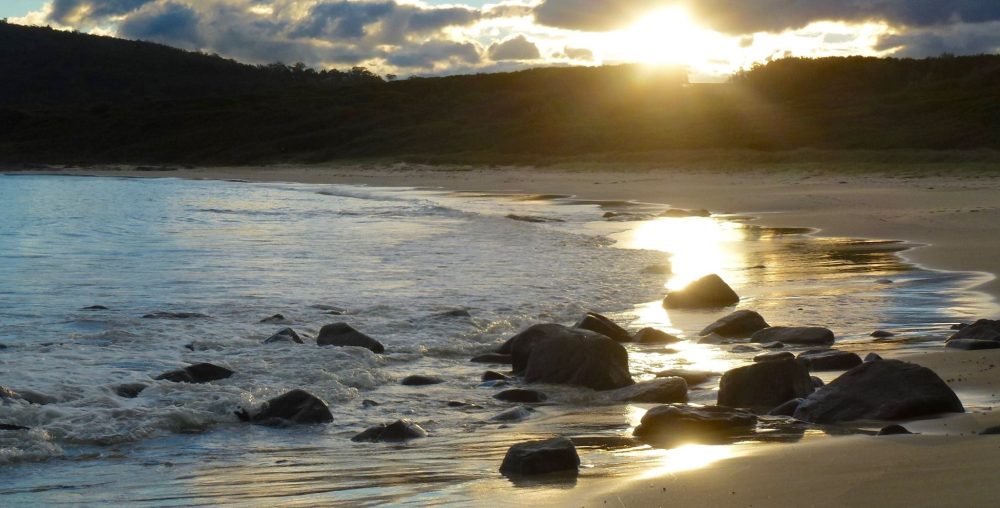
Theme: A Quiet Life.
My GGGF Dr. Thomas Lyle 1791-1859 may have sought a quiet life, but did not entirely succeed in this ambition.
Although described in the 1851 Census as “a Surgeon in general practice”, it appears certain from the numerous books and collections he left behind that he was far more interested in early Scottish music and songs, and in bryology (the study of mosses). Born in Paisley to a weaver family who may earlier have been farmers, his parents both died in their early 30s, leaving him with a elder brother John and younger sister Anne aged about five, three and one respectively. It is thought the children were brought up by relatives. John, initially a weaver, enlisted in the 91st Regiment of Foot and rose to the rank of Colour Sergeant, surviving Waterloo but defeated by yellow fever after a few months in Jamaica. Anne became a housekeeper to a wealthy Glasgow man. Thomas, who must have been the gifted one, was educated at Paisley Grammar School. He attended medical classes at Glasgow University. About 1815 he set up as a druggist in the High Street of Glasgow, and in 1817 he was licensed as a surgeon by the Faculty of Physicians and Surgeons of Glasgow.
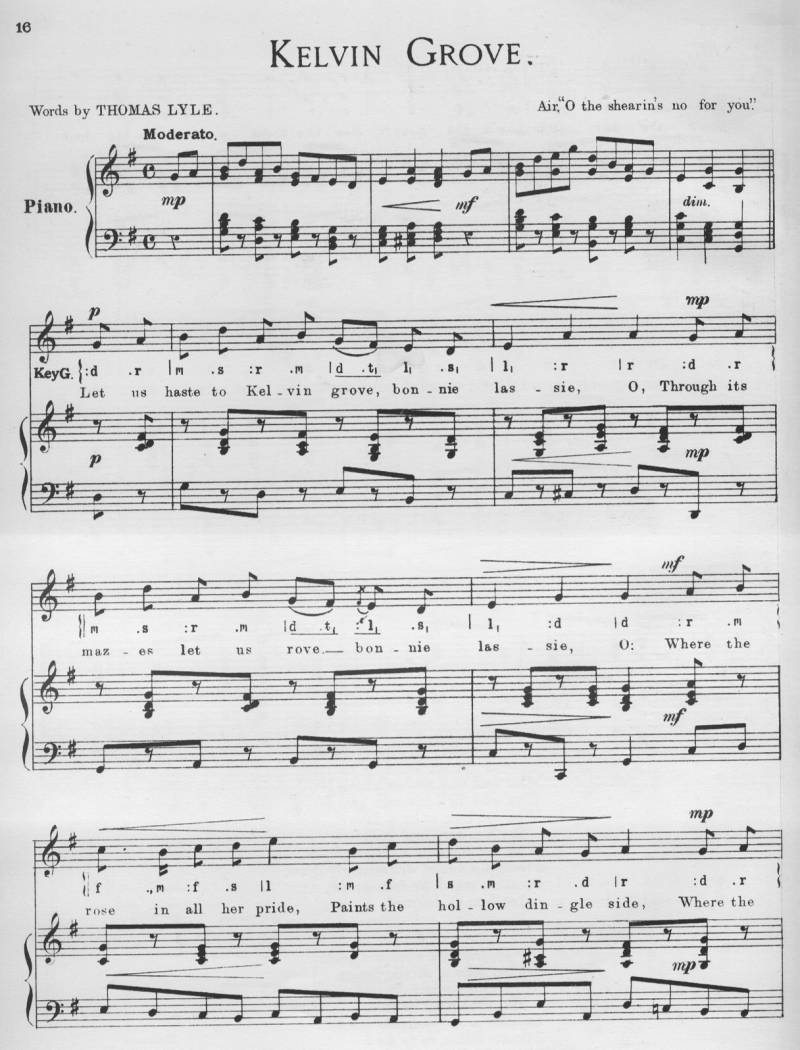
According to the Oxford Dictionary of National Biography, Lyle “… seems not to have enjoyed much success as a doctor. He was of a retiring disposition, happiest on botanical excursions, collecting old ballads, or writing verse for his own amusement… (He) was the author of several lyrics, but is remembered solely for the beautiful song ‘Let us haste to Kelvin Grove, bonnie lassie, O’ first published anonymously in the ‘Harp of Renfrewshire’ in 1820. Lyle contributed to RA Smith’s ‘Irish Minstrel’, and edited ‘Ancient Ballads and Songs’, London 1827. The latter work contained several of his own songs, including a version of Kelvin Grove somewhat different from the original..”
Dr. Thomas Lyle married Margaret Cochrane in Glasgow on 30 May 1821. They had four children in Glasgow then about 1830 the family moved to Airth in Stirlingshire – a Royal burgh and village on the River Forth, near Falkirk. (Incidentally, the Airth graveyard includes a number of cast iron ‘mortsafes’ – large coffin-shaped containers used to thwart the body snatchers of the early 19th century. Dr. Lyle would almost certainly have honed his surgical skills on such bodies in Glasgow some twenty years earlier). The origins of Airth go back to the 12th century and Airth Castle has been the site of many battles and skirmishes over the centuries.
At least three more children were born in Airth. A slightly earlier one died as a baby – he may have been the reason the family moved from Glasgow. The family stayed in Airth for many years. The Censuses show them still there in 1851 but by then all children had left home apart from the eldest boy who seems to have been his father’s assistant. Surprisingly, all the children had to earn a living – the two youngest girls were both cap makers in Glasgow before emigrating – separately – to Australia.
Why did they move to Airth? According to the current Airth Parish Community Council, the parish of Airth “… covers approximately 5500 acres of predominately good agricultural land with some woodland at Dunmore Park and around the famous Airth Castle. There is a working peat moss of around 500 acres to the west of Letham village. Part of this moss lies within the Parish boundary.” (Robert Smith). Thomas did practice in Airth, and seems to have taken part in village life as he signed the Census forms for a number of Villagers.The population in 1841 was 850. (In 2026 there is a single Medical Centre). But mosses seemed to have been his first love. He does not seem to have provided particularly well for his children.
Lyle maintained a voluminous correspondence with Mr. William Wilson of Manchester (1799-1871), a world authority on mosses. A hand-bound volume of the collected letters from Mr. Wilson covering the period 1849 and at least 1854 (the date on the last collected letter) are in my possession. Also a treasured book of watercolours of mosses, meticulously catalogued.
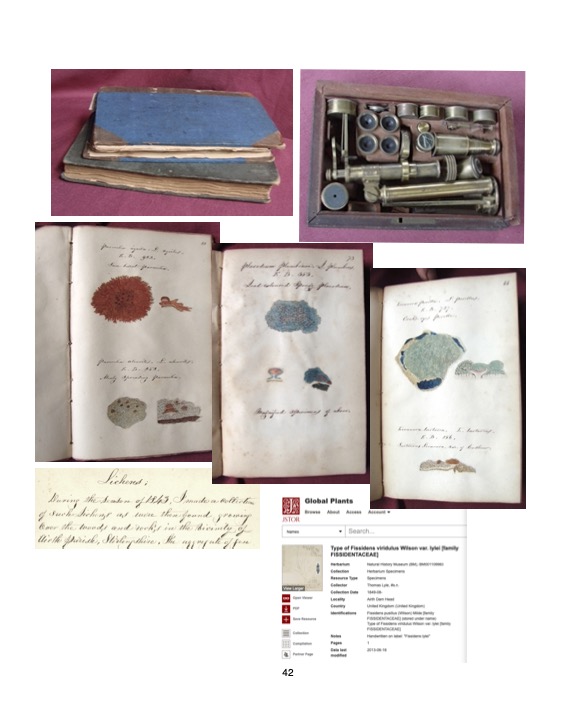
Dr. Thomas Lyle is listed in Desmond’s Dictionary of British and Irish Botanists and Horticulturalists (2nd Ed., 1994); and a collection of Lyle’s correspondence and some mosses are in the collection of Wilson correspondence at the Natural History Museum in London, and some plants at the Paisley Museum.
It would seem, if Lyle did indeed move to Airth for “a quiet life” involving roaming the countryside collecting mosses and perhaps doing a little doctoring, to some extent he succeeded. But – as poignantly indicated in a letter from Wilson dated 18 October 1853:
(after some bryological correspondence – a new paragraph, fresh pen)
If you must needs go to Glasgow, I sincerely hope that you will succeed in the attainment of your moderate wishes, and escape from the pestilence that you go to withstand – I shall rejoice if this revolutionary event of your life shall be productive of good to you and your wife – Whether we shall ever meet face to face, now that you are coming more within reach, is uncertain – I have still a load of toil before me and my health is quite precarious, not to mention my eyesight …
Then on 9 March 1854:
My dear Sir,
You have often been in my thoughts and I had fully intended to write to you on the day that I received yours informing me of your loss – it is a relief, I trust, both to yourself and to your departed wife (who must have suffered much under the protracted and hopeless illness) that she is gone to her rest. I trust also that you will have all the consolation which you need, in this your bereavement. The parting is a solemn event, and must have caused deep exercise of thought and feeling….
There was an epidemic of typhoid in Glasgow in the 1850s – possibly the pestilence referred to. It was indeed the cause of Lyle’s death in 1859.

