52 Ancestors ….

Theme: What Wasn’t Written Down

This story follows directly from the previous week’s theme.

Actually “it” WAS written down but has never been found.

When the young Thomas Darchy was collected from his Guardian Dr. Sacc in Neuchatel in 1829 by Julius Charles Hare, ostensibly to be returned to his mother’s family in England, Hare was also handed a mysterious sealed package which was labelled “Not to be opened except upon the death of Mr. Broadfoot.” Broadfoot was the original Guardian of the child, present at his baptism and authorising his transfer to the care of Dr. Sacc.

If only that package had been retained! It almost certainly would have solved the mystery of Thomas’ birth. Who were his parents? Why all the mystery and subterfuge? Despite years of research by various persons including myself, no clear explanation has ever been found. It is not with the estate papers of Dr. Broadfoot, who died in 1837, nor with any of the voluminous papers of Julius Charles Hare.

The early existence of such a package is not in doubt. It is mentioned in a long legal document. The relevant part, as translated into English, reads:

“On his side the aforementioned Dr Sacc having perused the documents produced by the Bearer (ie Hare) and compared it with his correspondence and with the document in the same hand and recognised the writing and the signature of Mr Alexander Broadfoot as well as his seal …. And in no way doubting the reality of Mr. Charles Hare’s mission …. He sends back with him in all good faith the aforesaid Thomas Darchy to bear him to his destination according to the instructions he has received on this matter, and adds for him (ie Darchy) sincere good wishes for his happiness.

“Then … Mr Charles Hare acknowledges this action in the name of his client and in his own name. He guarantees the said Dr. Sacc from all other charges in the matter of the said child by giving to him this paper in full and entire discharge for and against any future claim (he having) besides received with the said child his original Baptismal Certificate as well as a packet with an unbroken seal which was given to him by Mr Broadfoot which bears the inscription ‘Not to be opened except upon the death of Mr Broadfoot’. In support of this action the parties have had the present document drawn up …. They renounce everything which might affect its validity, or obligation on their property now or in the future. “
52 Ancestors …. Week 38, 2026

Topic: A Document with Personality.

I have a mysterious GGGfather named Thomas Darchy, born in February 1820, who as a young boy was under the care of a guardian, a Dr. Sacc, in Neuchatel, Switzerland. Dr. Sacc in turn had been authorised by a Dr. Broadfoot, a Scottish Army doctor on half pay, apparently acting for the mother’s family. In 1828 when Thomas was approaching ten years of age Dr. Sacc was ordered to hand him over to another person sent from England to collect him. This person, Julius Charles Hare, had links to English nobility and was quite well-known in Ecclesiastical circles, being a Fellow of Trinity College, Cambridge between 1822-1832 and then Rector of Herstmonceux Castle, East Sussex. He was known as a ‘most erudite English scholar’ who took in pupils to cram for university. He was also said to be of a romantic and helpful nature, and perhaps somewhat unworldly.

In other words the ideal tutor/companion to the young Thomas Darchy whose early language would have been Swiss-German possibly plus some French.

A legal document was drawn up in London on 12 September 1828 by a French clerc (notary) between Broadfoot and Hare. A passport was issued to Hare, acting on behalf of Broadfoot, by the Ambassador of His Majesty the King of the Low Countries – which was puzzling as Hare was a British subject and a respected member of the prestigious Trinity College. It was used as proof of Hare’s identity and is mentioned in another legal document. I have copies of all these documents except the passport.

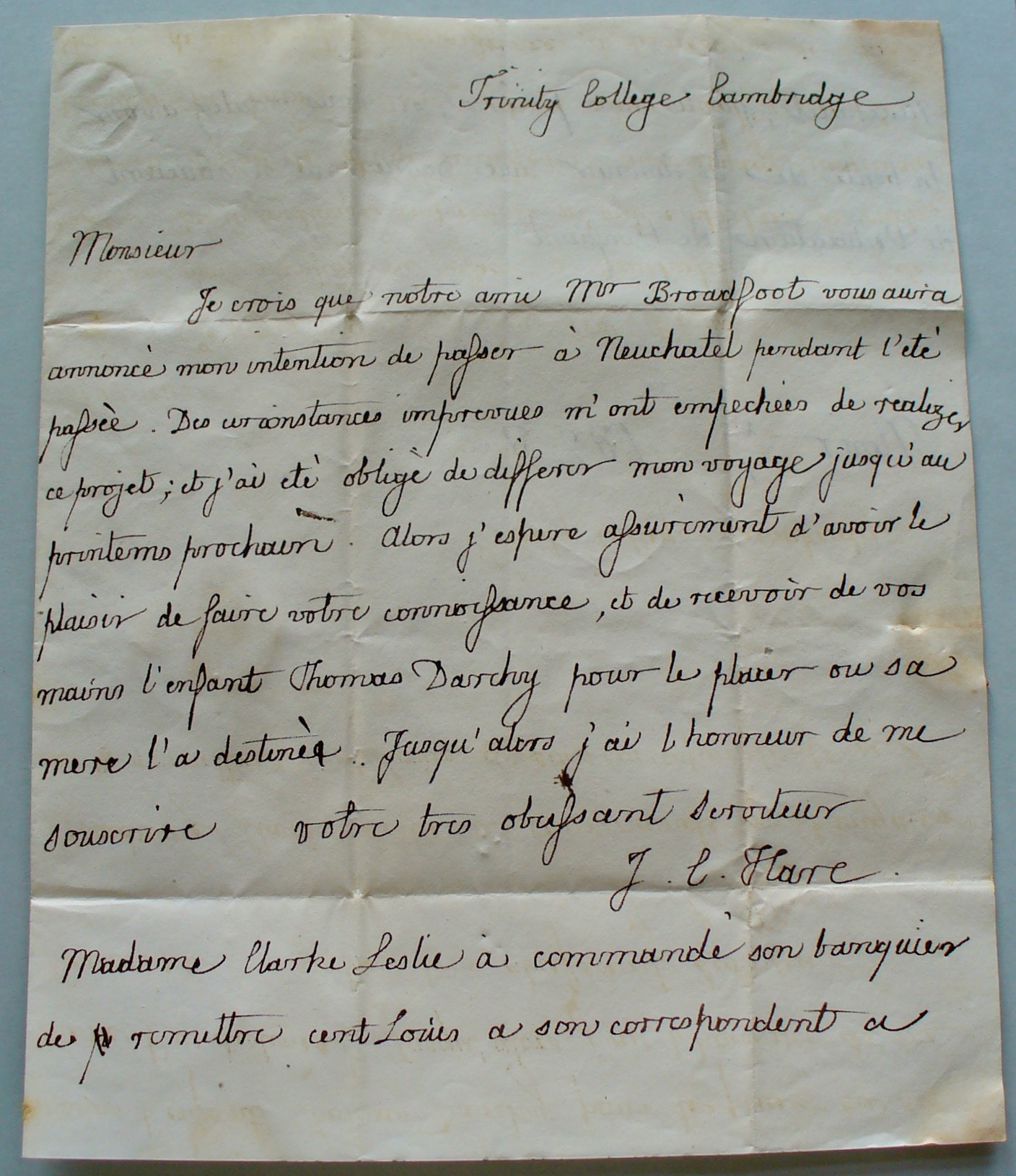
The “document with personality” however is a letter which Hare wrote to Dr. Sacc on 7 Nov 1828. It is in French, in a curiously schoolboyish hand, and the translation is:

Monsieur,
I think that our friend Mr. Broadfoot has told you that I intend to go to Neuchatel during the summer. Unforeseen circumstances prevented me from carrying out this project, and I have been obliged to postpone my journey until (the) next spring. Then I hope to have the pleasure of your acquaintance and of receiving from your hands the child Thomas Darchy to place him where his mother has destined him. Until then I have the honour to be your obedient servant.
J.C. Hare.

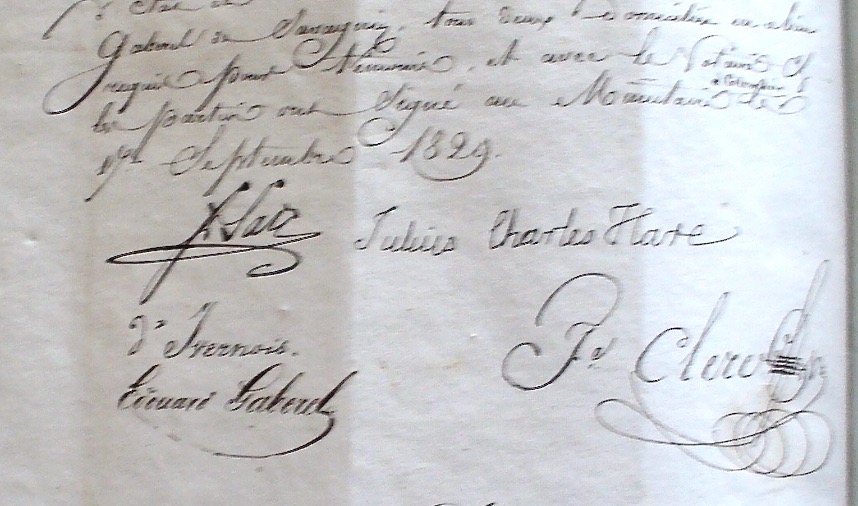
Thomas Darchy was indeed collected by Hare, as attested by yet another document dated 17 Sept 1829. But after that date his whereabouts still remain unknown until he turned up on board a sailing ship in Australian waters, aged 20, a wealthy young Englishman with a mysterious past.

52 Ancestors … Week 35.

Theme: A Spot on the Map. (I have been unable to keep up with the weekly stories.)

Airth, Stirlingshire, Scotland. The name Airth comes from the Gaelic Aird meaning a height or a hill, where the original village stood.

Airth was once a Royal Burgh; it is 6 miles (10 km) north of Falkirk town on the banks of the River Forth. A Royal dockyard was created on the banks of the river in 1506 and was used to build and refit early Ships of War. The shipping fleet was destroyed in 1745 by Bonnie Prince Charlie, which curtailed Airth’s further development as a port.

The earliest part of Airth Castle dates from the late 15th century; it is now a hotel. There is also a ruined parish church dated to the 12th century. There are several interesting grave inscriptions inside the church and many grave markers in the extensive graveyard.These include three cast iron mortsafes dating from the body snatching days.

My GGGFather Dr. Thomas Lyle lived in Airth between about 1830 and 1853. He trained in Glasgow, studying anatomy, surgery, chemistry, medicine, midwifery and infectious diseases at Glasgow University. Quite possibly some of the anatomy lessons involved bodies obtained through the body snatchers! He practiced in Glasgow for a time, advertising as a surgeon in 1825.

Why move to Airth? As far as is known there were no relatives of Lyle or his wife in the area. The birth of his second stillborn son in Glasgow he attributed to his wife being exhausted from ministering to their eldest son Thomas, ill with an ‘intermittent fever’. Perhaps this prompted their move to the country north of Glasgow, a day’s coach ride away. Or more likely it was his desire to live in the country so he could more easily follow another of his interests, that of bryology. Also a quiet place where he could write poetry and study music. According to the British Dictionary of National Biography, Vol. 34, 1893: “(Thomas Lyle) was the author of several lyrics, but is remembered solely for the beautiful song ‘Let us haste to Kelvin Grove, bonnie lassie, O’ first published anonymously in the ‘Harp of Renfrewshire’ in 1820. Lyle contributed to RA Smith’s ‘Irish Minstrel’, and edited ‘Ancient Ballads and Songs’, London 1827. The latter work contained several of his own songs, including a version of Kelvin Grove somewhat different from the original.”

The 1841 Census for Stirlingshire showed the family living in Airth Village. Thomas gave his age as 45 and his wife’s as 40; the children’s ages were given as 15, 14, 13, 7, 6 and 4. Not all agree with birth entries in the family bible, but were probably rounded up – Thomas was closer to 50 and his wife to 44.

By 1851 however the family was scattered. Thomas (“Surgeon in General Practice”) and Margaret were still in Airth, together with the eldest boy Thomas aged 27, “Assistant” presumably to his father. Dr. Thomas filled in the Census form himself and added the details of their two neighbours as well.

The other children were lodging in Glasgow and all were employed. Apparently doctoring in a village did not pay! More likely Thomas spent most of his time on his other interests. He maintained a voluminous correspondence with a noted expert on Bryology, and we know from the letters he received in return that he eventually returned to Glasgow for the sake of his wife’s health. She died a year later in 1854; Lyle died in 1859 from typhus which was endemic at the time.