52 Ancestors …. Week 48.

Theme: Troublemaker.

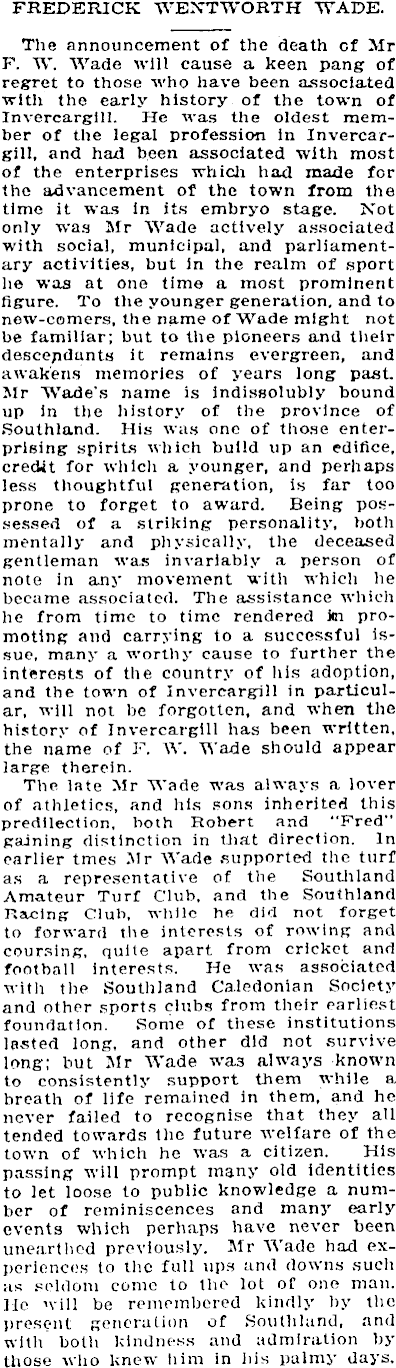
One definition of Troublemaker is ‘Someone who thrives on conflict’. That would be my Great grandfather Frederick Wentworth Wade, a barrister and solicitor. He was born in Dublin, Ireland on 23 September 1838 to schoolteacher Robert Wentworth Wade and his wife Annie Gibbons, who were married clandestinely (without parental approval) in Dublin by a German Lutheran priest (Oh the joy when I finally found their marriage!)

Frederick was the 5th of nine children and probably left home at an early age to seek fame and fortune. It is thought that he joined the navy or merchant navy but no specific record can be found. He turned up in Melbourne, Australia about 1859, working for a firm of accountants. He was said to have had a remarkable faculty for dealing with figures. In 1862 he went to Invercargill at the bottom of New Zealand, initially working as a clerk and then partner/ accountant, but very soon he was a law clerk and eventually gained his creditations as a barrister and solicitor in 1869. He set up a practice in Invercargill and remained there to the end of his days.

One of his obituaries described him as having been associated with most of the enterprises which made for the advancement of the town from the time it was in its embryo stage.

He made the news every now and then and was not free from litigation himself. Some of his cases attracted much attention. One of his last cases in 1909 involved a sad tale about the spread of scarlet fever. This case was eerily prescient of the spread of Covid in 2020 – he defended the charge that a man had failed to give notice to the District Health Officer that his daughter was sick with an infectious disease – scarlet fever. Wade explained that while his client admitted the facts, there were mitigating factors. The man’s daughter had been ill a few days previously with a cold and when she became ill again it was thought the cold had returned; it was actually scarlet fever but the man had no medical knowledge. The man’s two daughters had continued to work in a milk factory as did their father, and a man employed to taste the milk became ill. The man’s son continued to attend school and a boy sitting next to him caught the fever and died. Result: the man was Fined one pound and ordered to pay costs of one pound 18 shillings.

In 1878 he defended a notorious wife murderer; an account of the trial said he ably defended the murderer but it was a hopeless case. (Many years later a film was made about it).

He was once charged with using insulting language to the Licensing Bench – “Before you separate, gentlemen, I would like to tell you, you have been guilty of wilfully, wantonly and deliberately inflicting gross injustice, and those of you who are in private business will particularly and individually suffer”. The defence said the words were used after the business of the committee had closed, and he was dealt with leniently, with a fine in default of 24 hrs imprisonment.

In another case he brought a charge against the local police Sergeant who called him a “pettifogging lawyer” while acting for an accused man. It was concluded the remarks were not addressed to the Bench and the case was dismissed with costs.

When Frederick died aged 73 in August 1912, one of the oldest practitioners of Law in the town, many fullsome obituaries appeared in the local newspapers.

52 Ancestors – Week 47.

Topic: “This Ancestor Stayed Home”.

Coming from eight separate lines of emigrants who arrived in Australia between 1806 and 1879 from Ireland, Scotland and England (plus one mysterious ancestor with possible Prussian/French blood) I cannot think of an example who “stayed at home”. All the women seemed to have been adventurers to a greater or lesser degree.

However there was one Great Uncle who might qualify, in a way. He certainly WANTED to stay at home. Herbert William Hunt 1913-1937 was the seventh of eight children born to NSW country Bank manager Edwin Herbert Hunt and his wife Lillian Josephine Harrison. All his brothers were early businessmen. But Herbert, always known as “Wibb”, was a gifted musician.

He was only 24 when he died, some said of a broken heart because his father ordered him to work in the Bank while he only wanted to play the piano. (Actually he may have died of septicaemia following a throat infection.) His obituary says it all:

BRILLIANT YOUNG PIANIST PASSES – The Late Herbert Hunt
The musical fraternity and the district generally suffered a sad loss by the untimely death last
Sunday of Mr. Herbert William Hunt, aged 24 years, of Norfolk Road, Epping.
Although comparatively young in years, the late Herbert Hunt was definitely a figure in the
local musical world, and apart from being a keen and enthusiastic student of music, he was a
pianist of outstanding brilliance. When he appeared on all too few occasions at local musical
functions and recitals, his interpretations, particularly of Bach, his favorite composer, were such
as to stamp him as an artist of exceptional ability.

52 Ancestors …. Week 46.

Topic: ‘This ancestor went to market…”

Henry Prendergast was my Great Great Grandfather. Born in Tuam, Galway in 1813, he emigrated to Adelaide, Australia with his wife and nine children in 1854. It is not known what he did in Tuam before emigrating but once in Australia he soon became the first shopkeeper in the little inland village of Maude on the banks of the Murrumbidgee River in the sparsely settled ‘outback’ of NSW. His would have been the only store for many, many miles around. Occasionally either he or his eldest son would have had to travel to the nearest large town to stock up on supplies, most likely by riverboat or horse dray.


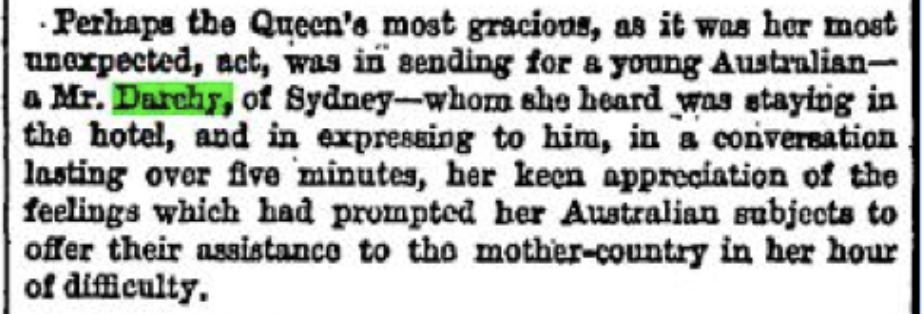
The town history shows it was established in approximately 1861 on a reserve made up of portions of land from two extensive sheep and cattle properties, one of which was originally established by one Thomas Darchy. Some doubts were expressed about the viability of a township so close to the river, but it went ahead. A store was erected and the following year a post office which Henry Prendergast operated. A hotel followed and a monthly Court of Petty Sessions was introduced a few years later. The licence for the hotel was transferred to another of Henry’s sons Patrick in 1864, and by 1865 John was the postmaster. Henry died in 1867. Many of his descendants still live in the district.


The store is still there today and is still the only little shop in the town.


Not-so-incidentally to this story one of Henry’s daughters, Margaret married John Stoddart in Melbourne in 1866 and bore him two children, but John died in 1875 and four years later Margaret married Frank Darchy, son of local magistrate and wealthy land owner Thomas Darchy. The marriage was frowned up on by the Darchys – Margaret was not only ten years older than her new husband, but she was a widow with two children, and worse still was of the wrong religion (!). But the marriage endured, four children were produced and I am one of the descendants. The photo below shows Margaret with her eldest son Frank Downs Darchy, his wife Lydia and various female relatives.

52 Ancestors – Week 45. Topic – Spirits. War and Peace.

(Unfortunately I was unable to complete Week 44 -Topic: Spirits).

My Great Great Uncle John Lyle 1789 – 1822 was born in Paisley, Scotland and died of yellow fever in Jamaica. At that time he was Colour Sergeant in the 91st Regiment of Foot.

The son of a weaver and farmer, he was initially a weaver but enlisted at Paisley on 24 August 1805 when he was 18. Scottish military records are very detailed – he was 5 feet 3 inches in height, which increased to 5 feet 7 inches in the next 6 years.; brown complexion, gray eyes, brown hair and a round face.

We do not know what caused him to enlist – perhaps he was bored, perhaps attracted by the enlistment bounty ….. He rose in the ranks quickly, becoming corporal a year after enlistment and Sergeant seven years later.

John fought at Waterloo – and survived.

He married soon after enlistment but his first child a son was not born until 1810 after the Regiment returned home on leave (?) after serving in the Peninsular wars against Napoleon for several years.
Did his wife followed the Regiment? Conditions would have been difficult even though as the wiie of a Sergeant she would have had some standing among the women. After Waterloo they remained in France for some years and in 1818 their third child was born in Valenciennes.

It is not known if John’s wife accompanied him when the regiment was posted to Jamaica in 1822, but John died there only 3 months later. The Regimental Returns for June-July 1822 show that following John’s death, a quite reasonable sum for those days was retained “. .. for the benefit of his three orphan children left with the regiment.” Despite searching for years I have been unable to determine the fate of the children.

A much fuller story is at https://nancyvada.me/john-lyle-of-the-91st-foot/

52 Ancestors … Week 43.

Topic: Dig A Little Deeper.

There is always a little doubt about the accuracy of on-line records. Are you CERTAIN you have the correct person? It is not always practicable to order certificates. You may think the record must be correct because it is an unusual surname – but I have found otherwise.

One of my Great Aunts, Margaret Hunt, married a Bill Wiblin/Wiblen. I soon found them and their family in Australian records. Seeking to expand the family tree I looked for Bill’s parents and discovered a huge number of Wiblin families all living in the same small country area in NSW. That rang some cautionary bells, but not quite strongly enough!

I was fairly certain I had Bill’s family correct. He had a large number of uncles, aunts and siblings, all of whose names and dates I noted and put in the family tree. There was a slight discrepancy about his birthplace but initially I put that down to a transcription error.

But something did not fit. Checking newspaper reports, birth records, etc it became obvious that I had the wrong family. It was not difficult to find the correct one, thankfully a little smaller! Then it became a task to delete all the incorrect family members from my on-line trees.

Lesson learnt – always check the facts and if something doesn’t agree – check again.

52 Ancestors – Week 42.

Topic: Friends.

Remembering that this is a Genealogical discussion: It is impossible to estimate the number of ‘friends’ I have made online – many of them distant relatives who are only too willing to exchange family information. Some are ‘mine’, some are my husband’s relatives. Many live in other countries. Some have remained correspondents for years; others for only a short time, but if something pops up – sometimes years later – that needs running past them, we often resume just where we left off. The inestimable value of the internet and email!

And then there are of course my personal friends – people I have known since childhood – not related but sharing other kinds of bonds. Distance often separates us and, sadly, old age is also making inroads now- so many have gone either physically or just mentally – shadows of their former selves. With those friends I share great memories. With my internet friends I share often valuable genealogical information which could not be obtained anywhere else.

52 Ancestors … Week 41.

Topic: TRAVEL.

My Great Aunt Margaret Anne Hunt, always known as “Maggie” , was born on 9 Sept 1864 in Reading, Berkshire and travelled to Australia with her family in 1879. She spent much of her early years in the shadow of her big sister Fanny, the first woman to gain a Science degree in Australia. Fanny started a girls’ school in Ipswich, outside Brisbane, Australia and Maggie, who as far as is known had no formal nursing training, became the school matron. Later Fanny started another school in Toowoomba, Queensland which she named Girton after Girton College at Oxford. Maggie was again the matron.

In an interesting twist of fate the building which housed Girton was later taken over by a Mr. Ernest Gill who started a boys’ school there in 1910. His wife was Isabella Griffiths, daughter of AL Griffiths of the Griffiths family which founded the Toowoomba Foundry.

In 1911 Maggie married wealthy George Washington Griffiths, almost certainly the brother of AL Griffiths. She was 47 and he was 67. They were great world travellers and made one or more voyages to England via the newly-opened Suez Canal. It is said they crossed the Alps in a De Dion motorcar, saw a ‘flying machine’ (airship) over Lake Lausanne, brought back a tin of tea from Japan and also several huge ornamental vases, and some intricately carved items of furniture from northern India among many other mementoes. Many of these are still in the hands of Maggie’s siblings’ descendants.

When George died in 1924, Maggie had a wonderful time spending George’s money on more overseas travelling. One does wonder if George’s children from his earlier marriage were equally well provided for! Maggie survived him by another 15 years. She had no children.

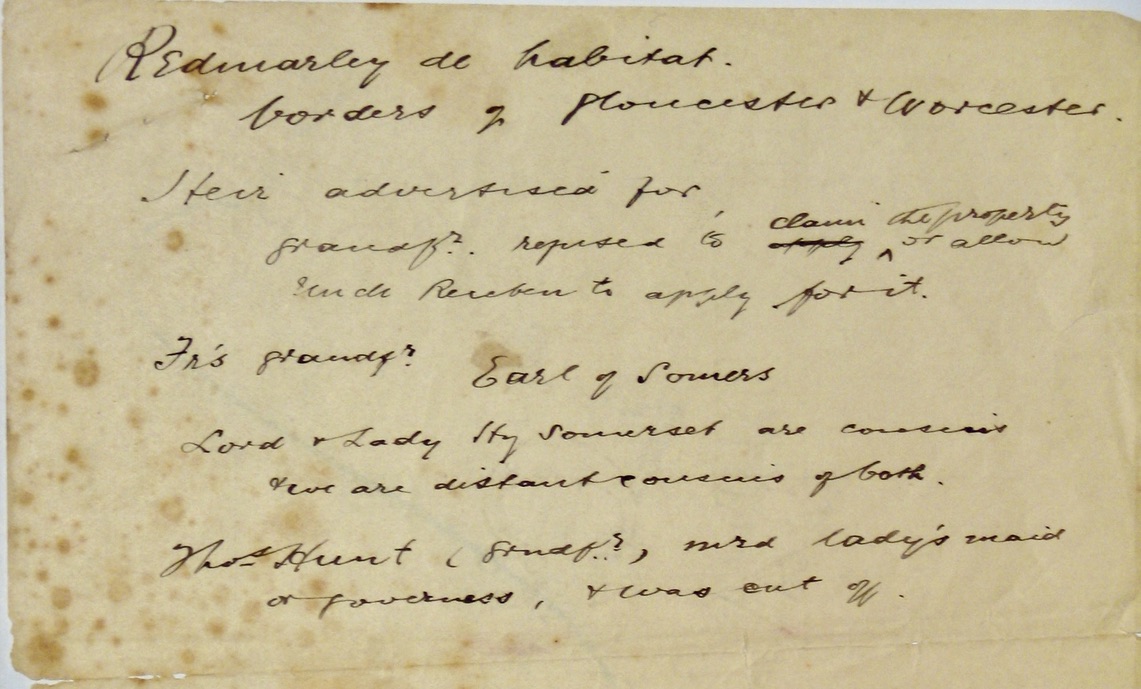
Although not part of the “Travel” story, it is worth recording that eventually Maggie bought a substantial house in northern Sydney some time after 1931 and named it “Redmarley” after the Hunt family’s ancestral village in Worcestershire. This particular “Redmarley”, one of a number of houses owned by Hunt family members, was at one time later a private nursing hospital run by Maggie’s niece Betty d’Archy, the author’s aunt. The family house in Toowoomba at the time Maggie was a matron at Griton, was also named “Redmarley”.

52 Ancestors …. Week 40.

Topic: LONGEVITY

My oldest ancestor was probably Margaret Lyle, born in Glasgow on 14 October 1827 and died aged 98 in Australia. Margaret was the fourth of eight children born to surgeon Thomas Lyle and Margaret Cochrane, his cousin. As the daughter of a surgeon it could be surmised that Margaret led a comfortable early life, however her father was far more interested in bryology (the study of mosses) and in writing ballads (he was the author of “Kelvin Grove”) than surgery. By 1851while Dr. Lyle occasionally practiced surgery in the little town of Airth in Stirlingshire, where the last three children were born, Margaret (then aged about 23) and two of her younger siblings were in Glasgow earning a living.

Margaret probably met her future husband Alexander Johnston, a cabinetmaker and a little younger than her, through their church. They married on 25 March 1853, Alexander’s birthday, in Glasgow.

Their first son Charles arrived in December 1854 in Airth. He was less than a year old when his parents embarked on the new clipper “Storm Cloud” for Australia the following year, with Margaret already pregnant with her second child George who arrived three weeks after their voyage ended. The long sailing voyage must have been difficult for Margaret, heavily pregnant and probably still grieving following the loss of her mother just before they departed.

The family settled in Launceston in northern Tasmania. A daughter was born in 1858. Ten years later, which must have been a surprise, another son (my grandfather) was born in 1868.

Margaret and Alexander lived in the same house until Alexander died aged 76 in 1906. Margaret survived him by almost 20 years, dying aged 98 at the home of their eldest son Charles in Sydney.

Their story is told in more detail at https://nancyvada.me/alexander-johnston-margaret-lyle-tasmanian-pioneers/

It is curous about Margaret’s longevity. It does not look like heredity had much influence. Her paternal grandparents only lived to 30 and 32 (probably succumbing to cholera or similar) and her father was 67. Her maternal grandfather was 53 and her mother 57. Of her siblings, the next oldest were the sisters Mary Anne and Amelia, 74 and 85 respectively, who also emigrated to Tasmania. “Something in the water??”

Margaret Lyle’s children were 78, 67 and 84 respectively (one other son drowned in a shipwreck at 29). Her 67 year old daughter Margaret Johnston (whose husband FJA Huxtable lived to 72, his father to 83 and grandfather Dr. William Huxtable (1791-1887) to 87, had four children 85, 90, 77 and 81 and most of their grandchildren and great grandchildren are also long-lived. A Huxtable longevity gene? Certainly modern medicine must play a part. But still ….Does that mean that I, another great granddaughter of Margaret Lyle, may just possibly reach 100???

52 Ancestors – Week 39.

The theme for this week is Surprise.

DNA testing has certainly opened the door to finding more cousins. But too often after establishing a family link and exchanging a couple of emails, communication stops. But not always.

My Great Grandmother Margaret Prendergast (1844-1915) arrived in Australia from Ireland as a 6 year old in 1854, together with her parents and most of her 9 siblings. They went to a small country town in South Western NSW called Maude, where they stayed. Grown-up Margaret went to Melbourne, married, was widowed after a few years, then married again to my Great Grandfather, and lived in various country towns while he worked at droving or managing remote sheep and cattle stations. Grandfather did the same.

I was born in Sydney, Australia, lived in Brisbane for many years and moved to New Zealand in 2000.

Margaret’s elder brother Patrick John Prendergast (1837-1886) stayed in Maude and married a local lady. They had 10 children of whom one went to Blackall in outback Queensland, where some descendants still live. A great granddaughter of his, named Joan, now lives in Brisbane. She is a third cousin with whom I have established DNA contact via quite a small match – but I recognised the surname!

So after discussing at some length via various emails the coincidence that we both lived in the same city for many years but never knew the existence of each other, I casually mentioned that I now Iive in a certain town in New Zealand. And Joan exclaimed – “So does my sister!” What a surprise.

Pat and I are now good friends and see each other often. The known Prendergast family tree has greatly expanded. It is so good to have at least one relative in my new home town. Incidentally I also have another third cousin living here from a different family entirely.

52 Ancestors …. Weeks 37 and 38

Topic for Week 37: Prosperity; Topic for Week 38: Adversity.

Both Prosperity and Adversity have been major features of my Australian Darchy family – so I am combining the two weeks’ postings.

My mysterious ancestor Thomas Darchy, born in 1820 in Augsburg Bavaria to English/Scottish/French/Prussian parents – the still unravelled story possibly involving a runaway heiress – spent his first 20 years in the care of a guardian in Switzerland, He was ‘collected’ in 1830 by a respectable churchman who had to sign all sorts of legal papers, then disappeared for the next 10 years and finally turned up, unaccompanied, and a very wealthy young man, on a ship in Australian waters in 1840.

He soon became involved in the budding Australian grazing industry – cattle and sheep – exploring and taming wild country and pushing westwards from the south-east coast (the only settled area at the time). His wife Susan Byrne was said to have been the first white woman west of the Murrumbidgee River. He owned or leased several properties including “Gelam”, before settling on “Oxley” near Hay in the Riverina area of New South Wales, some time before the birth of his sixth child in 1857. A tutor and later governess was employed to teach the ten children and later the boys were sent off one by one to a prestigious boarding school in Melbourne.

A newspaper correspondent journeying towards the Hay district in 1872 wrote:

“Continuing the journey for a few miles I got thoroughly into the much dreaded “lignum” country.  The name is doubtless a corruption of polygonum. It is a kind of hard-stemmed, thick, rushlike plant, with a number of branches from each stem. The lignum country presents an extraordinary sight.  There are scores of miles of it – the lignum growing from five to fourteen feet high, in fact over horse and rider’s head. It resembles a great artificial plantation, and is said to bear a nice flower, but it was not in flower when I saw it. No use whatever is made of this plant, and not a blade of grass was growing near it. In fact the lignum country is the terror of the traveller, whether in a vehicle or on horseback. The ground on which it grows is quite black, and exceedingly sticky and tenacious. A few yards over this adhesive soil made my horse’s hoofs resemble pans, and another horseman and myself had to dismount several times to clear the tenacious clayey composition off. The wheels of a buggy resembled cheeses, all the spokes being filled up with this black clay. The driver had to dismount at intervals and with a spade clear the spokes of this waxy substance, in order to make the slightest progress.

“Regarding “Gelam” … This is one of the stations first taken up by Mr. Thomas D’Archy, Esq., about thirty years ago.  Mr. D’Archy also took up the station above “Pimpanpa”. The difficulties and strange adventure, particularly with the blacks at that time, of Mr. and Mrs. D’Archy, were of a very remarkable kind, but their recital would occupy too much space here… “Gelam” has an area of about sixty square miles, and a frontage to the Murrumbidgee of ten miles.  It carries about 5000 sheep and 500 head of cattle….

(And a little later) … to avoid a long dreary ride of nearly forty miles without a habitation, I took a northerly course across plains, the greatest part of which were under water for eighteen miles to “Oxley”. Large quantities of wild fowl were on the plains, chiefly bustards and wild duck. It was about four o’clock in the afternoon when a narrow belt of trees on the plains indicated my approach to the “long and lazy Lachlan.” “Oxley” is the residence and station of Thomas D’Archy, Esq., J.P.  I received a most hearty welcome at the station and remained there several days.  Mr. D’Archy is the oldest resident in that part of the country; and the health of this hospitable pioneer and his kind hearted lady, were drunk in bumpers of champagne at the last Pastoral Association’s dinner held at Hay.” … “Oxley has an area of 160 square miles and has a frontage to the Lachlan of eighteen miles. Mr. D’Archy has marched with the times, and has seen almost all his early compeers come and go. The station is well improved. Sixty or seventy miles of wire fencing have been erected on the run which is also subdivided into paddocks.  Mr. D’Archy was the first to secure the waters of the Lachlan by damming.”

So, Thomas Darchy overcame some early adversity to achieve prosperity. But five years later he died aged 57, probably of apoplexy (stroke). Too much good living?

He did not live to see Adversity hit his family again in the form of a major economic depression in 1890, accompanied by a bad drought and rabbit plague, with prices of wool falling heavily and later a shearer’s strike. By then several of his sons were running their own properties – mostly leased on long-term loans held by investors based in Britain with no understanding of Australian conditions.

My own great grandfather Frank Darchy, in partnership with a brother and cousin, was forced to give up his property “Cuthowarra” near Wilcannia, and his brother Michael also went broke at “Tarcoola”. Frank, declared bankrupt, took to droving and was for a time an outback postman. Michael was more fortunate and managed to hold on to some of his properties.

Another brother Louis also went droving and was for a time a station overseer – but by 1910 he was a station cook and took his own life in despair in 1910. Yet another brother FritzEdward whose four children were all born in 1890-97, was to die in a lunatic asylum aged 56.

Fortunately Thomas Darchy’s three daughters were not so affected; two married and the third made a name for herself as a journalist – the subject of another story.