52 Ancestors – Week 10.

This week’s theme is ‘Translation’.

I have a mysterious Great great grandfather named Thomas Darchy who was born in Augsburg, Bavaria in 1820 but lived the first eleven or so years of his life with a Prussian-born guardian in Neuchatel, Switzlerland. When he was aged 10 the guardian received a letter from someone apparently connected with Thomas’ mother’s family, saying the boy was to be collected and taken …. where? The guardian was most upset and drafted a reply in archaic French – not his native language – full of crossed-out words and other words added above and below – and by the greatest good fortune that draft has been was found in the Neuchatel archives, along with some other legal papers.

Over the years several translations have been made by a variety of people, including me using an on-line translator. Not all agree. The general consensus is that the distraught guardian wrote, in part:

“And what do you want to do with him? Send him to boarding school? Or in other words, abandon him, because you do not want to look after him and his mother will continue to watch him from a distance at her pleasure”. … “Regarding the rest, I do not understand how Madam L. was able so easily to consent to this arrangement, which is precisely the opposite of what she told me two years ago in Geneva, when she seemed to fear his presence in England (deleted…. and assured me she wanted to leave him here for better hiding him). She said in her own words that he would never know his mother and that the mother’s family would forever ignore his existence. She told me her final wish for her son, and she gave me her express wish, to raise him entirely as Swiss.” … “ I would like to remind you that this child is here under the protection of the government and that I am his guarantor…”

“ Personally, I am deeply worried about the consequences that this change will have for my dear child, for who shall he count on in the future. On you? Alas! You live with 200-300 livres of him, you are married, a public servant. (deleted …and you have no interest to see him prosper and to make his way). Or his mother? Much less than on you, because she doesn’t want him and as she says, she cannot look after him. Thus, he will be abandoned and alone, continually in boarding schools and he will become what he can.”

We do not know for certain what happened during the next ten years, but in 1840 Thomas turned up on a ship in Australian waters, a wealthy young man aged just 20. He went on to found an Australian grazing empire – at one stage the family owned or leased vast tracts of sheep and cattle pasturage. Sadly much was lost in the depression of the 1890s. Most of his sons including my own great grandfather became drovers. One became an outback postman.

But nobody has ever managed to discover just who he was!! We have a baptismal certificate from Augsburg but it is suspected that his parents’ names were falsified. Family stories abound – he was the illegitimate son of a French noblewoman emigree and a Scottish nobleman, or a Prussian princess, or an Englishwoman who was one of George IV’s mistresses …. So the draft letter in the Neuchatel archives is important since it mentions his mother but does not of course give her name apart from referring to her as “Madame L”.

A much fuller account of Thomas’ early years is at https://nancyvada.me/the-mysterious-advent-of-thomas-darchy/

52 Ancestors – Week Nine.

The theme for this week is Gone Too Soon.

My maternal grandmother Lily Hunt was the tenth and last child of school teachers Edwin Hunt and Margaret Morgan who married in Reading, Berkshire in 1862. The seventh and ninth children, unfortunately, did not survive early childhood. The ninth only survived a few months, but the seventh lived for two years and her death was never forgotten, even in such a straight-laced Victorian family, and my Aunt Betty remembered hearing about her in the 1930s.

Alice Katherine Hunt, known as “Eulalie” or “Little Lallie”, was a real Christmas present, a much-loved child born on 25 December 1870 in Reading. She died two months before her third birthday. I do not know the cause of her death.

My aunt passed on to me a lovely little Memento Mori, a brooch of amethyst and seed pearls containing a lock of golden hair and inscribed on the back EH.

52 Ancestors …. Week 8.

The theme for this week is “I can identify…”

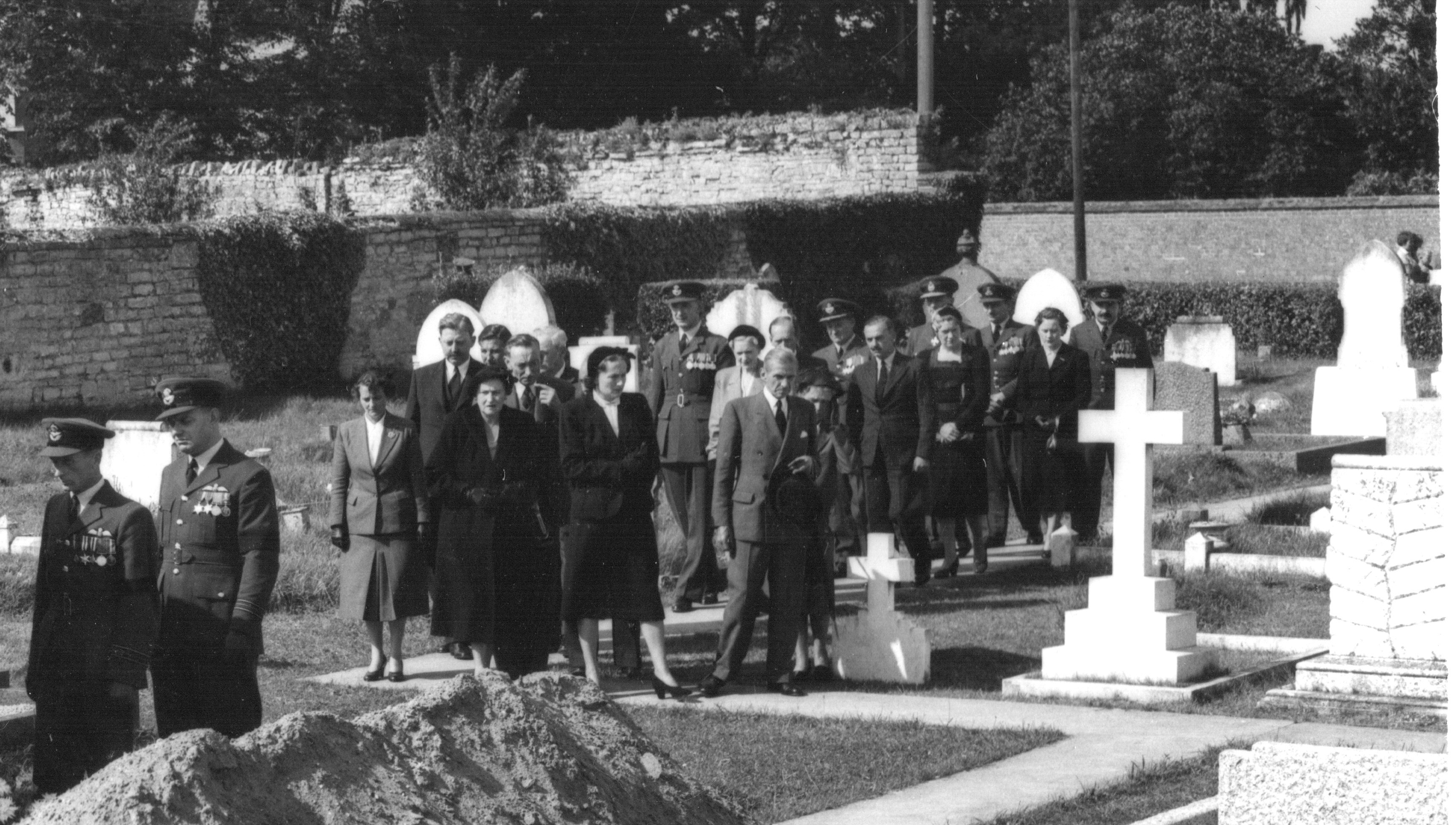
Or rather, I can’t. So frustrating! Trying to identify all the family members in several photos of my father in law’s funeral in August 1953.

Squadron Leader Wiliam Frederick Hoffmann AFC (“Bill”) remained in the British Air Force after WW2, and was on holiday at Penzance in Cornwall with his wife and small son aged 6 when on the 26 August 1953 he saw a woman who seemed to be in difficulties in the water and swam out to rescue her. He lost his life but the woman was rescued.

He was given a full Royal Air Force funeral. Curiously while the funeral was reported in the newspapers, only his widow’s and his father’s names were included among the long list of Air Force dignitaries who attended. (His full story is elsewhere on this website).

So here is one of the photos and an enlargement of the family group.
I can identify some of those in the front row:

In the top photo, In the front row is Bill’s mother Dorothy “Daisy” (Darragh) Hoffmann (1891-1972) and Bill’s widow Joyce “Joy” (Attrill) Hoffmann (1921-1983) with Joy’s father Syd Attrill immediately behind them. Syd is easily identified from other family photos, as are Daisy and Joy. The man to Joy’s left is most likely Bill’s father William Hoffmann (1899-1955), a Belfast hairdresser, and almost obscured behind him, Bill’s sister Yvonne (1918 – 1977) who never married – all are in the front row again in the second photo.

So that’s Bill’s immediate family sorted.

But – who is next? Who is the tall baldish man in the second photo, in a prominent position almost next to Daisy, with a woman (his wife?) beside him. They could be Pearl and Charles Hoffmann (1892-after 1958), Bll’s Uncle, who was a dentist in Leeds. They had no children. But they are wide apart in the second photo, and the woman seems to be more with the tall man with abundant hair – perhaps he is Charles? Less likely one of these men could be Bill’s eldest brother Frederick Hoffman (1886-1975) (he dropped the second n), who went to the USA in 1916. His wife died in 1949. His son Frederick Jay Hoffman (1922-1973) and daughter Marcia were Bill’s only close cousins. I think it unlikely these cousins would travel from USA for the funeral but perhaps their father would?

Or it could be Daisy’s brother William Kendall Darragh (1883-1979) and his wife Charlotte; Bill would have spent his childhood with them. Their granddaughter thinks it is not them, nor their son Brian Kendall Darragh.

Going further back in the first photo, there is an older man with silver hair. He seems to be part of the immediate family group. The older man could not be either of Bill’s grandfathers as both died earlier, in 1933 and 1939 respectively. Could HE be one of the brothers Frederick or Charles??

I think I will leave it there. Below is a composite family tree.

52 Ancestors in 52 Weeks – Week Seven.

Topic: Outcast.

I have chosen a broad interpretation – “someone different from the others” but without the usual connotations of being cast out as a pariah.

My Great Uncle George Johnston (1855-1885) certainly fits this bill. With 12 close uncles and aunts and almost 40 first cousins in Scotland, he was the first seaman in his extended family.

Perhaps it had something to do with the fact that he was born in Tasmania, Australia a few weeks after his parents Alexander Johnston and Margaret Lyle arrived from Glasgow on the Storm Cloud in 1855 after a voyage of 71 days in the stormiest seas of the world.

He must have started at sea before he was aged 20. A number of letters George wrote to his family in Tasmania show that he spent many years on cargo and passenger boats, both sail and steam, plying between the Far East, The British Isles, North and South America and Australasia. He visited his extended family in Glasgow whenever possible and often mentioned them in letters home, making the letters a great treasure trove for this family historian!

Sadly George lost his life at sea when he was only 29. Not on the high seas in a howling storm, but off the Australian coast in reasonable weather when the powerful screw steamer on which he was second mate ran aground. He was posthumously awarded a gold medal for bravery.

His full story is at https://nancyvada.me/sailing/george-johnston-sailor-boy/

52 Ancestors … Week 6.

Topic; Social media

The advent of the Internet was one of the most significant events in my life, coming at the same time as my interest in genealogy was awakened. Early Rootsweb discussion lists (In the days before Ancestry) were rich sources of information, assistance and camaderie on a scale I had never experienced with childhood penfriends. My family trees grew and grew…

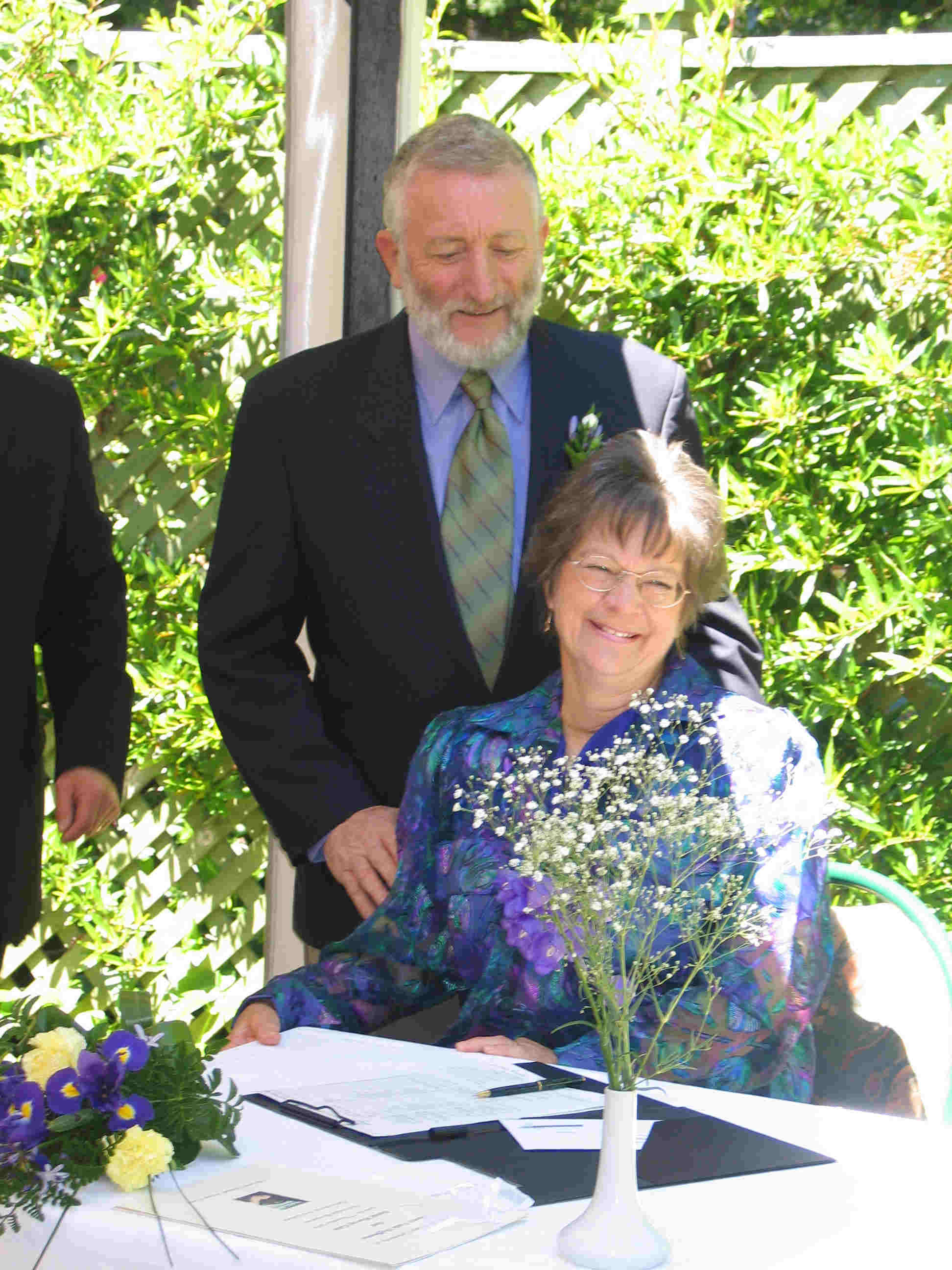
But it was more .. An Australian, I joined several international discussion lists for people with cochlear implants – at that time still a fairly innovative device – and ‘met’ Bev B., a Canadian, who invited me to make a joint presentation with her at an international conference in the USA. With the help of a Quota scholarship I travelled all over the US, attended several other conferences and met many of the people with whom I had chatted on-line. A few years later Bev planned to attend an Australian conference and asked if I knew anyone with a cochlear implant in New Zealand … yes, there was this guy on another of my lists … Bev visited him, played matchmaker and several years later there I was living in New Zealand with my wonderful new husband!

52 Ancestors ….. Week 5.

the subject for this week is Oops.

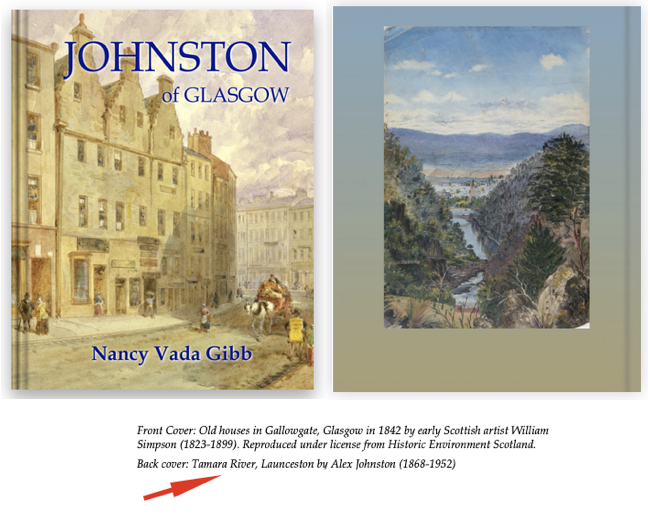
I had finished a family history book and published it with Blurb. Luckily I only ordered one copy. A cousin, proof reader par excellence, noticed a discrepancy in the Preview on Blurb and also asked if I could include a little more information which had arrived too late to be included originally. So I fixed everything, wrote a better Acknowledgement, and as a final touch decided to move the title of a painting on the back cover to the inside, to go with the description of the painting on the front cover.

On the back of the book is a painting of the Tamar River in early Tasmania, painted by my grandfather. Off to Blurb went the corrected pdf, and in due course a new edition of the book arrived. Some weeks later my cousin contacted me again. Errrr had I noticed the spelling of the river’s name? And sure enough somehow it had morphed into the “Tamara” River. …

52 Ancestors …. Week 4.

The subject for this week is Education.

There are many schoolteachers in my extended family but one was a real trailblazer – my Great Aunt Fanny Elizabeth Hunt 1863-1941. In 1888 Fanny became the University of Sydney’s first woman Science graduate and only the second in Australia. (Fanny was a perfectly acceptable name in those days, despite what Bradley Walsh thinks!)

She taught at a number of girls’ schools in Sydney for some years then became the inaugural headmistress of Ipswich Girls Grammar School just outside Brisbane, Queensland in 1891. Later she founded another school, Girton College in Toowoomba Queensland, in 1903.

I was to follow in her footsteps many years later, proudly wearing Fanny’s academic hood at my own graduation.

52 Ancestors …. Week 3.

Theme for this week: Out of Place

Herbert William Hunt (1913 – 1937), always known as “Wibb”, was my Grandmother Lily Hunt’s uncle (genealogically speaking my 1st cousin once removed). He was born in country Wedderburn, NSW to Bank manager Edwin Herbert Hunt and his wife Lillian Josephine Harrison, the seventh of eight children all but one of whom survived to adulthood.

All Wibb’s brothers became Accountants and/or Managers but he was musically gifted and wanted to devote his life to music. He was said to have been able to attend a concert then return home and play the music he had heard from memory. But family circumstances forced him to work in his father’s Bank, which he hated.

According to family lore he died of a broken heart – he was so miserable not being able to devote all his time to music. Officially he died of septicaemia following a throat infection and/or pheumonia.

His sole sister Mary was also musically inclined, but as a female she was ” not important and not considered Bank material (!).

52 Ancestors in 52 Weeks – Week 2.

The theme for this week is – Favourite Photo.

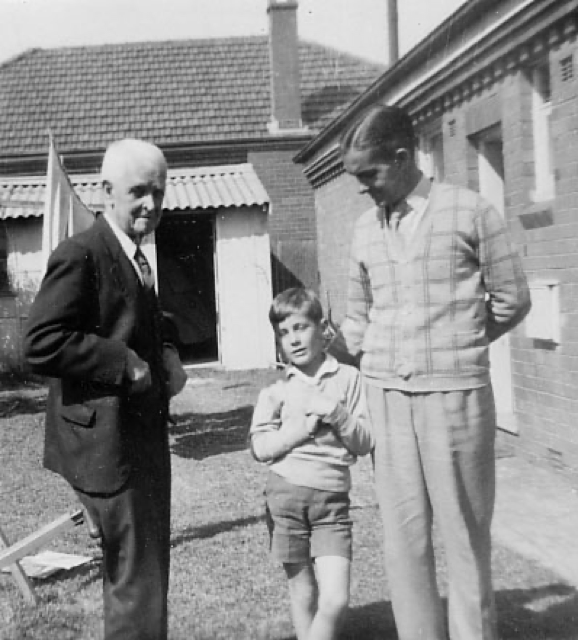
Because my paternal grandfather Alexander Johnston (1868 – 1952) hated having his photo taken, I only have a single photo of him, which he permitted his adored granddaughter to take with her little camera.

The photo shows:
My grandfather Alexander Johnston (1868 – 1952)
My brother Barry Arthur Johnston (1944 – 2017)
My father Warwick Lyle Johnston (1912 – 1998)

Taken about 1950 with my first camera, a little Baby Brownie. Made of black Bakelite, it took a roll of 12 black and white film, and the shutter was worked by a little lever at the centre bottom. The film was wound by hand.

Granddad was a journalist, artist and violinist. Born in Launceston Tasmania, his father was a librarian who “died in harness” but Alexander had the wanderlust from an early age. He spent some years in Fremantle and also on the Coolgardie goldfields in Western Australia in the 1890s, not as a miner but as a journalist working for the “Coolgardie Miner”. He made several trips to the Orient, as shown by some wonderful paintings, mostly in a series of sketchbooks which I treasure:

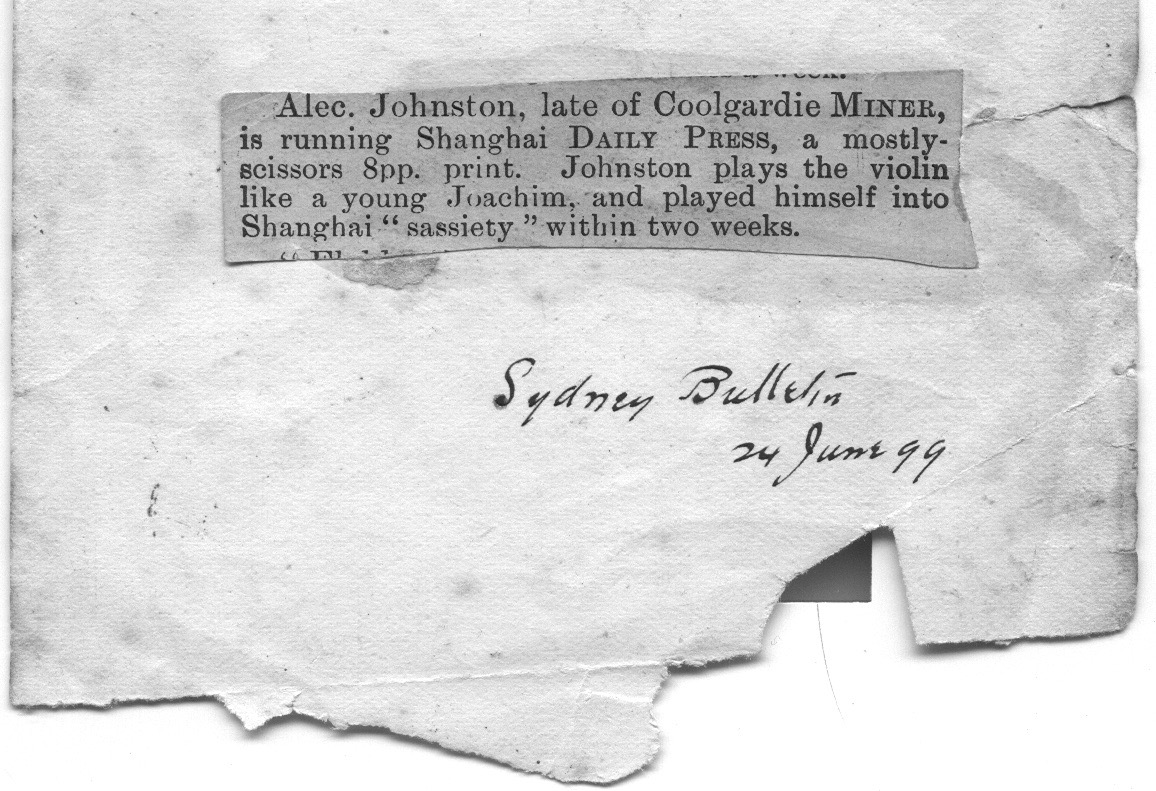
He also edited an English-language newspaper in Shanghai for a time, as evidenced by this scrap I found hidden among the pages of a book:

Granddad Alex was a private man who never spoke of his childhood family or earlier life to his son Warwick, who would have been astounded to learn all I have discovered. Ann Kerr who I wrote about in Week 1 was his Great Great Grandmother.

52 Ancestors in 52 Weeks – Week 1.

A “do something with your genealogy instead of letting it sit in your genealogy software” challenge. Started by Amy Johnson Crow (https://www.amyjohnsoncrow.com/52-ancestors-in-52-weeks/): “You’ve worked hard on your genealogy. You’ve made some fantastic discoveries. But what do you actually do with it? Those discoveries don’t do much good just sitting in your file cabinet or on your computer. That’s where 52 Ancestors in 52 Weeks comes in. It’s a series of weekly prompts to get you to think about an ancestor and share something about them. The guesswork of “who should I write about” is taken care of”.” 

So I’m going to try and do it … I have so many stories, some already published on this website and some in the three (almost four) family history books I’ve already published. And there’s some more research I want to do.

The theme for Week 1 (January 1-7) is “I’d like to meet”.

I’d like to meet my Great Great Great Great Grandmother (ie, 4xG Grandmother) Ann Kerr.

First some background, mostly from my published book about the Cochranes (https://au.blurb.com/b/11115249-cochrane-and-lyle): Ann was born on 21 April 1733, most likely in Paisley, Renfrewshire, Scotland. She was the daughter of John Ker(r) (born about 1700) and his wife Margaret. She had three brothers John, Patrick and one other boy. John left an elaborate will, very helpful in identifying the correct family!

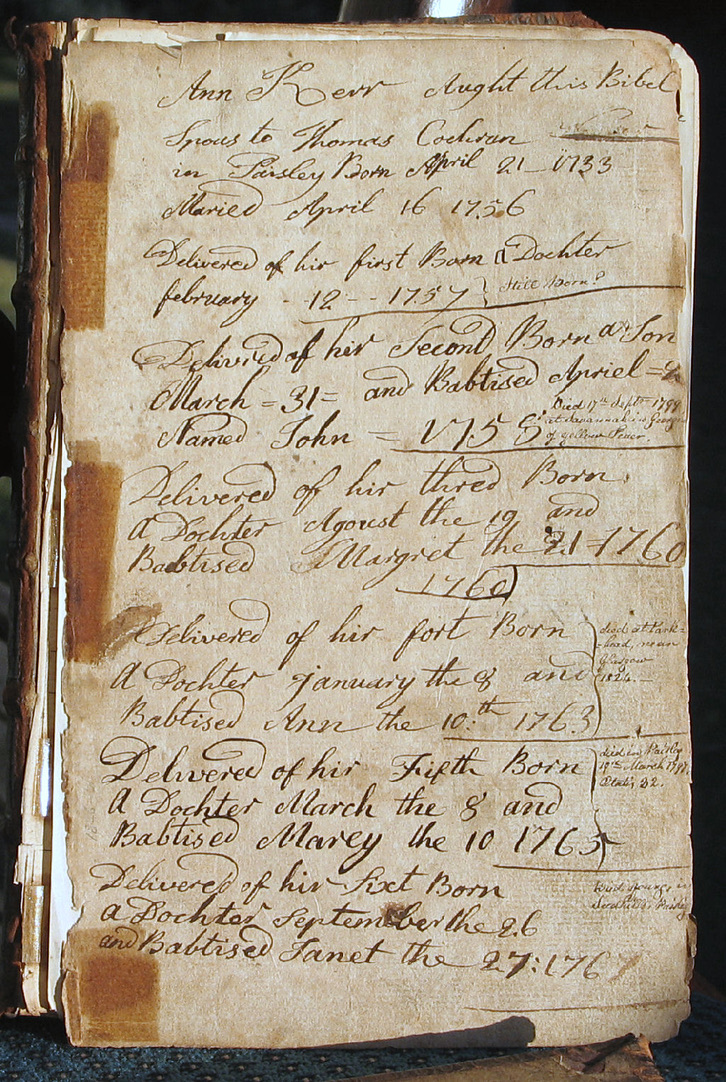
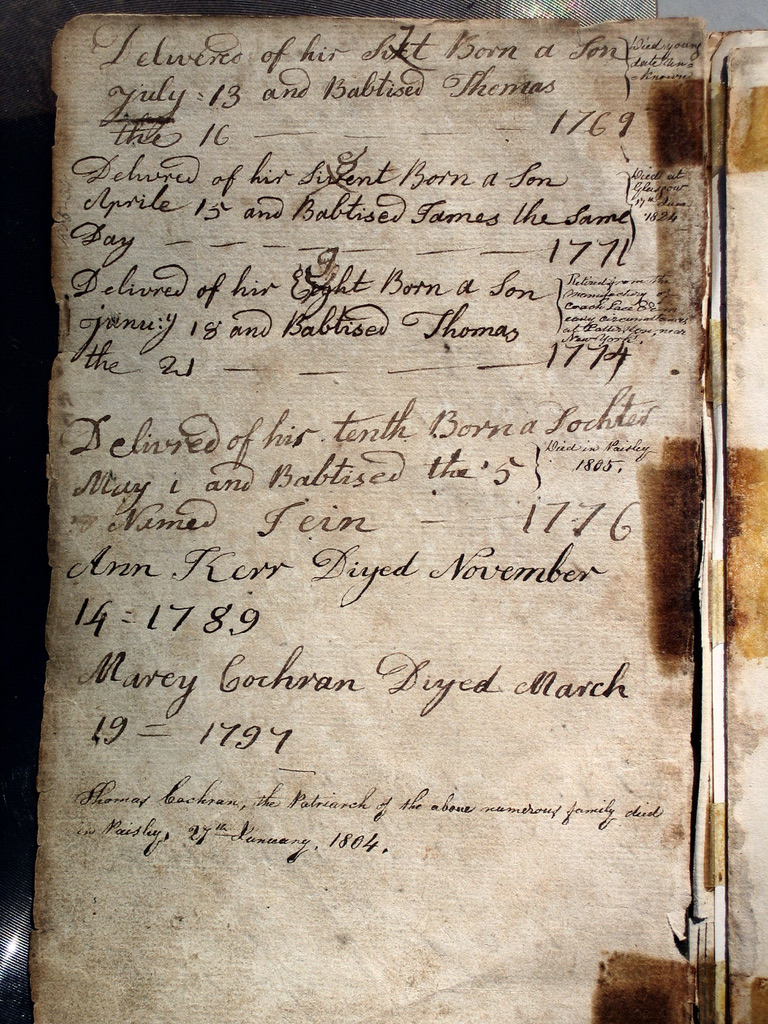
Ann married Thomas Cochran(e) on 16 April 1756 in Paisley. When Ann married she bought a huge bible in which she gradually recorded the names of all their children.

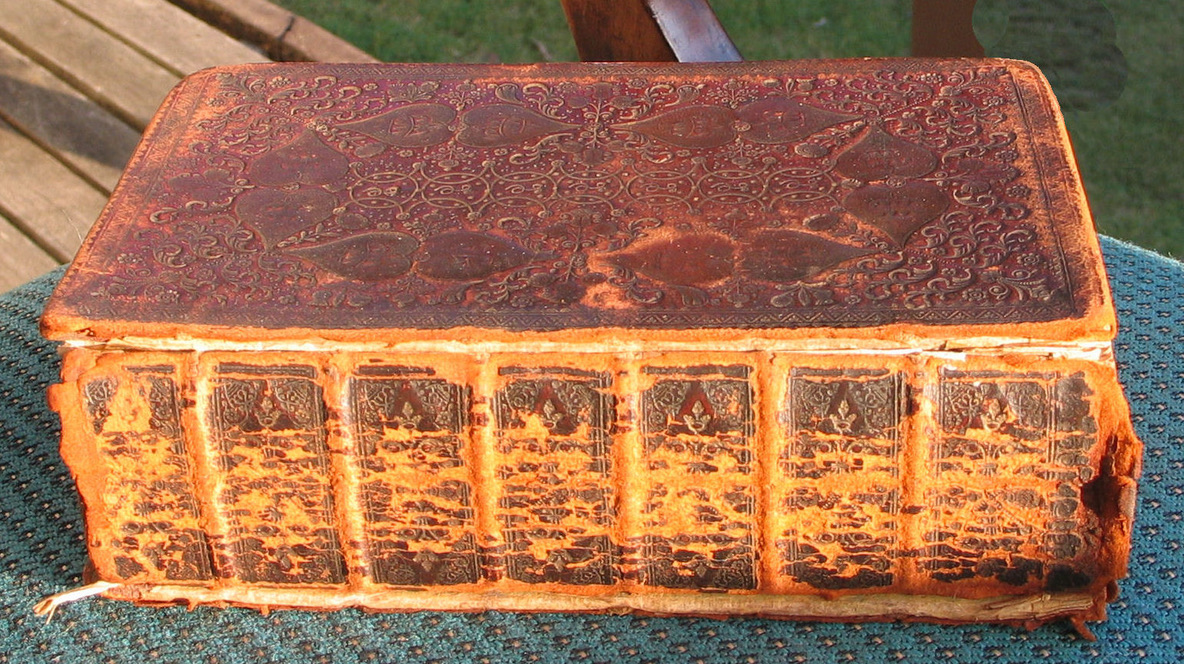
‘Thomas’ and ‘Ann’ being such common names, the bible entries have been absolutely crucial in identifying their children (and also in trying to correct numerous incorrect entries on websites such as Ancestry and MyHeritage and Genenet). The bible is a large ornate volume with gold-stamped leather spine and richly embossed cover, not something a poor family could afford. Most likely the Kerrs were an affluent family, perhaps her father was a merchant or manufacturer. If only Ann had recorded her parents’ names and dates as well! It is possible they originally came from Campbelltown, Argyllshire where Ann’s nephew (named in John Kerr’s will) resided. In the 18th century there was a great influx of people to Paisley following the Highland Clearances.

Thomas Cochrane is thought to have been a master weaver, quite a prestigious social position in those times.

Ann and Thomas had ten children, almost all of whom reached adulthood. After their marriage in 1756 Ann and Thomas Cochran(e) most likely resided in or near Paisley. The baptismal records of some of their children show that they were living in the village of Eaglesham to the south of Paisley and Glasgow at least between 1765 and 1771. Eaglesham was noted for handloom weaving, at least until the establishment of a water-powered cotton spinning mill in 1791. (It is also famous for being the landing place of Rudolph Hess during WW2 when he mistook Eaglesham House for Dungavel House near Srathaven.)

At some time before 1785 our Cochrane family moved to Paisley. Ann (Kerr) died there in 1789. She was 56 and had borne 10 children in 19 years. That was the same year the Seven Year War with France began, when George II was the reigning monarch.

In 1785 a coach ran from Paisley to Glasgow 6 times a day. Didd Ann ever take advantage of this to visit family, particularly her daughter Margaret born 1760 who married weaver Peter Stewart Donald in 1780 in Glasgow (I share some DNA with a descendant) or her daughter Ann born 1763 who married weaver John Houston in 1787?

Two of her sons emigrated to America some time before 1798 as they are not mentioned in the will of their uncle John Kerr. John born 1758 died in Savannah Georgia in 1799 aged 41 and Thomas born 1774 died “in easy circumstances” in Patterson, New York in 1850 – both facts added to the bible by Ann’s grandson Dr. Thomas Lyle.

Ann did not live to see two of her grandchildren marry each other on 31 May 1821 in Glasgow – Dr. Thomas Lyle (son of Mary born 1765) and Margaret Cochrane (daughter of James born 1771). Such cousin marriages were relatively common in those times. Three of Margaret and Dr. Lyle’s children emigrated to Tasmania, Australia in the 1850s. I am one of the descendants.