
52 Ancestors in 52 Weeks – Week 1, 2025

Theme: In the Beginning.

I have decided to take up the 52 Ancestors in 52 Weeks challenge again – I completed almost every week in 2023 but only the first few months in 2024. 2025 presents a whole new list of topics.

From as early as I can remember there was a huge old bible sitting on top of the piano …. There was a roughly-drawn family tree with a few names written inside it which meant nothing to me for a long time. I was told it came from my father’s Johnston family.

Something prompted me to copy the entry when I was about 12 …. And somehow, miraculously, that piece of paper survived …

Fast forward many years. I started to become interested in genealogy. My father knew nothing about his father’s Scottish Johnston family; granddad was a journalist and an intensely private man but I knew he had been born in Launceston, Tasmania and his ancestors came from Scotland. By then the bible had been lost, probably during a house move, but I still had that scrap of paper. It had a rough-drawn chart going back three generations, showing that Alexander Johnston married Margaret Lyle, they had 3 children Charles, Margaret and Alexander, and there were very few descendants – none from Charles, one only from Margaret who married a Huxtable, and although Alexander had two, one died in infancy.

But the Tasmanian Archives, when consulted, listed three children – George, Margaret and Alexander (my grandad). Where was Charles? Initially and somewhat naively I assumed Charles had been christened George – at that stage I had no birth dates.

All became clear eventually when I discovered an immigration record. Alexander and Bertha had a little son Charles with them when they emigrated to Tasmania in 1855. George was born soon after their arrival.

There are many stories about this family, probably the most interesting being about George, a merchant seaman who lost his life in a shipwreck off the Australian coast, when aged only 33. Charles, Margaret and Alexander all ended up living in Sydney with their families but over the years contact was lost; it was not until I started actively investigating that I made contact with some of their descendants – certainly more than that early rough tree indicated. Margaret in particular has at last count about 98 descendants!

I was born in Sydney, Australia but now live in New Zealand. By an amazing coincidence I discovered that one of Margaret’s descendants is actually living in the same city. How lovely it is to have a cousin here!
52 Ancestors in 52 Weeks – NEW Series for 2024.

Week 1 – Theme: Family Lore.

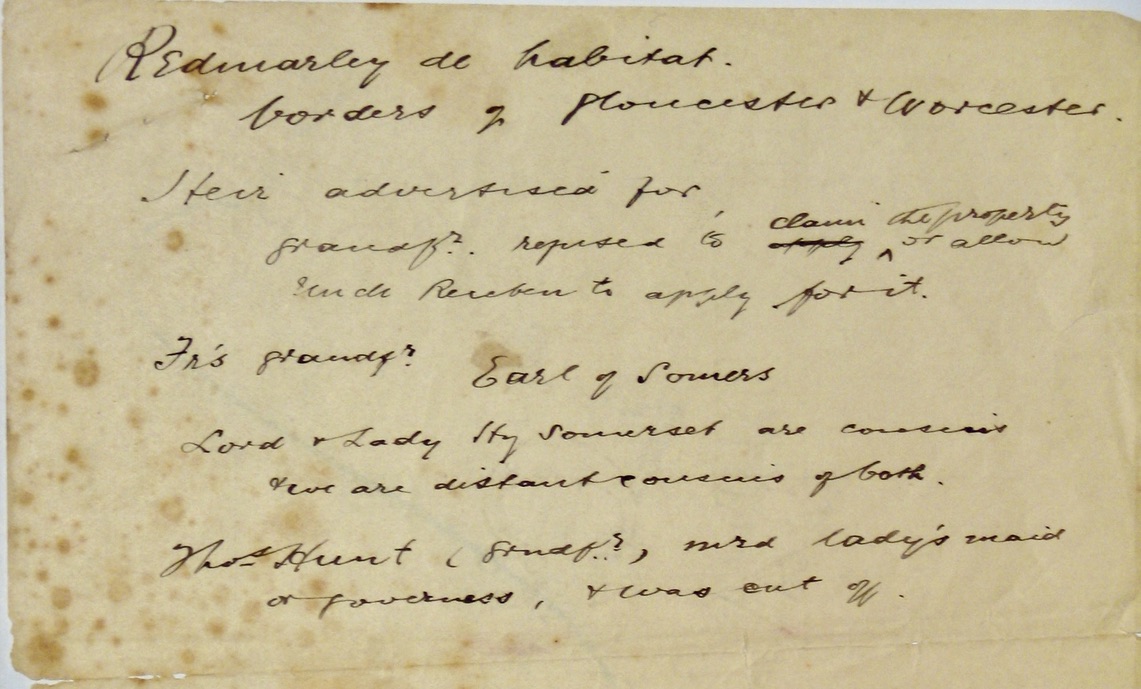
Unsubstantiated family legend recorded by my Great Great Grandfather Thomas Hunt’s grandson Edwin Herbert Hunt 1866-1921 says that Thomas was a cousin to Lord and Lady Henry Somerset. Further, it was said that when the Earl of Somers died without heirs, Thomas’ eldest son Reuben 1824-? was forbidden to apply for the title, because his father had married a lady’s maid or governess, and been cut off by the family. It was also intimated that Thomas Hunt was well off by styling him “Gentleman of the Down House, Redmarley d’Abitot”, Worcestershire.

Examining dates, I discovered that Thomas Hunt, born in 1793, was of a reasonable age to be a possible son or grandson of the First Earl of Somers, John Somers Cocks (1760-1841) who had been succeeded in his titles by his second but eldest surviving son, John. One interesting thing is that this son was born and christened in a town quite close to Redmarley d’Abitot where Thomas Hunt was born.

But It does not seem possible that Thomas Hunt or Reuben his eldest son could have claimed the title (if that was what it was all about, and not just ownership of property) unless Thomas or rather his father was the acknowledged illegitimate son of a Somers-Cocks, most likely the First Earl, and even then if illegitimate he could not claim or inherit a title. Thomas Hunt’s baptism record clearly names his father as William Hunt.

There is an unbroken succession to the 9th Baron Somers who was born in 1949. Thomas Hunt’s assertion that “heirs were advertised for” seems unfounded.

Regarding the second part of the claim, that Lord and Lady Somerset were cousins to Thomas and his son Reuben Hunt – ‘Cousin’ was a very loose term in those times and could refer to either a close or distant relationship. But none such can be found.

The third part of the claim, however, may have some truth. Thomas Hunt, a Cordwainer (shoe maker) according to the 1841 Census, married Ann (also known as Nancy) Welding/Weldeng, an employee of the Down House, a large country estate. He signed the marriage register with a cross but she signed her name. Ann came from the village of Upton St. Leonard’s, but they were married in the village church at Pendock, very close to the Down House. As a local historian put it,” If a girl married from her employer’s house, she got a present and maybe a bit of a feast – but if she gave notice and went home first, well, forget it. So the wise girl married where she was.” Possibly after their marriage Thomas went to live there too – so the Down House address could have been perfectly legitimate.