My mother “Vada” (d’Archy) Johnston was always very clever with her hands. A stay-at-home mother like most of her contemporaries, she was always knitting, crocheting or sewing something. She used to make all her own and my dresses. When my brother and I were young she went to a number of evening classes where among other things she learned to make lampshades and artificial flowers – some of the latter she then sold to a local dressmaker; they were beautiful and very realistic. I was fascinated by the process and loved watching her – she had a little bag full of sand and tools which were heated in the flame of a spirit lamp. Stamens, etc were purchased. Other tools of her trade were reels of fine wire, tiny wire clippers and scissors, and special fabric glue. Sadly I do not have any examples of her work.
It ran in the family. Her English-born mother Lily (Hunt) d’Archy did much embroidery but I think some of it was simply repairs – including to damask napkins, which I still have. Her sister my Aunt Betty d’Archy made my christening gown – ultra-fine muslim with lots of lace and tiny satin bows. It is shortly to be worn by my Great Niece .. the 6th wearer and 3rd generation.
Like most other late 19th Century families in England and Australia at least, my Darchy family delighted in never using a person’s full first name. It was usually just shortened – William became “Bill”, Frances became “Frank” etc, or the middle name was used – Edith Lillian was always “Lily” and her daughters Lillian Vada and Nancy Elizabeth were always “Vada” and “Betty”. Clara Cecille was “Clare” and George Thomas Darchy was always “Tim” possibly because there were several other Thomases variously known as “Tom” and “Dick”.
A few had more unique nicknames – Frances Clare Darchy was always known as “Aunt Jig” because when young she could never stay still. Her nephew FritzEdward Wreford Darchy was “Reefer” while another nephew also FritzEdward was “Son” or “Ted”.
My English mother -in-law’s father also came from a nickname-addicted family of ten. Adeline Maud Attrill was “Add”, Mabel Florence Attrill was “Mae” , Edith Emma Attrill was “Ede”, Sydney Claude was “Sid”. Not really unique nicknames but easy to trip off the tongue in a hurry!
I was always just plain “Nan”, even at school where there were some quite creative names, especially among the boarders. It wasn’t until I had left home and all the people who knew me that I became Nancy. When I started writing family stories I always used my middle name Vada as well, to distinguish me from countless other Nancys, not just within the family but out in the big wide world.
My GG Uncle Charles Johnston 1854-1933 was born in Airth, Stirlingshire. He was just two years old when he emigrated to Tasmania with his parents on the ‘Storm Cloud’.
He grew up in Launceston, Tasmania but must have moved to Sydney about six years before marrying Charlotte Jane Newsom, daughter of William and Ann Elizabeth Newsom, in 1891 when he was 37. They had one son born in 1894.
Charles was a draper rather than a carpenter, the latter being both his father’s and his son’s occupation. His father later became a Librarian, but that didn’t rub off on Charles either.
Charles had a small haberdashery shop in Falcon Street Crows Nest, North Sydney, only 100 yards from a major shopping centre and road junction . Charles’ cousin Walter Louis Huxtable was to say two decades later that Charles’ shop was “100 yards from a fortune”. Five roads converged at the junction and in the middle was a tram centre for trams from all parts of Sydney, then a burgeoning city. Nevertheless the business continued for many years, until Charles retired about 1920. He died aged 79. It is not known if Charlotte assisted her husband in the business.
I have now missed two deadlines, but looking back I did cover the Week 18 topic last year in Week 34, writing about English schoolteachers Syd Attrill from Plumstead, Kent and Flo Brown, a miner’s daughter from Wingate, County Durham.
The Week 19 topic I covered in Week 49 last year, writing about my maternal Grandmother Lily Hunt and her recipe book – which although not specifically mentioned, is full of recipes for preserves.
My Great Great Grand Uncle John Lyle, eldest son of Scottish weaver and/or farmer Robert Lyle (1768-1793) and Mary Cochrane (1765-1797) was born in Paisley on Feb 24 1789. He was to die of yellow fever in Uppark Military Camp, Jamaica on June 16, 1822, aged 33 and at that time a Colour Sergeant with the 91st Regiment of Foot.
The records of the 91st in the British National Archives are very informative. I know just how tall John was and the colour of his eyes, how much he was paid and whether he was well behaved or not!
John fought in the Peninsular Wars then after a short time ‘home’ was away again fighting in the Pyrenees. He had a wife and 3 children; it is not known if his wife and family followed the Regiment or stayed at home.
John fought at Waterloo – and survived. Between 1815 and 1818 the 91st remained in France as part of the Allied Occupation Army under Wellington. John’s last child, a daughter, was born in Valenciennes in 1818.
After about two years in Ireland, the Regiment received orders for Jamaica. The records show that John disembarked from the “Brilliant” on February 16th, 1822 – and died on June 17th. A note on his record says he left three orphan children in the care of the Regiment. (I have not been able to trace the children further.)
The book “Sharp’s Waterloo” by Bernard Cornwell, although fictious, gives a graphic picture of conditions existing in a regiment such as the 91st, and the life of a foot soldier and also his wife.
Scottish Country Dancing has three main categories – reels, jigs and strathspeys. “A typical Scottish Country Dance consists of a series of formations that are arranged in a different sequence for each dance, hence, having mastered the basic steps and some of the formations, a Scottish Country Dancer should be able to participate happily and easily wherever there is Country Dancing.” (Royal Scottish Country Dance Society, RSCDS).
There are more than 15,000 documented Scottish country dances, recorded in ‘Dance Cribs’ in a standard terminology and more recently in a special notation as well. As an example, below is one of my favourite dances – Miss Johnstone of Ardrossan (I actually was a Miss Johnston – but of Sydney, Australia).
No matter which country you happen to be in, the dance will be done in exactly the same way. So, here near the bottom of the world in New Zealand, twice a week my husband and I may be doing exactly the same dance as a couple on the other side of the world, and at exactly the same time (or at least on the same day).
MISS JOHNSTONE OF ARDROSSAN (R5x32) 5C set Roy Goldring 14 Social Dances.(MINICRIB. Dance crib compiled by Charles Upton, Deeside Caledonian Society, and his successors)
1- 8 1s set and cast 1 place, 1s followed by 3s dance up and cast – 1s to 3rd place and 3s to 2nd place.
9-16 1s cross down and dance reflection reels of 3 with 4s+5s on opposite sides – 1s end in 3rd place opposite sides
17-24 1s cross up and dance reflection reels of 3 on own sides with 2s+3s – 1s ending in 3rd place own sides
25-32 1s set and cast down 1 place, 1s followed by 5s dance up between 4s and cast – 1s to 5th place and 5s to 4th place.
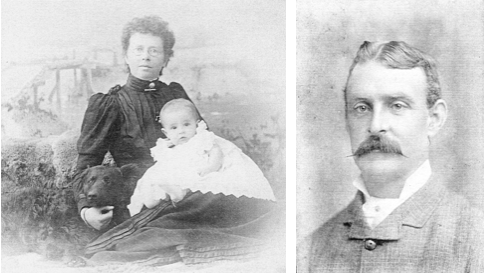
My Great Grandfather Francis (Frank) Darchy and most of his nine siblings were born on remote pastoral properties in early outback NSW in the 1850s. Initially they were educated by a private tutor and/or governess, but eventually all seven boys were sent one by one to a prestigious boys’ school in Melbourne, Scotch College, where most of them excelled at sport.
The school retains their records. Recently a cousin offered them a silver cup won by one of the boys for “Vaulting and Steeplechase” in 1871. It was awarded to “F. Darchy” – but which F? – Francis my great grandfather or FritzEdward, his brother? The school says “Usually if two boys of the same surname and initial were at school at the same time they would be distinguished from one another in some way, but I have seen no indication of that thus far in their cases.” However, the general consensus is that it was Francis. FritzEdward has been identified as the top sportsman who played in the first cricket teams of 1869-71 and the 1st Football teams of the same years. Louis was also a member of the First XIII in 1877. The oldest of the brothers, Thomas, who entered Scotch in 1861, was a member of the First XI in 1963 and sadly died later that year during the school holidays after a fall from a horse.
Drought, a rabbit plague and a severe Depression came along in the 1890s; much of the family’s fortune was lost, and the children had to go out and earn their livings. They became stockmen, a wool sorter, an outback mailman …. Occupations far removed from those envisaged during their early schooling and young-man-about-town days in the Melbourne Social scene – the photos were taken about that time.
I DID have a favourite recipe – “Del’s Banana Cake’ – which I obtained from one of my mothers’ friends when I was about 12. I carefully copied it into my mother’s recipe book. I loved messing around in the kitchen even then. But time rolls on, and the huge amount of sugar in the cake became excessive. Easy enough to adjust. But now another problem has reared its head – I have become gluten sensitive. And somehow that recipe does not adapt so well to GF flour even in its many combinations. It just doesn’t taste the same.
But a friend has come up with an absolutely wonderful GF chocolate cake. Putting all the ingredients including melted butter and unbeaten eggs in a bowl all at once seems so counter-intuitive to one reared on old fashioned “first cream the butter and sugar… sift flour twice…” method – but it WORKS. It even adapts to a sugar substitute. Margaret’s Chocolate Cake is now my favourite recipe …..
My Great Grand Uncle John Johnston (1831-1909), born in Glasgow, was the 6th son of a shoemaker. His brothers followed various other occupations including tailor, carver and gilder, gas fitter and carpenter. Initially a warehouseman, John married Benjamina “Jessie” Leckie in Glasgow when he was 24, according to the forms of the United Presbyterian Church. Soon after the birth of their first child less than a year later, they moved to Edinburgh where he studied for the Congregational Ministry at the Edinburgh Theological Hall. This was a little surprising seeing the Johnstons were mostly strong Presbyterians with several Reverends in the immediate family.
John must have preached for a time in Edinburgh, where their second child was born, but by August 1860 they were living in Stirlingshire, then they went to Pitsligo, Aberdeenshire and finally to Stoke Newington in London about 1870 where John continued as a Congregationalist Minister at the Raleigh Memorial Church. Jessie died there soon afterwards, leaving John with 4 living children aged between 9 and 16. John remarried about 1874 and had one more child, a son.
In 1875 John travelled from London to his birthplace to officiate at the marriage of his 23 year old niece Elizabeth Jane Johnston, daughter of his brother George and Elizabeth Jane nee Rae, to Adam Gray, the Minister of Sutton United Presbyterian Church in Cheshire. It must have been a happy family reunion – religious differences did not split the family.
The 1881 London Census shows John and his new wife, another Jessie six years younger than her predecessor, and the family including a new son born in 1874, living in Stoke Newington, London with one domestic servant. John was then 50, and a Minister of the Independent (Congregational) church – the Raleigh Memorial church (nowadays the Abney Reformed Church), at the corner of Milton Rd and Albion Grove. The family were still living in Stoke Newington in 1891, and John finally retired in 1907. Together with two of his sons, he lies in the famous Cemetery of Abney Park.
Between 1886 and 1903 Charles Booth did an important survey into life and labour in London; the original records are held in the British Library of Political and Economic Science. Among these papers are 27 pages devoted to “… an interview with the Reverend J. Johnston, 36 Park Lane, Stoke Newington, Minister of the Raleigh Memorial Congregational Church Albion Road. The interviews followed the questionnaire Form B – Nonconformist Churches. They contain answers to questions concerning the general character of the population, people employed, buildings used, services and meetings held, numbers attending, social agencies connected with the church, education work, visiting work, charitable relief, co-operation with other church institutions, remarks on local government, police, drink, prostitution, crime, marriage, thrift, health, housing and social conditions ..… Sept 1897.” According to a family historian such ‘interviews’ (also) often contained a wealth of personal detail, faithfully recorded by Charles Booth and his cousin Beatrice Potter (Mrs Sidney Webb) even if it was just an incidental joke – the Victorians never said anything in a short way.
John’s obituary, which appeared in the Congregational Year Book for 1910, contained an interesting anecdote near the bottom: JOHNSTON, John, was born in Glasgow February 8, 1831. Trained for the Congregational Ministry at the Edinburgh Theological Hall, his first pastorate was at New Pitaligo (Edinburgh), 1862-66, removing from there to Cambuslang, 1866-70. It was, however, at the Raleigh Memorial Church, Stoke Newington, London, 1870-1907, where most of his pastoral work was accomplished. When Mr. Johnston accepted the call in 1870 the cause was a mission connected with Hare Court Church, but a separate church was formed in 1872, a new building in Albion road opened in December 1880, with 1,020 sittings, at a cost of £8,000, this debt being subsequently entirely liquidated. In 1895, in celebration of his faithful ministry, Mr. Johnston was presented with a testimonial, and in 1907, on his retirement, with an annuity of £70, a cheque for 100 Pounds, and an illuminated address. Mr. Johnston twice underwent imprisonment for non-payment of the education rate, being an ardent Passive Resister. He died on February 2 1909, at the age of seventy-eight.
The ‘education rate’ referred to was a locally-collected tax fixed on property values, collected from everyone in the parish to support Church of England institutions such as a National School (after the National Society for the Education of the Poor in the Principles of the Established Religion); other schools were not allowed to share this money but had to depend on voluntary contributions, so no wonder a congregational minister would be against it.
My Paternal Grandfather Alex Johnston, writing under the pen name Spartacus Smith, was a journalist with the ‘Sydney Mail’, a weekly magazine in Sydney, Australia in the twenties. Here is what he wrote about ‘The Magic Disc’ on 24 February 1926:
“Of all the inventions given a wondering world there is none more wonderful than the talking machine. When I look at that black disc with the concentric circles scratched on its face I marvel at the magic. When I once pulled a machine to pieces, I found nothing but the needle, a disc, and a sound box, or something of the kind – but there was no wonder about that. All that remained was the circular plate with the line so neatly drawn. I looked at it with a magnifying glass but saw nothing more. Take your “records” and put them in the box. Start it going, and you hear a brass band. You can distinguish the cornet, you can hear the euphonium. Put in another and it is the voice of a singer, with the accompaniment of a piano. The two together! It is astounding. ….
“I feel full of exclamation marks in writing on this subject. Two instruments always astonish me when I see them. One is the homely sewing machine … to see the sewing machine replacing the work of human fingers with perfect loops and knots at a ratio of five hundred to one never fails to draw my admiration. But the talking machine is ingenuity almost without any explanation. …
“Edison was under inspiration from many predecessors in research when he made that first phonograph. They had been trying for long to catch the voice and bottle it up….
“It is interesting to know how this century is preserving the voices of notable people. Matrices are put in hermetically sealed boxes and deposited in the British Museum, and the grand Opera in Paris, Germany, and other countries are making collections. Posterity will hear such people as Melba, Lloyd George, members of the Royal Family …. “
How Granddad would have loved a glimpse into our modern world. He had seen aeroplanes of course – but jet liners? space travel? How he would marvel at the ease with which his granddaughter is composing this on a computer! I wish he was still with us – but he would now be 156 years old.



 Nancy's Families