52 Ancestors …. Week 13.

Topic: A Family Pattern

My Scottish Johnstons were not a very imaginative lot. Within five generations there are eight Charles, eight Georges, 12 Marys (five with the same middle name, originally a Generation 3 surname) five Alexanders and four Margarets, Peters and Roberts. Almost all born in Lanarkshire, particularly Glasgow.

The earliest known who can be identified with certainty is Charles Johnston, born in Graetney, Dumfriesshire (on the Scottish-English border) about 1725. He married Helen Glendinning on 8 July 1753 in Graetney. They had six known children, one of them the second Charles. There appears to have been a wider Johnston clan at Graetney as there were other baptisms of Johnstons about the same time as “my” Charles’ children. A subject for future research!

Charles 2 had six children including Charles 3 and Alexander 1. Also a John. Incidentally I only recently discovered that the Graitney Johnston/es were almost certainly descended from the original Lord Johnstone of Lochwood and Earl of Hartfell, a title created by King Charles I in 1633.

The children did not seem to follow the same occupations as their namesakes; nor did the families follow strict naming patterns, which might have made identifying them a little easier!

Of course I couldn’t resist going a little further …. Here is a page from the PR Births in Graetney in 1771. A little difficult to read! But after enlarging and careful scanning I’ve found a total of five Johnstons who may or may not have been related.
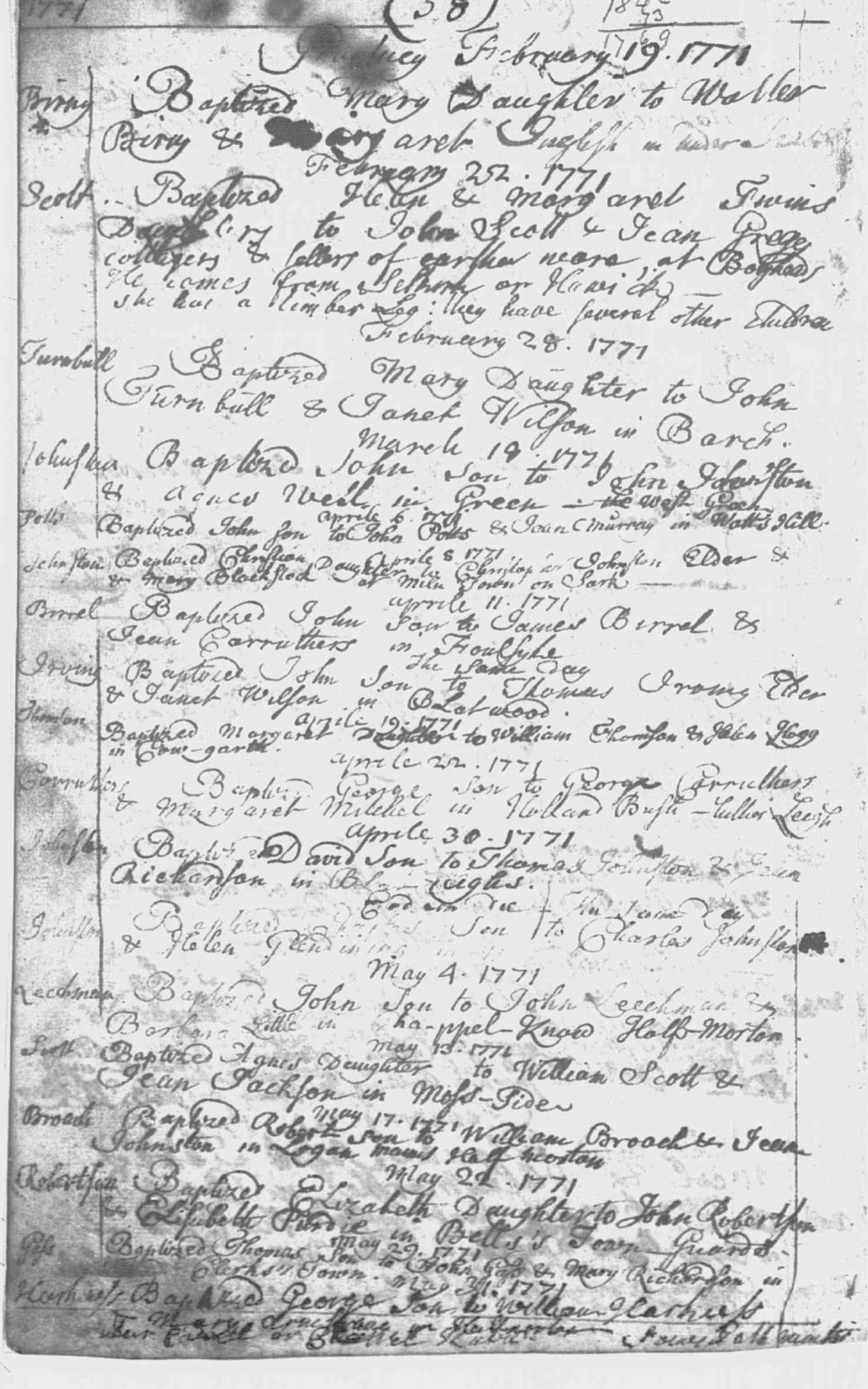
March 19, 1771. Baptised John son to John Johnston and Agnes Well in Green – the West Green.

April 8, 1771. Baptised Christian, daughter of Christopher Johnston elder and Mary Blackstock at Miln town on Sark. They m. 12 June 1747 and had 10 children.

April 30, 1771. Baptised David son to Thomas Johnston and Jean Richardson in B….oights. (some more lettering, indecipherable) they m. 1748 Graetna. According to FamilySearch. They had about 11 children.

April 30, 1771. Baptised Charles son to Charles Johnston and Helen Glendinning in N. Graetna. – 7 children

May 17, 1771. Baptised Robert son to Willam Broach and Jean Johnston in Logan M… Half Morton. (There were about 10 Jeans born within a reasonable time frame in the general area so she cannot be identified with certainty).

52 Ancestors ….. Week 12. (I have missed the previous 2 weeks)

Theme: an Address with a story.

A formal address can include the name of a house or building as well as the street and town/city, etc. I have chosen to focus on a house name.

The first time I encountered the name “Redmarley” was on a huge ornate nameplate near the front door of my maternal aunt’s home in Sydney, Australia, which 10-year-old-or-so me used to admire on our frequent visits.

Many years later I discovered it was the name of a village in Worcestershire (now Gloucestershire) where my maternal GGGGMother Elizabeth Cook (1775-1859) was born and married William Hunt. They had 12 children, all born there – the full name being Redmarley d’Abitot.

British Military History records that the “Battle of Redmarley” was fought on July 27, 1644 between Cromwell’s General Massey and the Royalist General Mynne – at which 170 Royalists were killed. Seventeen of the casualties have been identified as buried in the Redmarley churchyard. There are gouge marks on the south side of the church tower, made by Cromwwell’s soldiers sharpening their weapons before the battle.

After that brush with fame, Redmarley d’Abitot sank back into obscurity and was rarely if ever mentioned in the histories of the region, with one exception. It was where the last English ‘Trial by Water’ of a reputed witch was held. The story goes that William Lygon, the first Earl Beauchamp, was riding through his constituency in 1820s when he came upon a throng of excited rustics, and learnt they were about to put an alleged witch through the ordeal. He managed to assert his authority as a County Justice and saved her.

My GGGF Thomas Hunt was the eldest of the 12 children of William and Elizabeth. He married in 1819 and at some time in the next eight years, moved his growing family to Reading, Berkshire. From there several of his children emigrated to Australia, taking the Redmarley name with them – there are or were at least 6 houses in the Sydney area called Redmarley. A name that endures. Yet it was at least 40 years between the Thomas Hunts moving to Berkshire and then some of the children emigrating to Australia, and none of the children would have ever lived in (and most likely never visited) the original Redmarley.

As a postscript – guess what my own home is named! It seems particularly apt as it is built of red brick.

According to Wikipedia, the name Redmarley comes from ‘woodland clearing with a reedy pond’, from the Old English words hrëod and lëah. An alternative derivation has been suggested as from the local red heavy clay or marl. The difficulty with this explanation is that the word marl entered the language many centuries later. D’Abitot is thought to come from Urse d’Abetot, who was Sheriff of Worcestershire and who held the manor in 1086.