
52 Ancestors 2024 … Week 13

Topic: Worship.

My Great Grand Uncle John Johnston (1831-1909), born in Glasgow, was the 6th son of a shoemaker. His brothers followed various other occupations including tailor, carver and gilder, gas fitter and carpenter. Initially a warehouseman, John married Benjamina “Jessie” Leckie in Glasgow when he was 24, according to the forms of the United Presbyterian Church. Soon after the birth of their first child less than a year later, they moved to Edinburgh where he studied for the Congregational Ministry at the Edinburgh Theological Hall. This was a little surprising seeing the Johnstons were mostly strong Presbyterians with several Reverends in the immediate family.

John must have preached for a time in Edinburgh, where their second child was born, but by August 1860 they were living in Stirlingshire, then they went to Pitsligo, Aberdeenshire and finally to Stoke Newington in London about 1870 where John continued as a Congregationalist Minister at the Raleigh Memorial Church. Jessie died there soon afterwards, leaving John with 4 living children aged between 9 and 16. John remarried about 1874 and had one more child, a son.

In 1875 John travelled from London to his birthplace to officiate at the marriage of his 23 year old niece Elizabeth Jane Johnston, daughter of his brother George and Elizabeth Jane nee Rae, to Adam Gray, the Minister of Sutton United Presbyterian Church in Cheshire. It must have been a happy family reunion – religious differences did not split the family.

The 1881 London Census shows John and his new wife, another Jessie six years younger than her predecessor, and the family including a new son born in 1874, living in Stoke Newington, London with one domestic servant. John was then 50, and a Minister of the Independent (Congregational) church – the Raleigh Memorial church (nowadays the Abney Reformed Church), at the corner of Milton Rd and Albion Grove. The family were still living in Stoke Newington in 1891, and John finally retired in 1907. Together with two of his sons, he lies in the famous Cemetery of Abney Park.

Between 1886 and 1903 Charles Booth did an important survey into life and labour in London; the original records are held in the British Library of Political and Economic Science. Among these papers are 27 pages devoted to “… an interview with the Reverend J. Johnston, 36 Park Lane, Stoke Newington, Minister of the Raleigh Memorial Congregational Church Albion Road. The interviews followed the questionnaire Form B – Nonconformist Churches. They contain answers to questions concerning the general character of the population, people employed, buildings used, services and meetings held, numbers attending, social agencies connected with the church, education work, visiting work, charitable relief, co-operation with other church institutions, remarks on local government, police, drink, prostitution, crime, marriage, thrift, health, housing and social conditions ..… Sept 1897.” According to a family historian such ‘interviews’ (also) often contained a wealth of personal detail, faithfully recorded by Charles Booth and his cousin Beatrice Potter (Mrs Sidney Webb) even if it was just an incidental joke – the Victorians never said anything in a short way.

John’s obituary, which appeared in the Congregational Year Book for 1910, contained an interesting anecdote near the bottom:
JOHNSTON, John, was born in Glasgow February 8, 1831. Trained for the Congregational Ministry at the Edinburgh Theological Hall, his first pastorate was at New Pitaligo (Edinburgh), 1862-66, removing from there to Cambuslang, 1866-70. It was, however, at the Raleigh Memorial Church, Stoke Newington, London, 1870-1907, where most of his pastoral work was accomplished. When Mr. Johnston accepted the call in 1870 the cause was a mission connected with Hare Court Church, but a separate church was formed in 1872, a new building in Albion road opened in December 1880, with 1,020 sittings, at a cost of £8,000, this debt being subsequently entirely liquidated. In 1895, in celebration of his faithful ministry, Mr. Johnston was presented with a testimonial, and in 1907, on his retirement, with an annuity of £70, a cheque for 100 Pounds, and an illuminated address. Mr. Johnston twice underwent imprisonment for non-payment of the education rate, being an ardent Passive Resister. He died on February 2 1909, at the age of seventy-eight.

The ‘education rate’ referred to was a locally-collected tax fixed on property values, collected from everyone in the parish to support Church of England institutions such as a National School (after the National Society for the Education of the Poor in the Principles of the Established Religion); other schools were not allowed to share this money but had to depend on voluntary contributions, so no wonder a congregational minister would be against it.

52 Ancestors (2024 ) …… Week 12.

Topic: Technology.

My Paternal Grandfather Alex Johnston, writing under the pen name Spartacus Smith, was a journalist with the ‘Sydney Mail’, a weekly magazine in Sydney, Australia in the twenties. Here is what he wrote about ‘The Magic Disc’ on 24 February 1926:

“Of all the inventions given a wondering world there is none more wonderful than the talking machine. When I look at that black disc with the concentric circles scratched on its face I marvel at the magic. When I once pulled a machine to pieces, I found nothing but the needle, a disc, and a sound box, or something of the kind – but there was no wonder about that. All that remained was the circular plate with the line so neatly drawn. I looked at it with a magnifying glass but saw nothing more. Take your “records” and put them in the box. Start it going, and you hear a brass band. You can distinguish the cornet, you can hear the euphonium. Put in another and it is the voice of a singer, with the accompaniment of a piano. The two together! It is astounding. ….

“I feel full of exclamation marks in writing on this subject. Two instruments always astonish me when I see them. One is the homely sewing machine … to see the sewing machine replacing the work of human fingers with perfect loops and knots at a ratio of five hundred to one never fails to draw my admiration. But the talking machine is ingenuity almost without any explanation. …

“Edison was under inspiration from many predecessors in research when he made that first phonograph. They had been trying for long to catch the voice and bottle it up….

“It is interesting to know how this century is preserving the voices of notable people. Matrices are put in hermetically sealed boxes and deposited in the British Museum, and the grand Opera in Paris, Germany, and other countries are making collections. Posterity will hear such people as Melba, Lloyd George, members of the Royal Family …. “

How Granddad would have loved a glimpse into our modern world. He had seen aeroplanes of course – but jet liners? space travel? How he would marvel at the ease with which his granddaughter is composing this on a computer! I wish he was still with us – but he would now be 156 years old.

(The full article, with beautiful illustrations, can be read at https://trove.nla.gov.au/newspaper/article/160391061?searchTerm=The%20Magic%20disc)

52 Ancestors 2024 … Week 11

Topic: Achievement

My Paternal Great Grandfather Frederick Wentworth Wade (1838-1912) was the first of his family to settle in New Zealand, and the first and as far as is known only person in the family to profess Law.

His father Robert Wentworth Wade (abt 1795-1870) was a schoolmaster in Dublin. As the fifth of nine children born between 1832 and 1848, he would doubtless have had to make his own way in the world.

He may have joined the Royal Navy or have signed on as a seaman in a merchant ship, but either way he turned up in Melbourne, Australia in the late 1850s and before long found work as an accountancy clerk. In 1862 he went to Invercargill at the bottom of New Zealand, where he soon became a clerk and then partner-accountant in a firm of Carriers. He was said to have had a remarkable faculty for dealing with figures. By 1863 he was an articled clerk to a Law firm, and was admitted to the Bar as a Solicitor and Barrister in 1869.

After various terms in partnership with other lawyers he set up on his own, always in invercargill. Apart from the usual legal business in 1878 he defended a notorious wife murderer. He was president of the NZ Law Society in 1884-85.

After his death it was said by his fellow members of the Bar that he was endowed with fine intellectual talents and was a particularly strong advocate who took a keen interest and part in public matters, with a genial manner which endeared him to many, and he always conducted his cases in a fair and honourable way. The Supreme Court adjourned for one afternoon to allow members of the profession to attend his funeral.

One obituary said he experienced to the full ups and downs “…such as seldom come to the lot of one man…” and predicted that Wade’s passing would prompt many old identities to let loose a flood of reminiscences “… which perhaps have never been unearthed previously”.

Sadly no photograph of him can be found.

52 Ancestors 2024. Week 10.

Topic: Language

I have traced my father’s Johnston line back to the Scottish borders in the mid-1700s. I understand that they spoke not Gaelic but a form of broad Lowland Scots called Lallans. Apparently it was also spoken in the Northern Isles and in the north of Ireland. Both Robbie Burns and RL Stevenson wrote about it:

They took nae pains their speech to balance,
Or rules to gie;
But spak their thoughts in plain, braid lallans,
Like you or me.
—Robert Burns in Epistle To William Simson

“What tongue does your auld bookie speak?”
He’ll spier; an’ I, his mou to steik :
“No bein’ fit to write in Greek,
I wrote in Lallan,
Dear to my heart as the peat reek,
Auld as Tantallon.
—Robert Louis Stevenson in “The Maker to Posterity”

One reason could be because while Highland Scots are of Celtic (Gaelic) descent, Lowland Scots are descended from people of Germanic stock. Investigating further, I discovered that in the late 18th century, the Gaelic language was heavily suppressed during the infamous Highland Clearances following the turbulent Jacobite uprisings.


There is a fascinating entry about Lallans in the Dictionaries of the Scots language at https://www.dsl.ac.uk/entry/snd/lallan giving lots of exam ples.

52 Ancestors 2024 – Week 9.

Topic: Changing Names

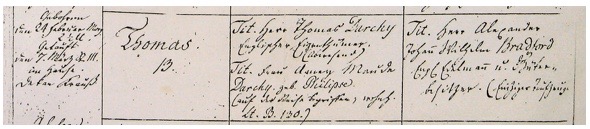
My GGGF’s birth is shrouded in mystery. Baptised in 1820 as Thomas Darchy, son of Thomas Darchy and Amey Maude Philipse. But was that the original spelling? No record can be found of the earlier Thomas or his marriage. Statements about his father and also the witness to the baptism appear false – Dr. Alexander Broadfoot, an impecunious Army doctor on half-pay, said he was “Herr Alexander Johannes Wilhelm Bradford, landowner of London” which he patently was not (!).


Thomas Darchy arrived in Australia in 1840, married and produced a family of nine. In time a couple of his son’s wives decided they liked the French spelling of the surname better, and all subsequent generations became d’Archy. Until today in a computerised business world where Darchy is far easier to type quickly!


In addition, members of my early Darchy family seemed to be in the habit of changing their first names. Not legally, but within common usage. It is not clear if some of the nicknames grew within the family itself or were bestowed by others or simply adopted by the individual. All seemed bent on changing their name away from Thomas!

The most extreme perhaps was my GGF who was baptised Joseph Kevin Darchy. Born in 1854 on a remote outback cattle station, he was probably baptised by the first priest to visit the district – who happened to be a Roman Catholic of the old school. Some of his brothers and sisters were subsequently baptised by another priest but given conventional names; others were baptised Church of England. At any rate my GGF was always known formally as Francis and informally as Frank.


One of his sons was baptised Thomas Eckiboon/Eccaboon/Echabon Darchy b. 1882, the middle name apparently coming from a nearby property. He was always known not as Tom, but as Dick, perhaps to distinguish him from his grandfather and uncle. In some records his surname became Darchie/Darcie. Strangely it was seldom Darcy.


His brother FritzEdward b. 1885 was variously known as “Son” within the family and “Ted” to everyone else. Again possibly to distinguish him from an elder uncle.

One of Francis’ brothers was George Thomas Darchy b.1864. Apparently he hated the name George and was always known as “Tim”.


Other brothers William, Michael and Louis managed to retain their original names! As did their 3 sisters.

Only one grandson – son of Michael – was always known by his first name Thomas. In all there were six Thomases within 3 generations. Perhaps not so unusual for those times. But confusing for the researcher …