52 Ancestors 2024 ….Week 4.

Topic: Witness to History.

In 1885 Queen Victoria of England and her daughter Princess Beatrice spent some time at Aix-Les-Bains, a thermal spa town on Lake Bourget in the Savoie, eastern France. On April 14 it was Princess Beatrice’s birthday; the town was gaily decorated with flags and the previous evening there was a display of fireworks on the hill.

In the morning, the band of the 4th Regiment of Dragoons played a selection of music and various people presented the Princess with bouquets. Among them were two of my Great Grandfather’s sisters – Miss Susan Darchy (1857-1922) and Miss Rose-Ann Darchy (1866-1930), representing the people of New South Wales, Australia. (The Times, 17 April 1885).

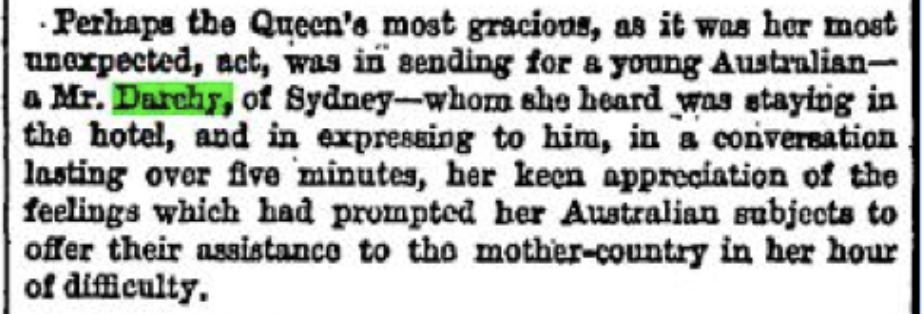
Four days later Susan and her brother Louis Darchy (1860-1910) were again presented to the Queen, according to The Times’ Court Circular of April 18th:

Louis was to have yet another meeting with Queen Victoria (The Penny Illustrated Paper and Illustrated Times, May 09, 1885):

This was reported again at a later date in the Riverine Grazier, a country NSW newspaper, on 12 January 1894, which gives the explanation:

52 Ancestors 2024 … Week 3.

Topic: Favorite Photo.

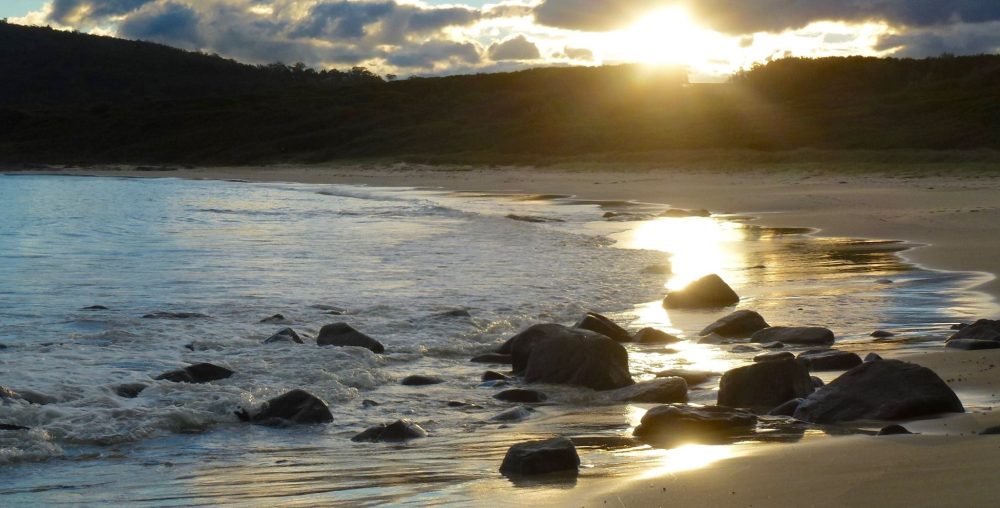
This photo is of my late mother in law, Joy Hoffmann, and our beloved cat Minou who lived to 19. Take on board our boat in Pittwater, NSW, Australia, about 1975. Although the following story is a sad one, I still love this photo for the peaceful happy time it represents.

Joy was visiting us from England. About 23 years earlier her husband Squadron leader Bill Hoffmann AFC was drowned when aged only 39, while trying to rescue a woman in difficulties. So his widow had every reason to hate the sea and anything to do with it. But her son Geoff, my first husband, wanted to show her his boat ….

Less than 20 years later Geoff himself died from melanoma and eight months later Joy herself died, her friends said of a “broken heart” – certainly it would have contributed. It is a lasting regret that I didn’t get to know her better.

And Minou? In cat years, she outlived everyone. She also outlived at least twice the normal number of cat lives (9 x 2) and had a string of adventures anyone would envy … lived in various houses all over two Australian states, caught a snake, got stuck in a chimney and had to be hauled out by her tail, was resident mouse catcher on a tomato farm, lived on a boat for some years and fell overboard several times, flew in a plane, went on long car trips and almost got lost in the bush, once spent an afternoon in a parrot cage at an airport ….

52 Ancestors …. Week 2 (2024)

Theme: Origins. (“Genealogists often get the question, “Where is your family from?” With this week’s theme, you could explore an immigrant ancestor, but you could also think about the origin of other aspects of your family. Who was the first person in your family to settle in a particular town? If you have a long line of people with the same occupation, talent, etc, who was the first person you know who did it?”).

My GGrandfather Frederick Wentworth Wade (1838-1912), born in Dublin, was the first of his family to settle in New Zealand, and the first and as far as is known only person in the family to profess Law.

He was one of the first settlers in the southern NZ town of Invercargill, was on the Committee formed in 1869 to investigate formation of the first Borough Council, and served on the early Invercargill Council to 1878.

One of his obituaries described Frederick as having been associated with most of the enterprises which had made for the advancement of the town from the time it was in its embryo stage. “Not only was he actively associated with social, municipal and parliamentary activities, but in the realm of sport he was at one time a most prominent figure…” The list included turf interests, rowing, coursing, cricket and football. He was also Sergeant-Major in the first Volunteer company formed in Invercargill, ultimately becoming Captain.
Frederick was a founder, office bearer or early member of various prominent Invercargill institutions – the Invercargill Club, Irish Athletics Society, Fire Brigade, Bowls Club, Coursing Club, Turf Club, Southland Racing Club, the Athenaeum, the Hospital Trust, the Chamber of Commerce and the Southland Caledonian Society. He became a Trustee of the Savings Bank in 1872 together with his brother in law James Blacklock (NZ Gazette)
“… and up to his last illness had not missed a meeting…” according to an obituary in the Southland Daily News.

Disappointingly none of these institutions or their successors have a photograph of Frederick.

He was said by his fellow members of the Bar to be endowed with fine intellectual talents and was a particularly strong advocate who took a keen interest and part in public matters, with a genial manner which endeared him to many, and he always conducted his cases in a fair and honourable way. The Supreme Court adjourned for one afternoon to allow members of the profession to attend his funeral.

One obituary said he experienced to the full ups and downs “…such as seldom come to the lot of one man…” and predicted that Wade’s passing would prompt many old identities to let loose a flood of reminiscences “… which perhaps have never been unearthed previously”.

52 Ancestors in 52 Weeks – NEW Series for 2024.

Week 1 – Theme: Family Lore.

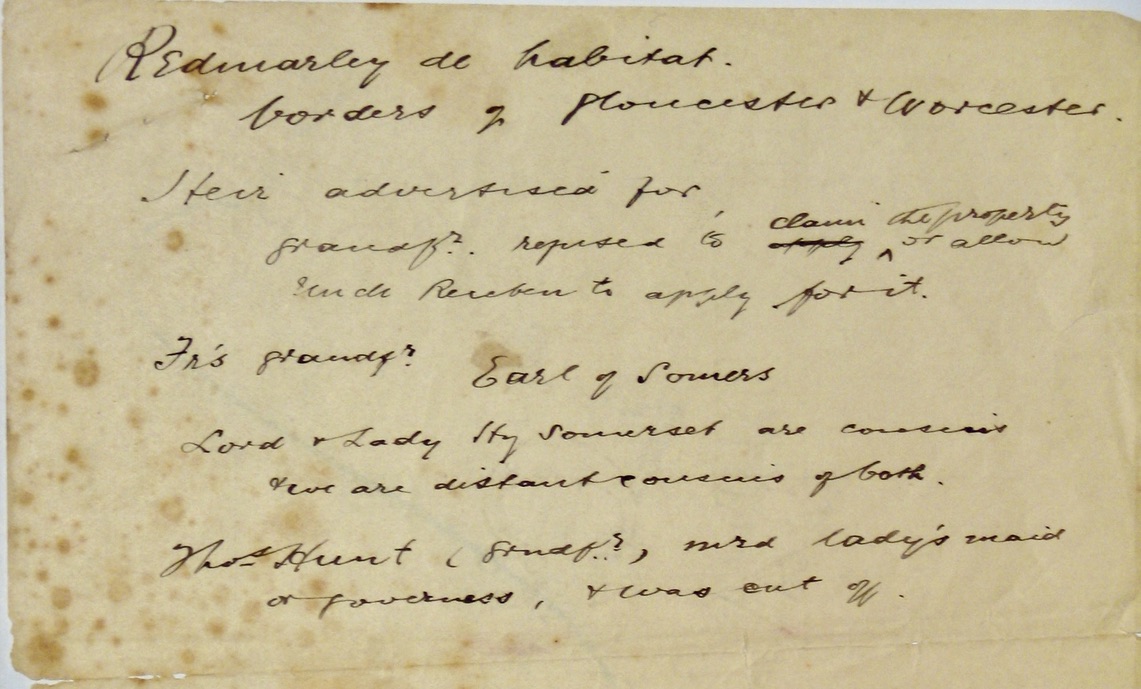
Unsubstantiated family legend recorded by my Great Great Grandfather Thomas Hunt’s grandson Edwin Herbert Hunt 1866-1921 says that Thomas was a cousin to Lord and Lady Henry Somerset. Further, it was said that when the Earl of Somers died without heirs, Thomas’ eldest son Reuben 1824-? was forbidden to apply for the title, because his father had married a lady’s maid or governess, and been cut off by the family. It was also intimated that Thomas Hunt was well off by styling him “Gentleman of the Down House, Redmarley d’Abitot”, Worcestershire.

Examining dates, I discovered that Thomas Hunt, born in 1793, was of a reasonable age to be a possible son or grandson of the First Earl of Somers, John Somers Cocks (1760-1841) who had been succeeded in his titles by his second but eldest surviving son, John. One interesting thing is that this son was born and christened in a town quite close to Redmarley d’Abitot where Thomas Hunt was born.

But It does not seem possible that Thomas Hunt or Reuben his eldest son could have claimed the title (if that was what it was all about, and not just ownership of property) unless Thomas or rather his father was the acknowledged illegitimate son of a Somers-Cocks, most likely the First Earl, and even then if illegitimate he could not claim or inherit a title. Thomas Hunt’s baptism record clearly names his father as William Hunt.

There is an unbroken succession to the 9th Baron Somers who was born in 1949. Thomas Hunt’s assertion that “heirs were advertised for” seems unfounded.

Regarding the second part of the claim, that Lord and Lady Somerset were cousins to Thomas and his son Reuben Hunt – ‘Cousin’ was a very loose term in those times and could refer to either a close or distant relationship. But none such can be found.

The third part of the claim, however, may have some truth. Thomas Hunt, a Cordwainer (shoe maker) according to the 1841 Census, married Ann (also known as Nancy) Welding/Weldeng, an employee of the Down House, a large country estate. He signed the marriage register with a cross but she signed her name. Ann came from the village of Upton St. Leonard’s, but they were married in the village church at Pendock, very close to the Down House. As a local historian put it,” If a girl married from her employer’s house, she got a present and maybe a bit of a feast – but if she gave notice and went home first, well, forget it. So the wise girl married where she was.” Possibly after their marriage Thomas went to live there too – so the Down House address could have been perfectly legitimate.